Where Two Oceans Meet: On the Fragmented Body in Ibrahim Ahmed’s Work
Words by Ahmed Shawky Hassan
The body often enters history only after it has already been transformed into something else: an archive, a document, a photograph, a border record, a laboring tool, or a target of surveillance.
Across migratory geographies, material conditions, inherited memory, and colonial systems of representation, the body rarely appears as a complete entity. It survives through fragments: gestures passed across generations, garments that outlive their wearers, photographs detached from their original contexts, and architectures that regulate movement and visibility. The body carries movement within it. It absorbs labor, displacement, aspiration, fear, and repetition. It becomes a surface where political histories settle and re-emerge.
In the practice of Ibrahim Ahmed, the body appears through these fragments. It moves between Egypt, Bahrain, and the United States. It reappears through textiles marked by labor and migration. It resurfaces through family archives, inherited gestures, and repeated acts of reconstruction. At times, it disappears altogether, leaving behind only traces.
Where Two Oceans Meet began from this unstable body: a body that moves across borders, carries memory, fragments under systems of representation, and continuously negotiates the terms of its visibility.
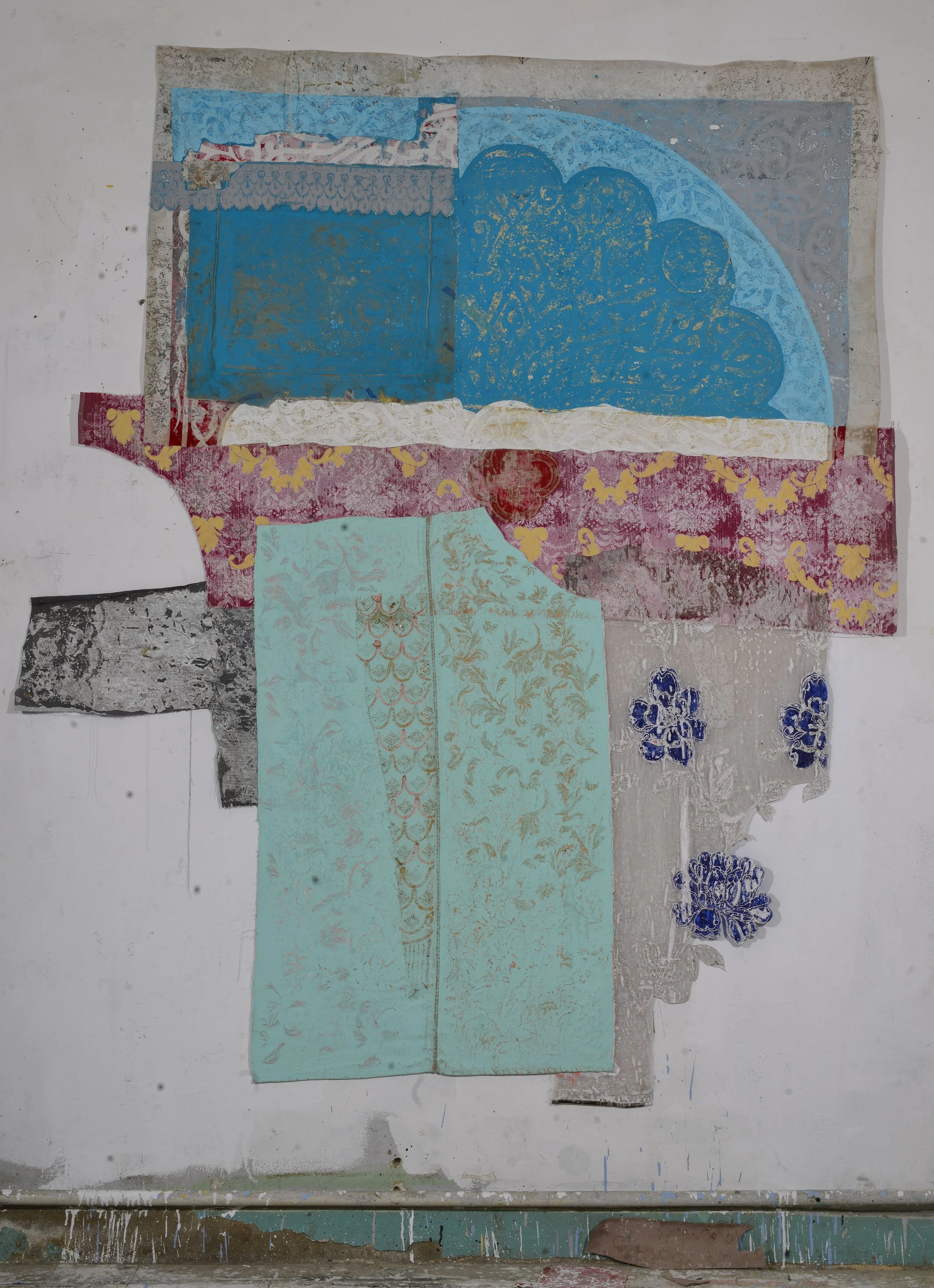
Ard El Lewa (2015–2016) Credit Hesham M. Hasan - Courtesy of the artist
This condition runs through Ibrahim’s work as an ongoing material and political question. Migration shapes his trajectory, though his work expands beyond autobiography toward larger structures that organize who gets to move freely, who remains suspended, and whose body becomes legible through fixed stereotypes.
One of the earliest articulations of this appeared in Ard El Lewa(2015–2016), where Ibrahim collected fabrics from multiple sources and covered them with dense layers of pigment until they resembled eroded walls. These surfaces carried the physical residue of neighborhoods shaped by labor, density, and informal expansion. The works preserved traces of social movement embedded within the material itself.
That relationship between body and material expanded in Only Dreamers Leave (2016), later presented at the Dakar Biennale in 2018. Thirty life-sized sails made from embroidered domestic fabrics hung in suspension across space. Their ornamental motifs referenced baroque and arabesque iron gates associated with Egyptian architectural heritage. The fabrics carried the dream of movement while holding the weight of restricted passage. They suggested migration as aspiration, labor, and prolonged uncertainty.
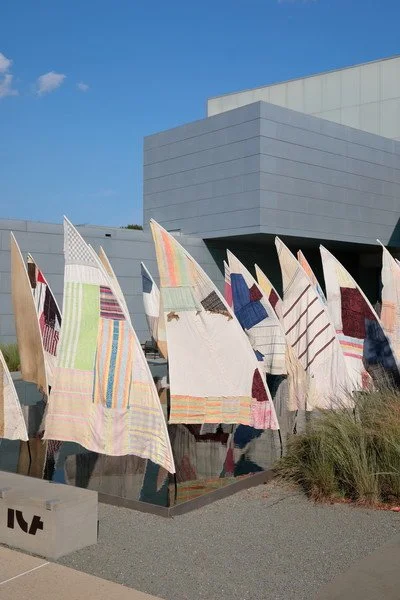
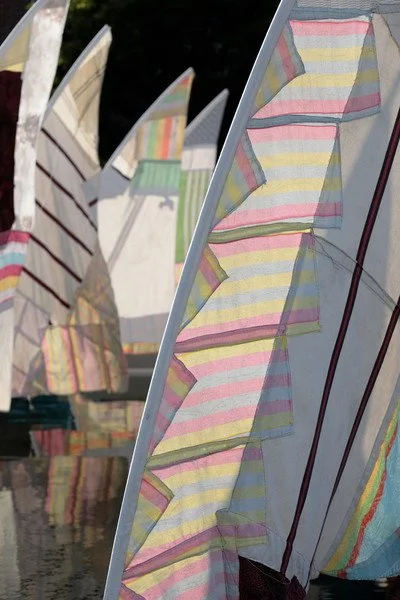
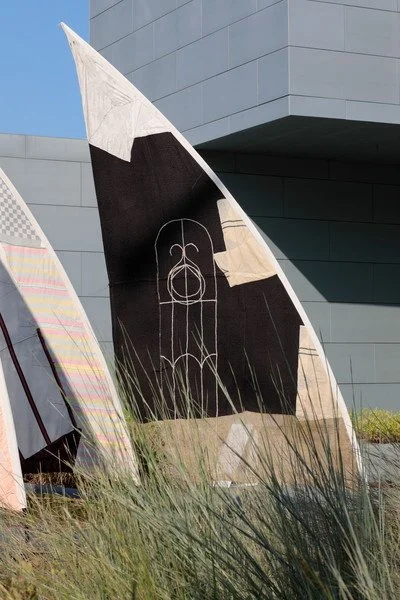
Only Dreamers Leave (2016) Courtesy of ICA - VCU
A similar tension surfaced in Does Anybody Leave Heaven?(2019), developed after Ibrahim returned to Cairo from the United States in 2014 and repeatedly encountered a question from people around him in Ard El Lewa: “Does anybody leave heaven?” Within this working-class neighborhood, the United States often functioned as an imagined horizon of mobility. Ibrahim collected clothes, bags, and textiles circulating through local markets and transformed them into a monumental fabric printed with the American flag that covered the ceiling of the exhibition space. The work exposed how desire for mobility becomes materially entangled with global power.
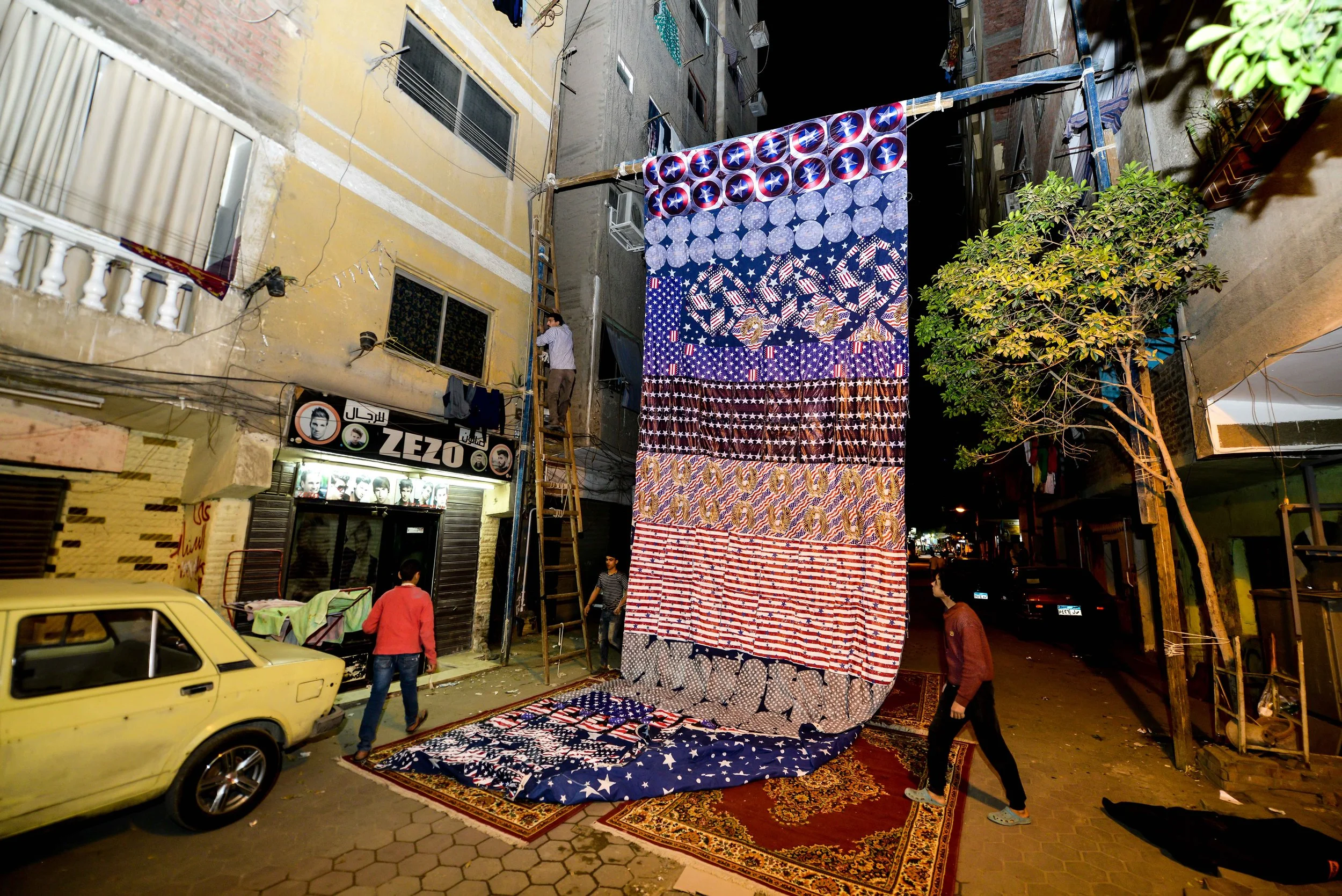
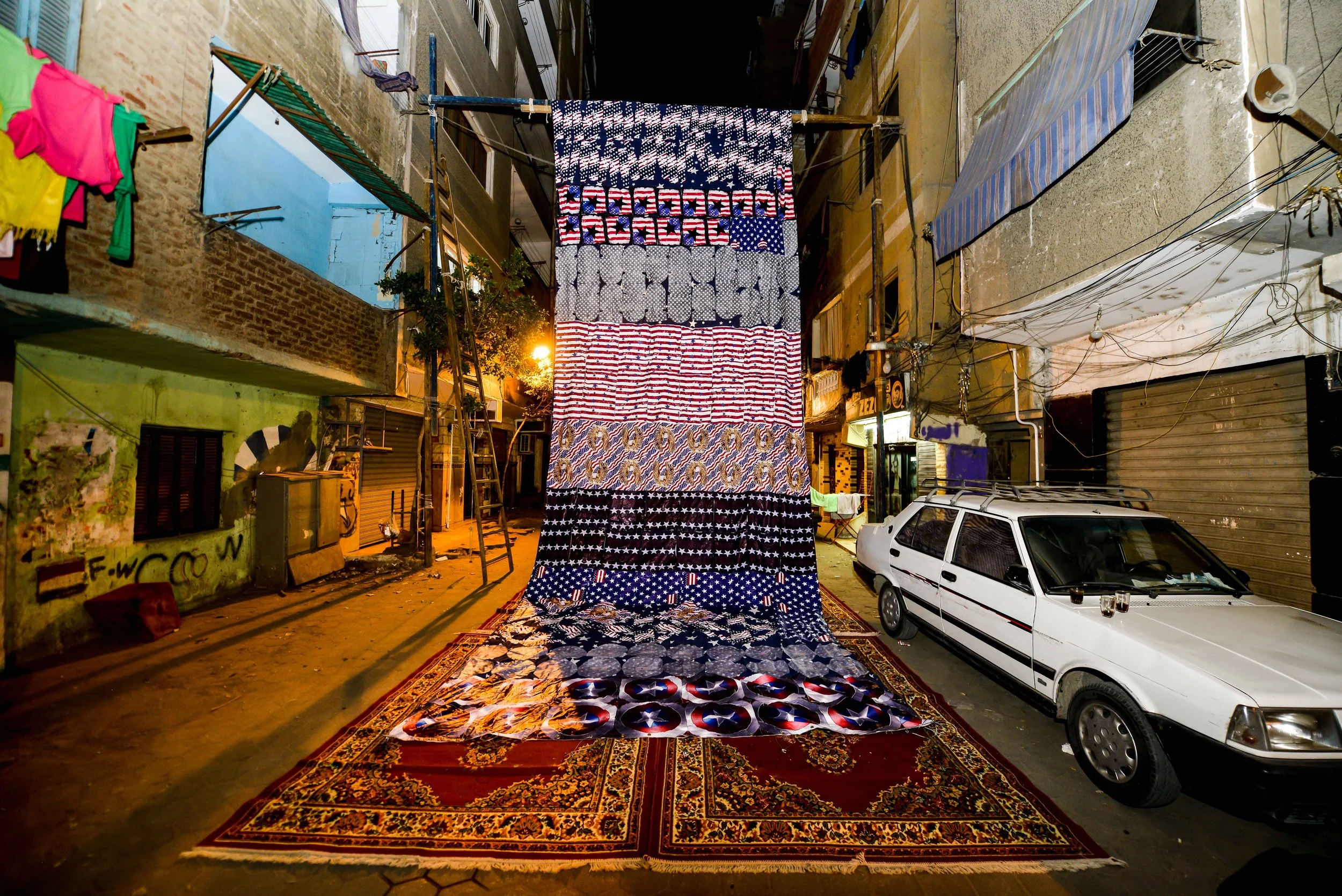
Does Anybody Leave Heaven? 2019. Credit: Hesham Mohamed Hassan, courtesy of Artist
These works positioned textiles as extensions of the body. Fabric carried labor histories, migration routes, class aspirations, and forms of intimate memory. The body remained present even when it was physically absent.
That absence took another form through photography.
One of the central curatorial questions shaping where two oceans meet involved disrupting photography’s historical relationship to fixed viewing. Photography often trains viewers to consume images from stable positions. The exhibition introduced instability into that encounter.
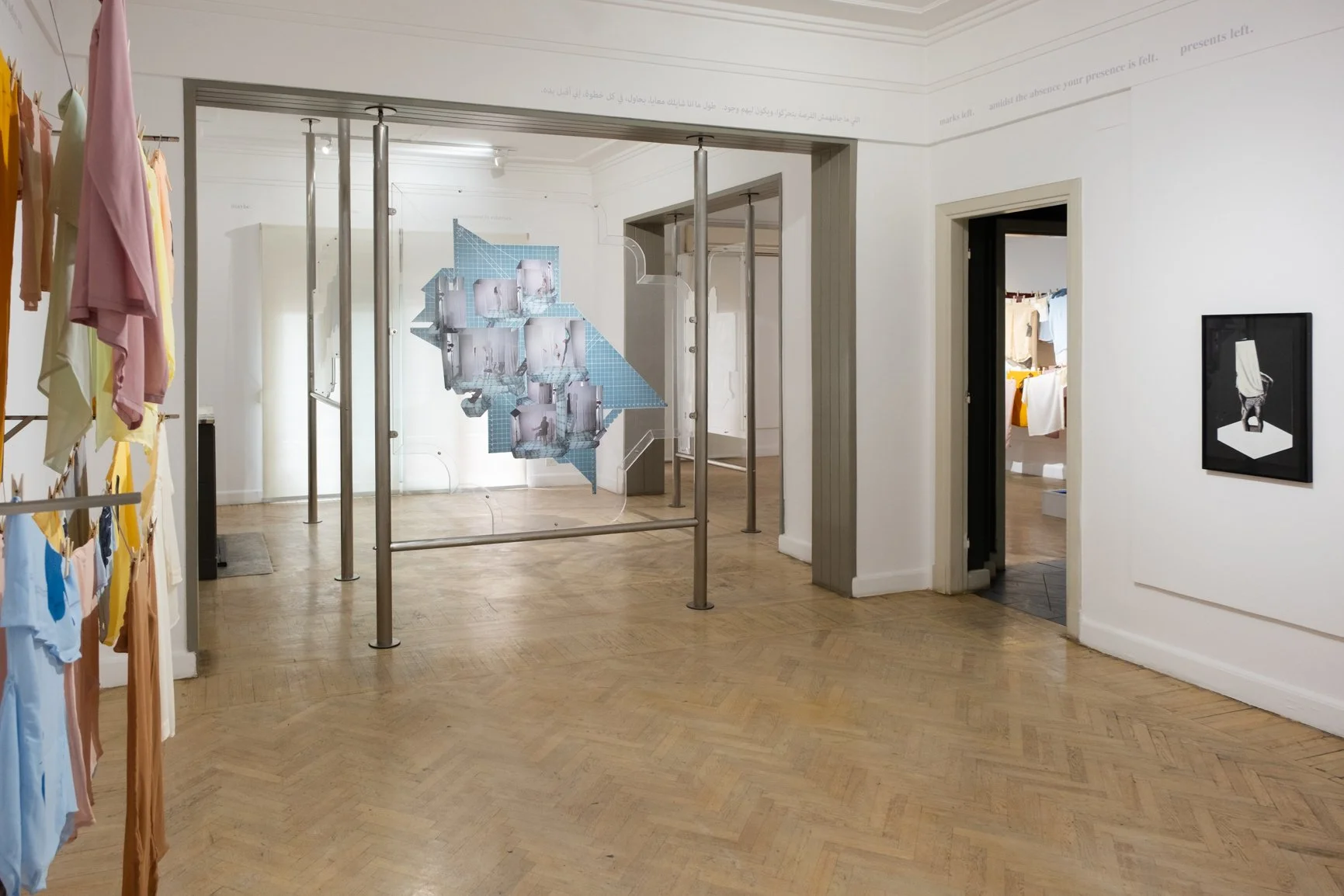
My curatorial intervention at Tintera Gallery introduced metal scaffolding throughout the exhibition space. Scaffolding functioned as both a display structure and a conceptual framework. It suggested repair, transition, incompletion, and temporality. Photographic works were installed on these structures as sculptural forms that demanded movement. Viewers circled images rather than standing in front of them. They encountered photographs from multiple angles, partial views, blocked sightlines, and shifting distances.
The scaffolding also interrupted the architecture of the gallery itself. Positioned at thresholds between rooms, it fragmented the exhibition while preserving visual continuity. Visitors moved through moments of disorientation before gradually reorienting themselves through repetition, delay, and bodily navigation. This spatial strategy extended Ibrahim’s broader concerns. His work consistently asks how bodies move through systems that regulate visibility. The exhibition translated that question into physical experience. Meaning unfolded through movement.
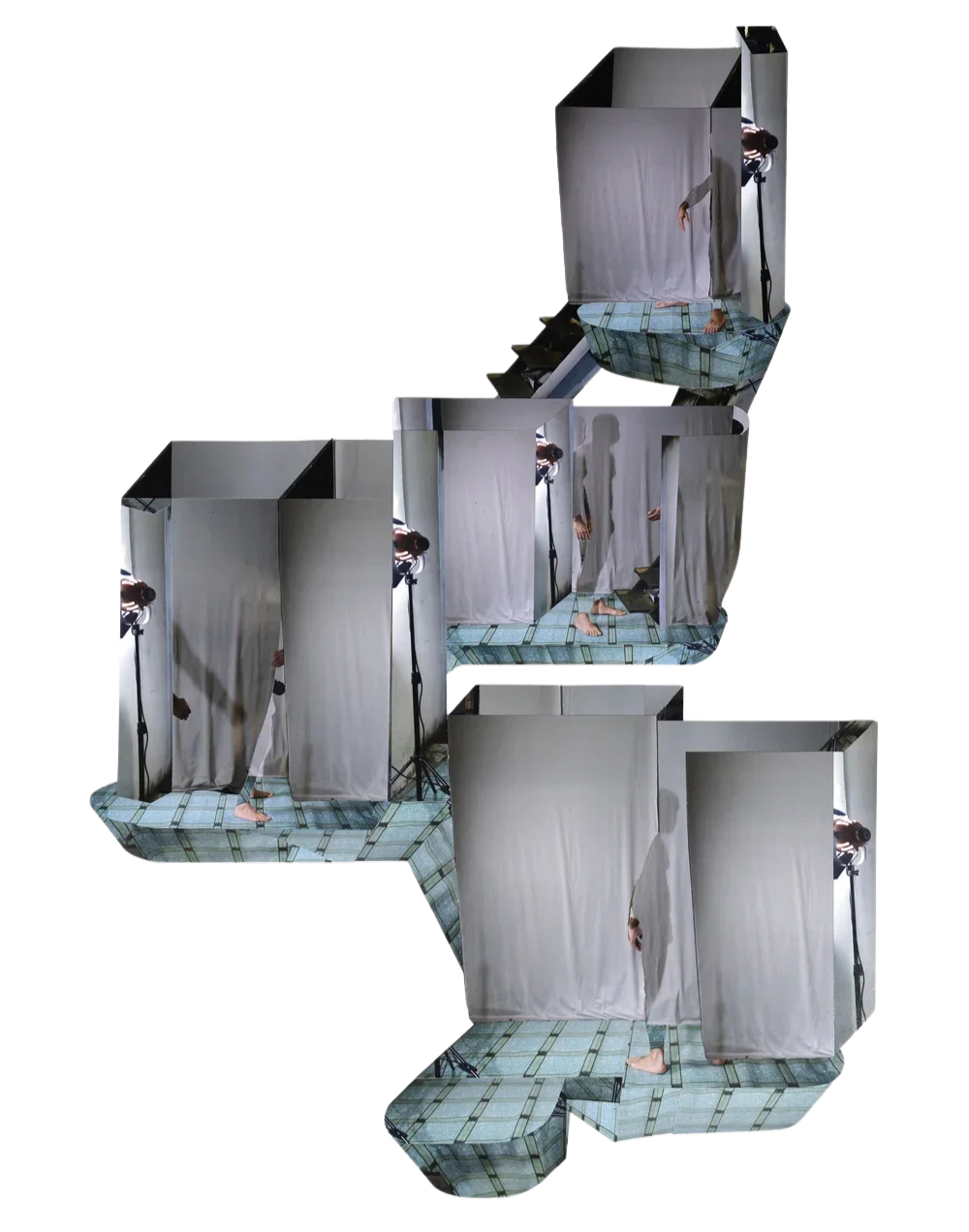
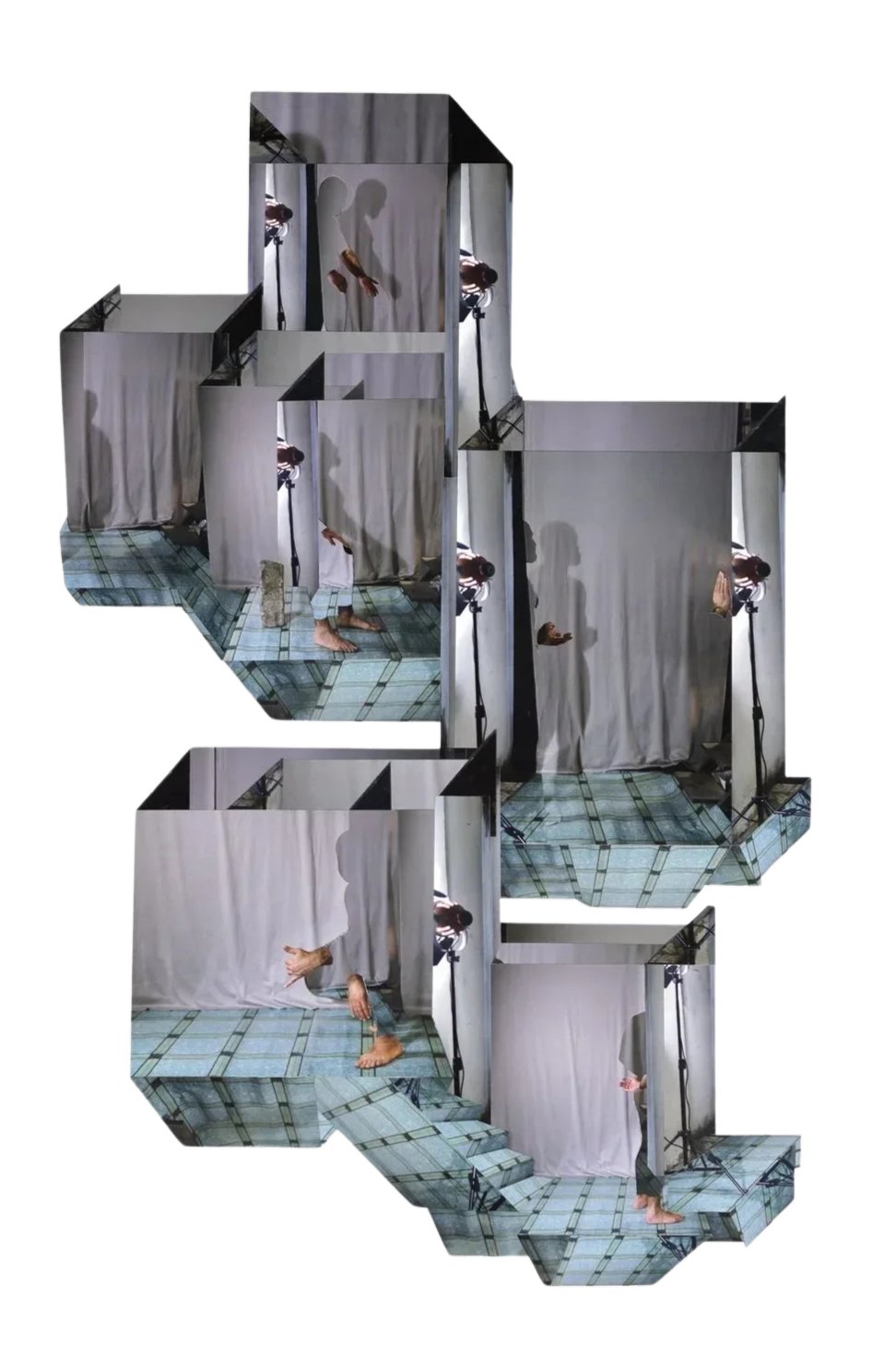
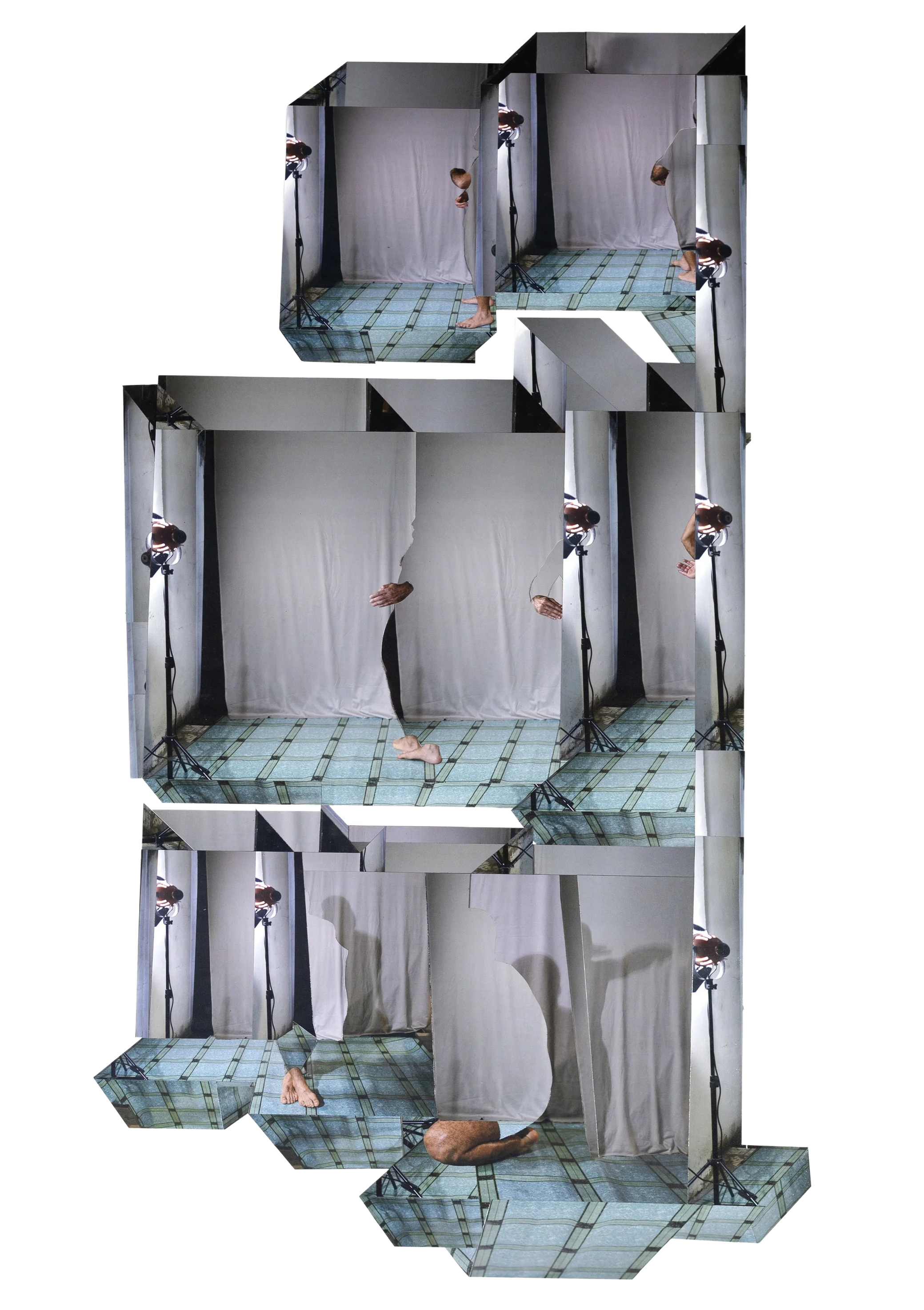
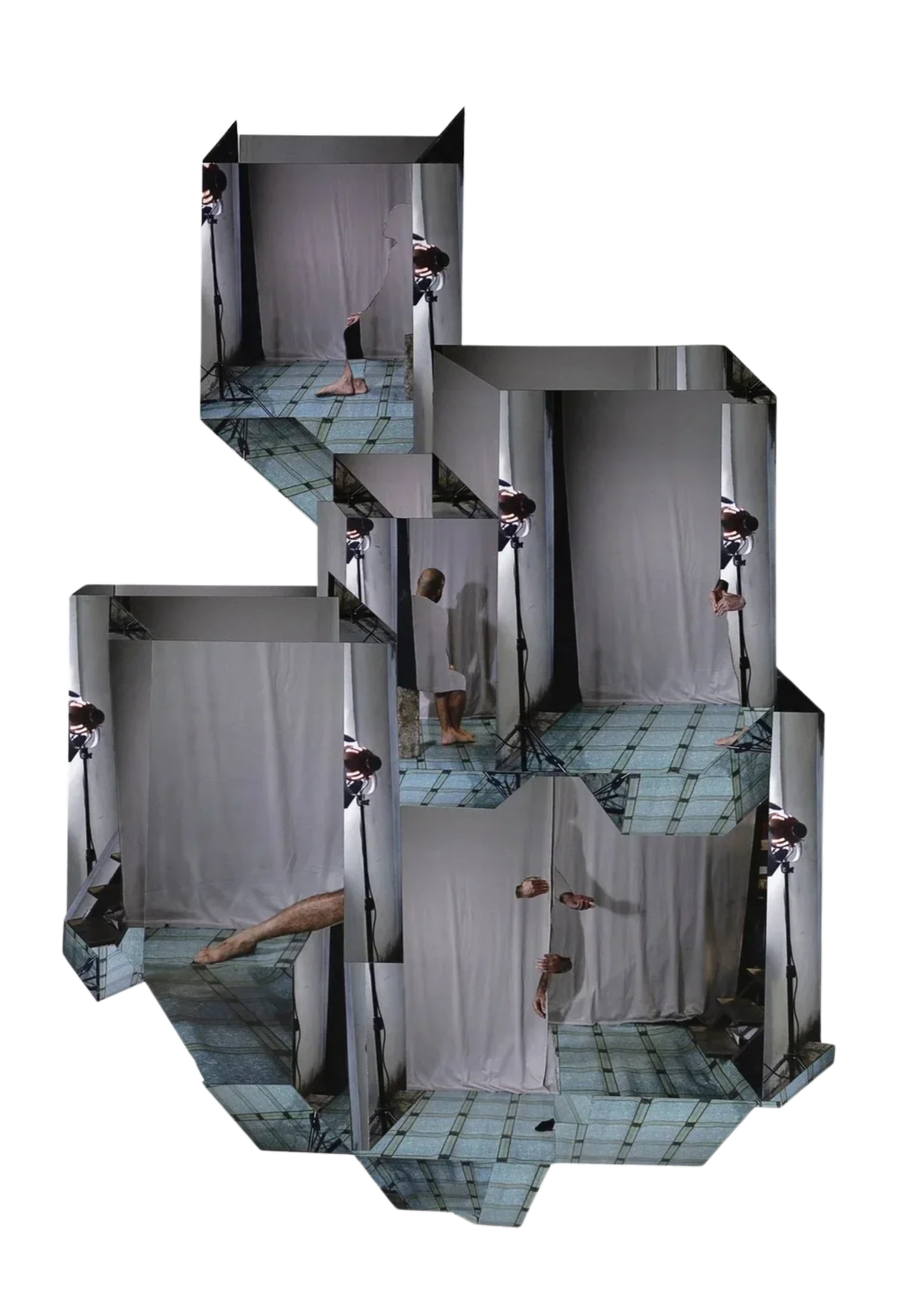
Credit: Marc Onsi, Courtesy of Artist
Architecture had already emerged as a recurring concern in Ibrahim’s work. In Nobody Knows Anything About Them (2019), he constructed an ornate suspended structure from discarded furniture collected from rooftops across Cairo. The installation appeared dense and elaborate while remaining structurally fragile. It carried the instability of improvised urban life and mirrored the vulnerability embedded in migration itself.
Questions of visibility became more urgent after September 11, 2001. Ibrahim was seventeen years old and on his way with his father to a community college in New Jersey when radio programming was interrupted by news of the attacks on the World Trade Center. His immediate response was deeply revealing: “I hope they’re not Muslims.”
That fear emerged from anticipating how quickly bodies could be transformed into symbols. In the aftermath of the attacks, he encountered hostility directed toward Arab and Muslim bodies. Complexity collapsed into stereotype. The body became instantly readable through violence. This experience reverberates throughout his later work.
quickly but carefully cross to the other side, 2021. Credit: Marc Onsi, Courtesy of Tintera Gallery
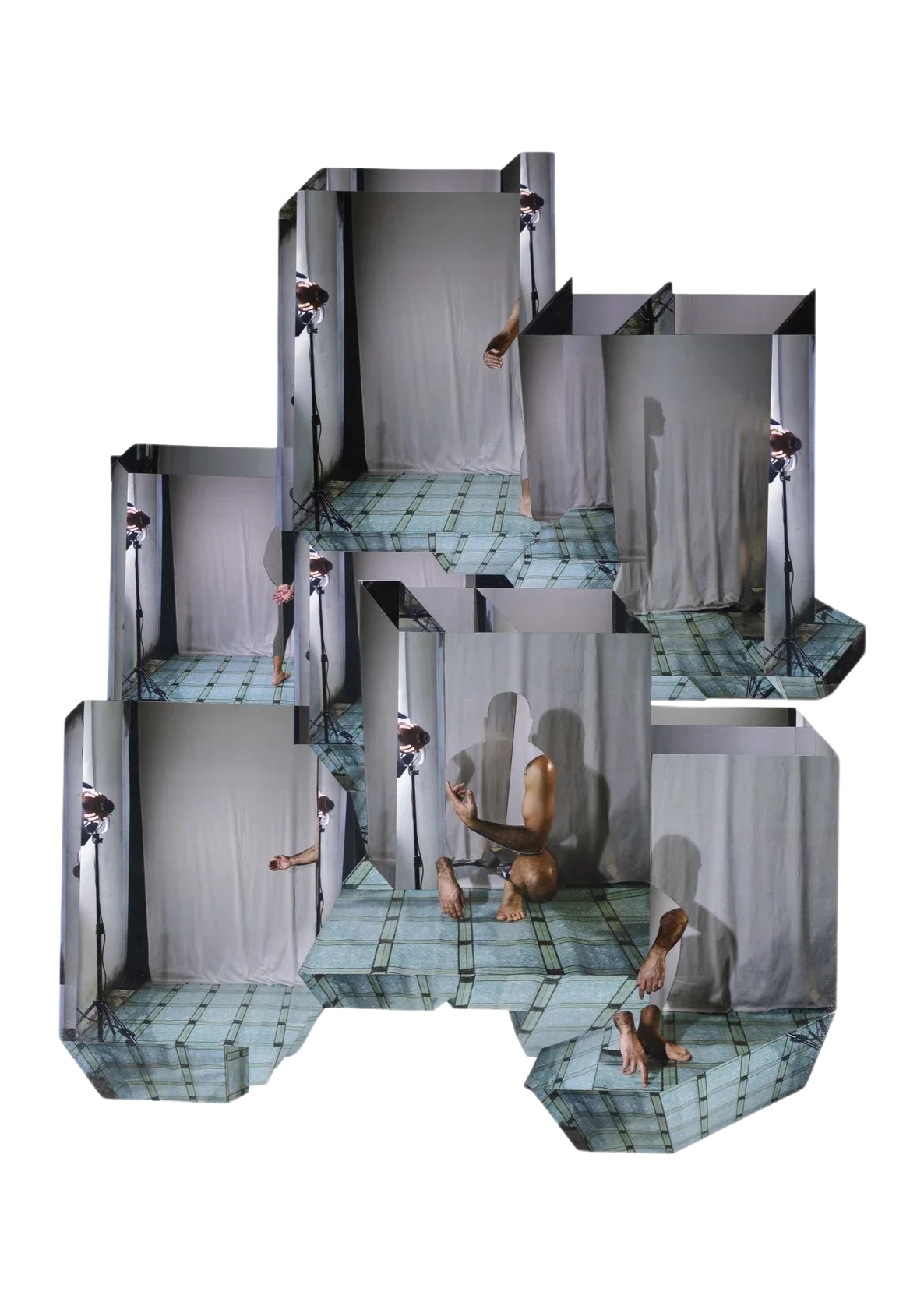
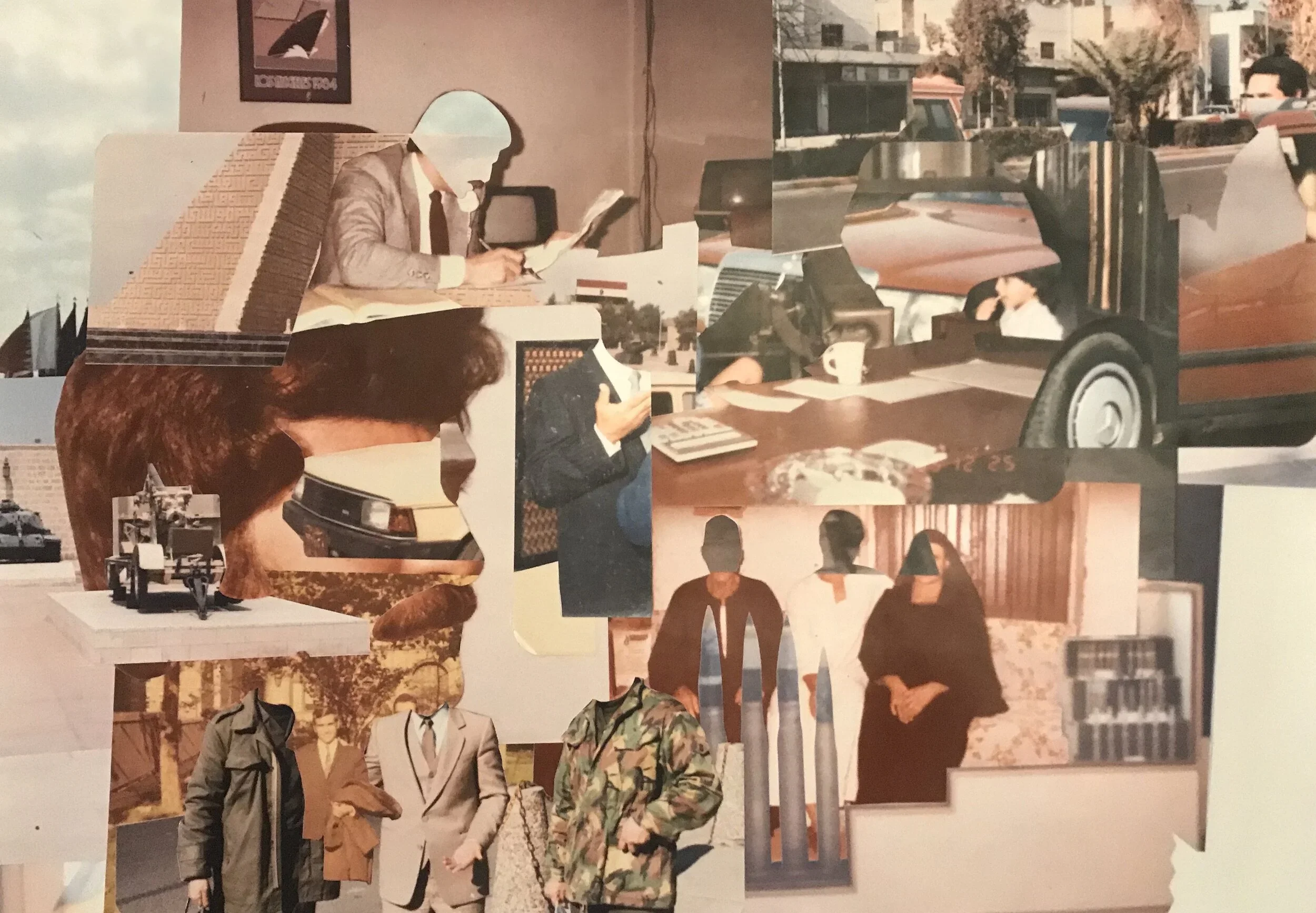
In quickly but carefully cross to the other side (2021), Ibrahim worked with his father’s archive. Family photographs became entry points into larger histories of class mobility, migration, masculinity, and aspiration. His father’s trajectory moved from rural Egypt to urban life and eventually to the United States.
Ibrahim reenacted his father’s poses from archival photographs by producing hundreds of self-portraits in his studio in Ard El Lewa. He photographed himself from multiple angles, repeated gestures, and reconstructed inherited bodily memory through performance. These works examined how social expectations settle into posture, gesture, and masculine self-presentation.
Some archival photographs held another historical rupture. In the 1960s, Ibrahim’s father photographed himself in front of the World Trade Center as a symbol of modern ambition. Decades later, those same images acquired entirely different political meanings. The archive revealed how historical events can reorganize the meanings attached to bodies.
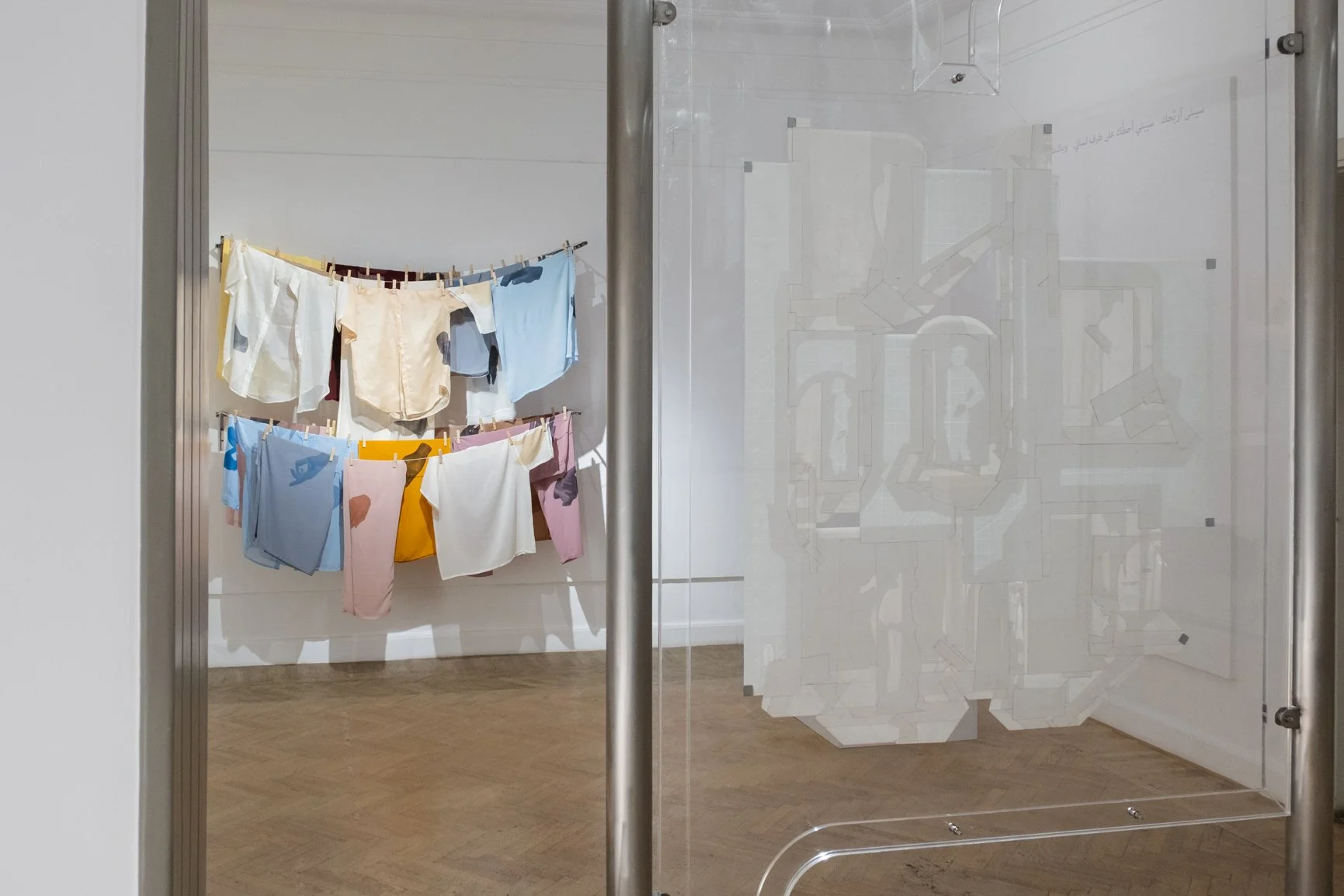
This trajectory gradually moved toward disappearance. In his exhibitions I Never Revealed Myself to Them (2022) and Amidst the Absence, A Present is Felt (2025), Ibrahim cut, fragmented, and reconstructed photographs until the body itself began to vanish. Remnants of images became sculptural traces.
Absence emerged as a charged form of presence. The body no longer carried the burden of full visibility. Fragments, voids, garments, and residue assumed that role. Chiffon garments introduced in recent works echo the clothing of both father and son. Their transparency carries fragility, repetition, and inherited identity. Poetry, which Ibrahim has written since his youth and introduces publicly for the first time in this exhibition, appears across the gallery walls. The poems create another layer of movement through space. They shape rhythm, pause, and circulation.
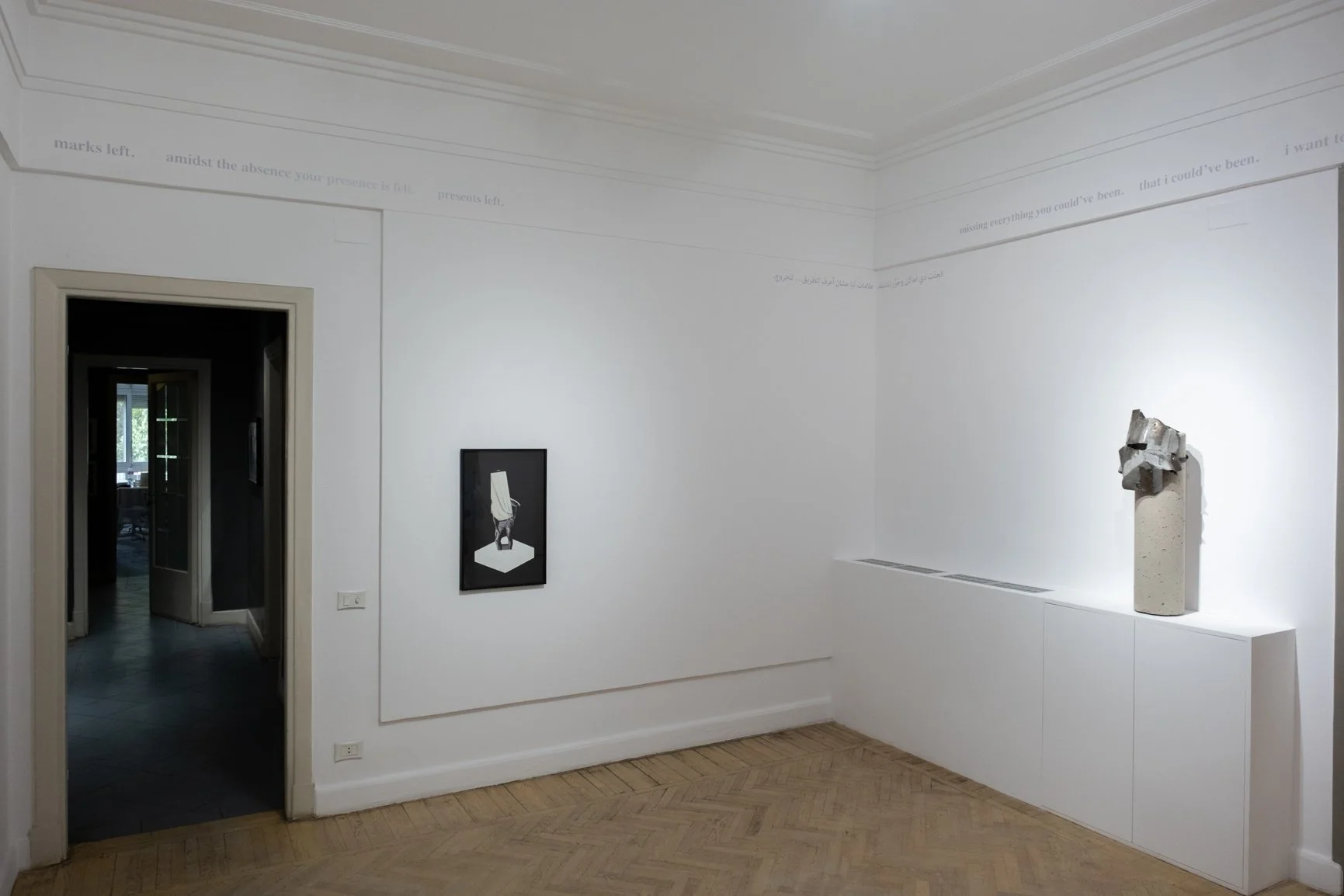
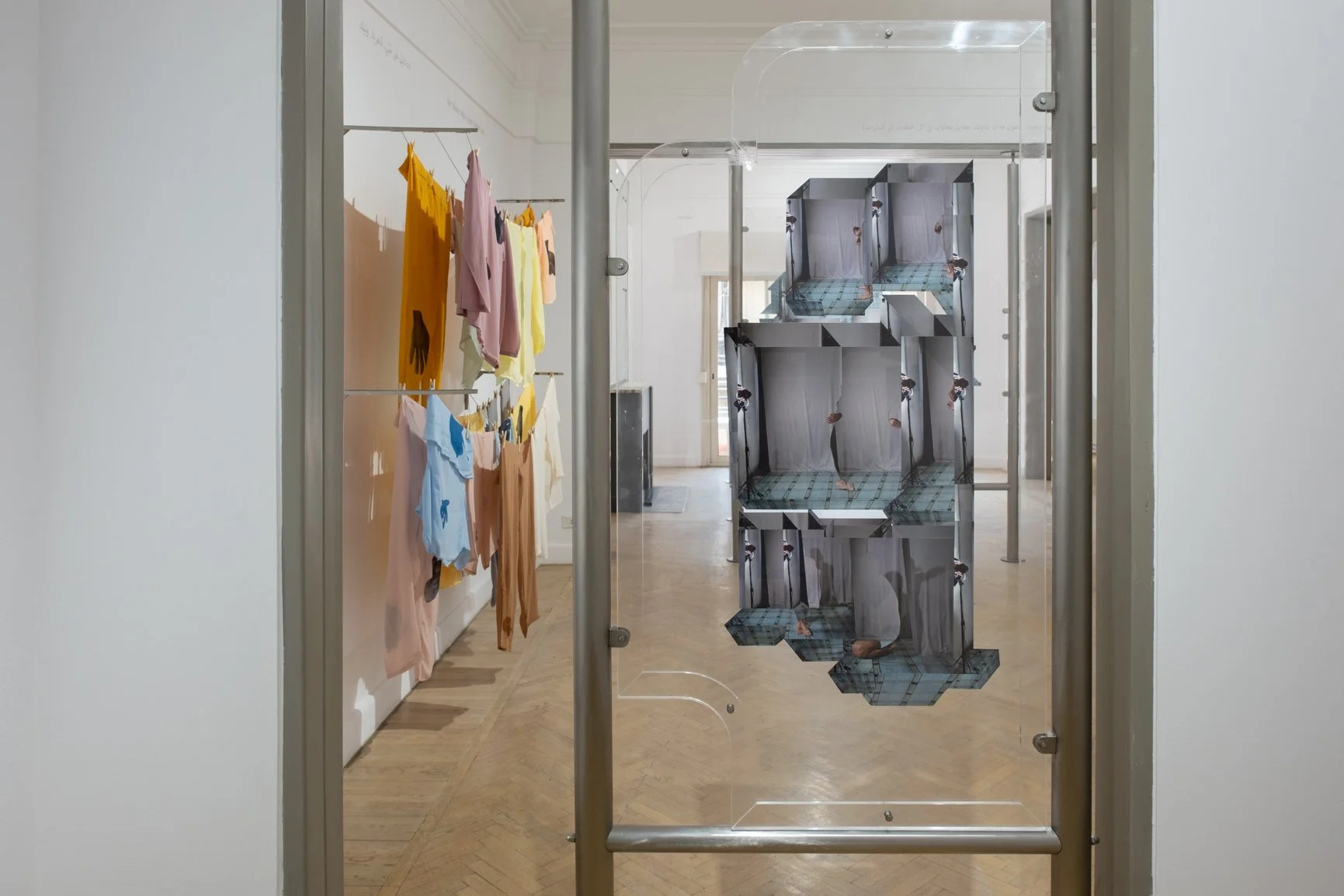
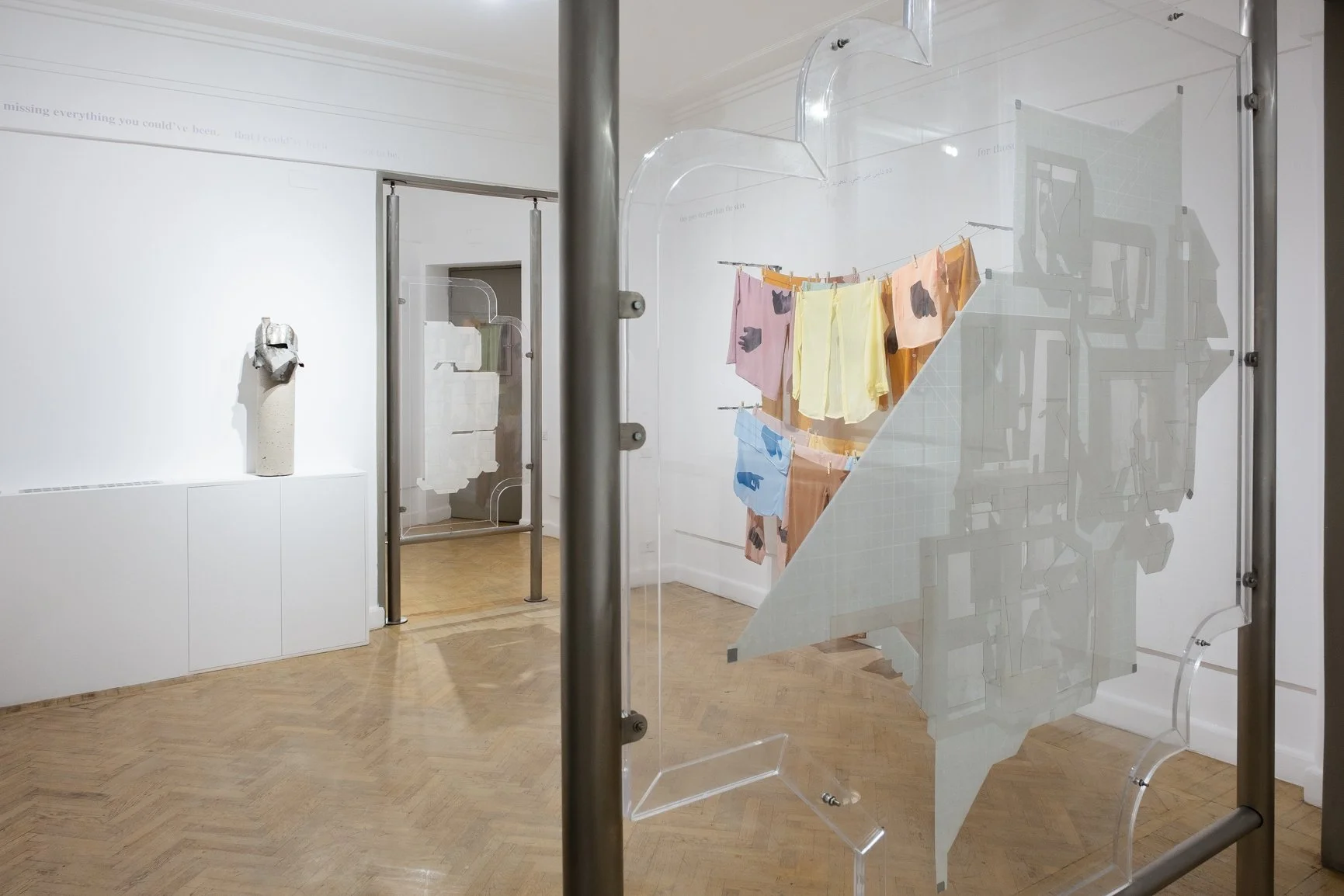
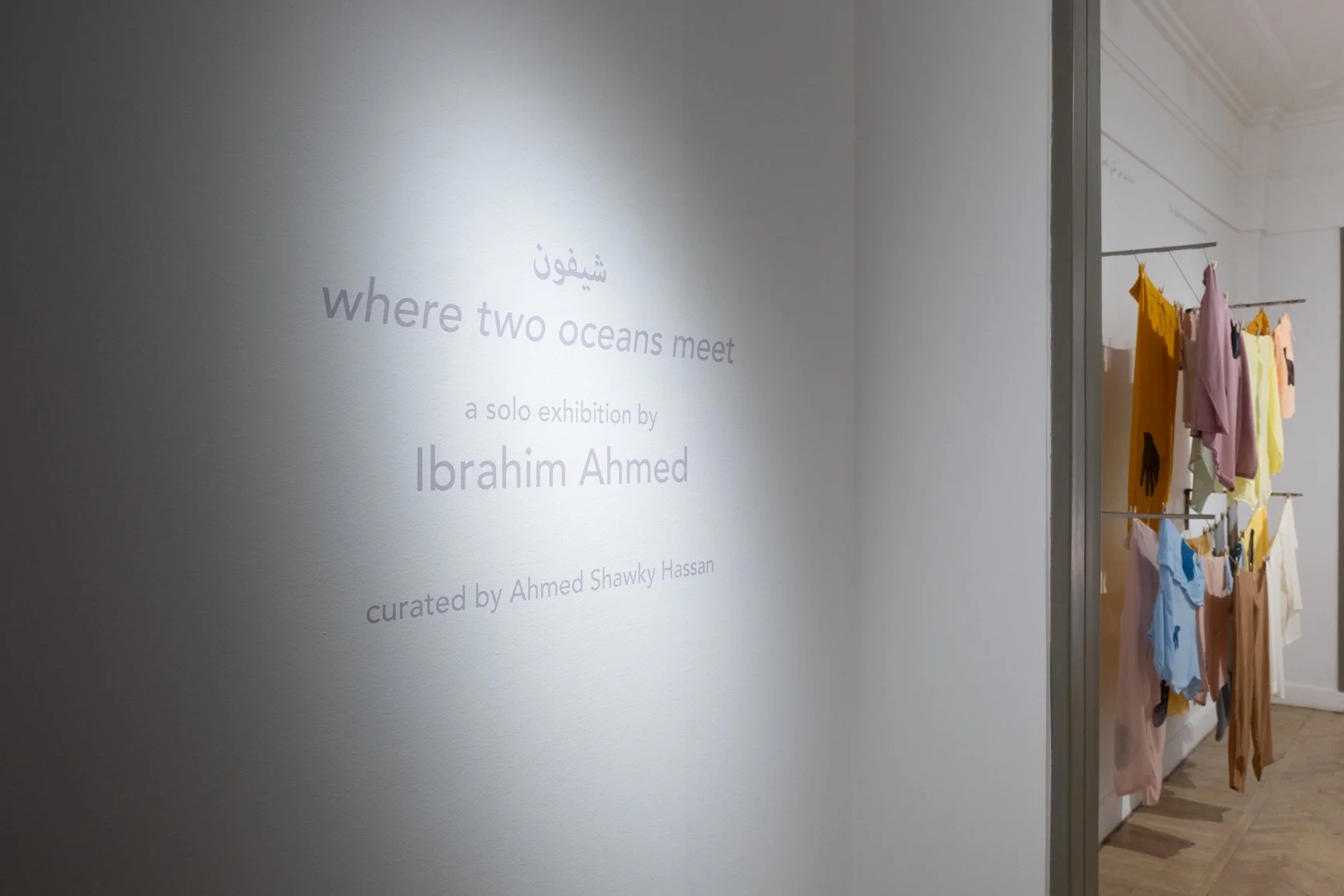
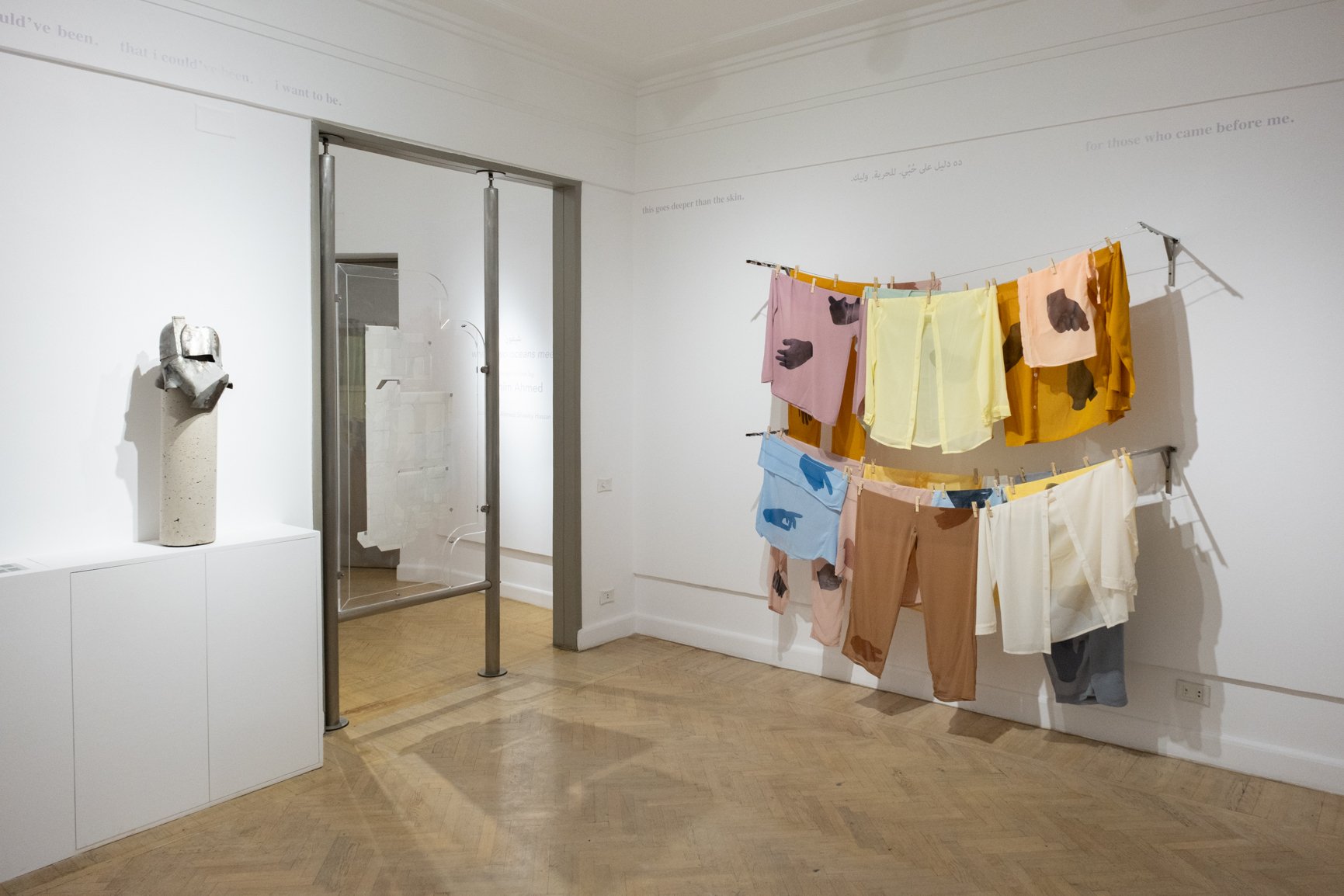
When Two Oceans Meet 2025. Credit: Marc Onsi, Courtesy of Tintera Gallery
By this point, the body exists everywhere in the exhibition: in fabric, architecture, movement, language, archives, and disappearance. Where Two Oceans Meet reflects on bodies that move without arriving at stable destinations. Bodies shaped by migration continue to carry multiple geographies at once. Bodies shaped by archives remain unfinished. Bodies shaped by visibility learn how to disappear.
The meeting point between two oceans is often imagined as a place where boundaries dissolve. Here, it becomes a site of friction where currents collide, overlap, and reshape one another. Ibrahim’s work inhabits that unstable meeting point.
The fragmented body remains in motion there.

Courtesy of Tintera Gallery
About Contributors:
Ahmed Shawky Hassan is an artist, curator, and author, born in 1989 in Ismailia, Egypt. His research-based artistic practice explores the influence of historical and contemporary narratives in shaping dominant perceptions of art. His projects trace the circulation and dissemination of these narratives within the contemporary art field, questioning the forms of authority that contribute to their consolidation.
Ibrahim Ahmed, born in Kuwait in 1984, navigates a transnational upbringing between Bahrain, Egypt, and the United States. This experience informs his practice in materiality, identity, and power. Since relocating to Egypt in 2014, he has been based in the informal neighborhood of Ard El Lewa, where his work critically engages with the socio-political structures that shape cultural narratives.