Reviving the Hidden Histories of Beirut’s Working Girls: In Discussion With Yasmina Fayed
Anchored as a fixture on the stage of Metro Al Madina, Al Souq Al Oumoumi serves as a visceral excavation of Beirut’s pre-war red light district. While the theater’s works lean on nostalgia or satire, this production, led by the formidable Yasmina Fayed, strips away the glittering veneer of the cabaret to confront the raw, physical reality of survival and the government’s role in the prostitution market in the 1950s. We explore how Fayed navigates the heavy duality of the stage: honoring the brutalized histories of the women of Al-Mutanabbi Street while reclaiming the female form as a site of power, vengeance, and unapologetic agency.
For more than a decade, Metro Al Madina, led by Hisham Jaber, was housed in a small underground theater adjacent to Al Madina Theater in Hamra. In 2023 it moved to Beirut’s former Aresco Palace in Clemenceau, accommodating larger crowds and giving more room for the performers to rehearse and exist in that space. Al Souq Al Oumoumi is one of the performances that came to life on this new stage, featuring a bigger regular ensemble than Metro’s plays usually host, including Romy Melhem, Chantale Mailhac, Monzer Baalbacki, Randa Makhoul, Rola Sheil, Roueida El Ghali, Yal Solan, Khouloud Yassin, Mohammad Assaf, Joseph Azoury, and Dani Harb, as well as musicians performing live behind the scene.
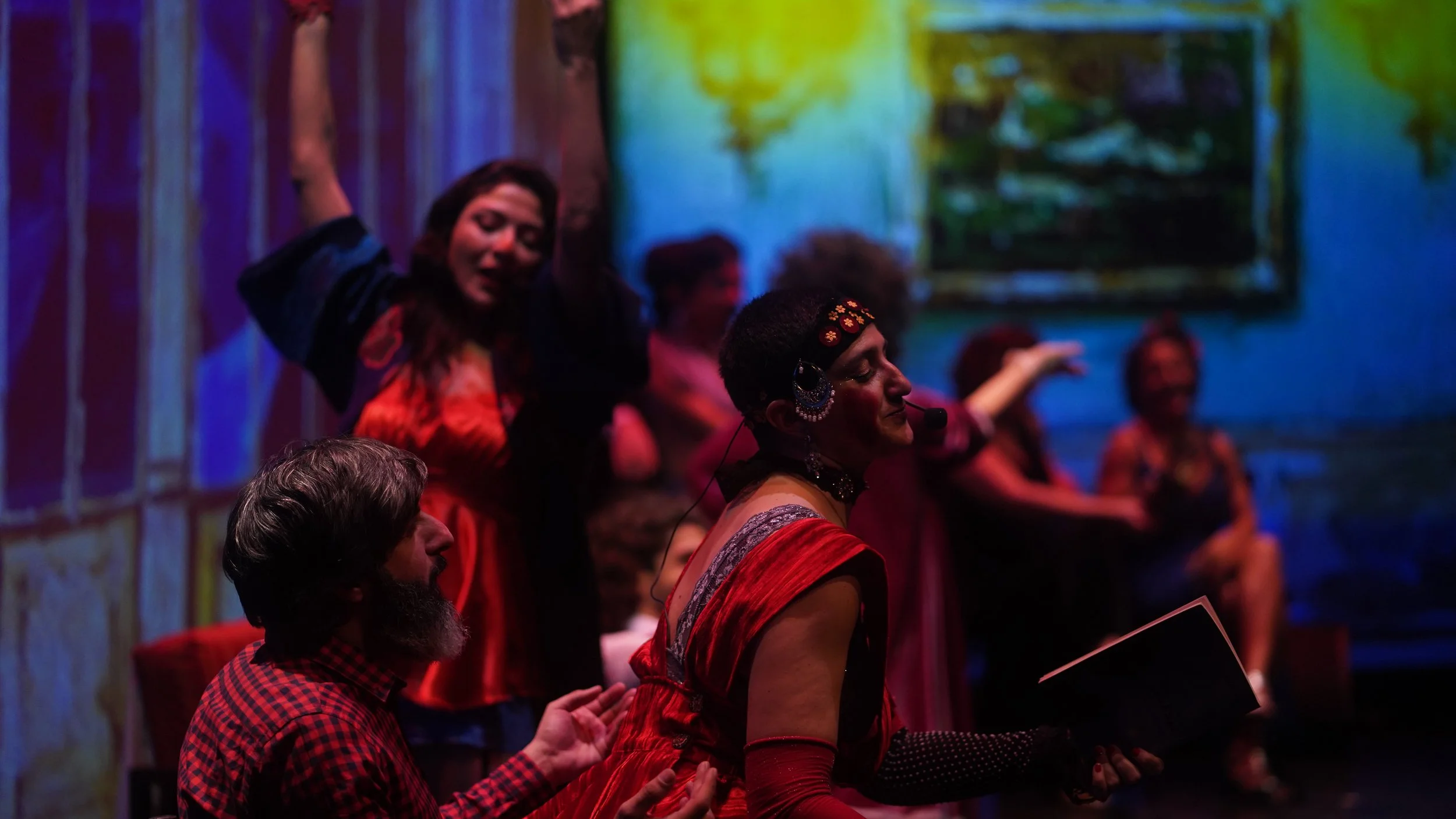
Al Souq Al Oumoumi is set in a street named Al-Mutanabbi in pre-war era, red-light district of downtown Beirut. Why is the street named after the Abbasid poet, and where did the plot and script draw most of its inspirations?
The origin of the street’s name remains an enigma for most historians. However, Beirut is a city of profound history, and it comes as no surprise that one of its streets would bear the name of a great poet. As a city rich in hidden beauty—its secrets etched into tiles, walls, and buildings—the story of the “working girls” was almost inevitable. A street named after a revered poet quietly safeguarded the secrets and misfortunes of its women, keeping them hidden behind closed doors.
We’ve seen you in musical cabarets like The Hishik Bishik Show and Bar Farouk, but the undertone of both felt a lot more comedic, and in which the professions of the female characters were looked at through a wider lens. Was it a conscious choice to zero in on the lives of these “patronesses” in Al Souq Al Oumoumi? If so, why now?
When I first proposed the Hishik Bishik show and the Egyptian cabaret theme to my friend Hicham Jaber—and later with the creation of Bar Farouk—the focus of these productions was primarily musical. They revolved around songs steeped in nostalgia, melodies that summon the “good old days,” when poets, composers, tarab singers, actors, and film directors gathered around a shared dream: to fill the Arab world with beauty. From that era emerged magical artistic unions—Chadia and Abdel Halim, Faten Hamama and Omar El-Sherif—duos that shaped an entire generation’s understanding of love, music, and longing.
At the heart of our cabaret shows was the desire to revive the love born of pure art. Gradually, as performances unfolded night after night, characters began to take form. Comedy surfaced, as did tender and heart-warming moments. Beneath the singing, dancing, and acting lay a concealed layer—the world of prostitution, embodied in the figure of al-muʿallima. She remained hidden, veiled by spectacle and rhythm.
When Hicham wrote Al Souq Al Oumoumi, the true inner self of the muʿallima finally emerged. The time had come to descend into her darker spaces: her fears, her wounded and malnourished soul, her longing for safety, her yearning for the end of abuse, and her fragile search for love. All of this unfolds within a world constructed around her—one that both defines and suffocates her.
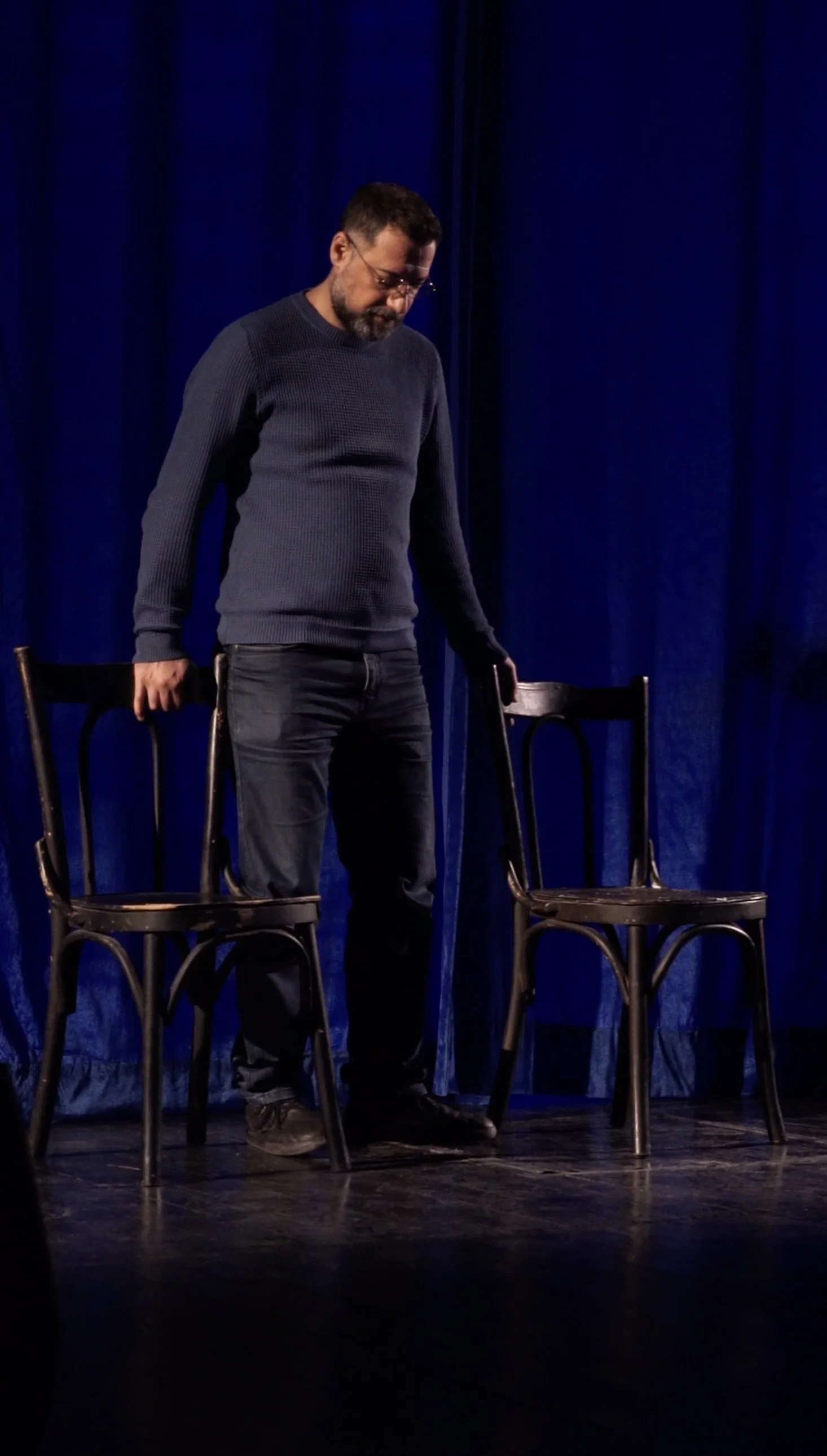
Writer Hicham Jaber at the rehearsals of Al Souq Al Oumoumi
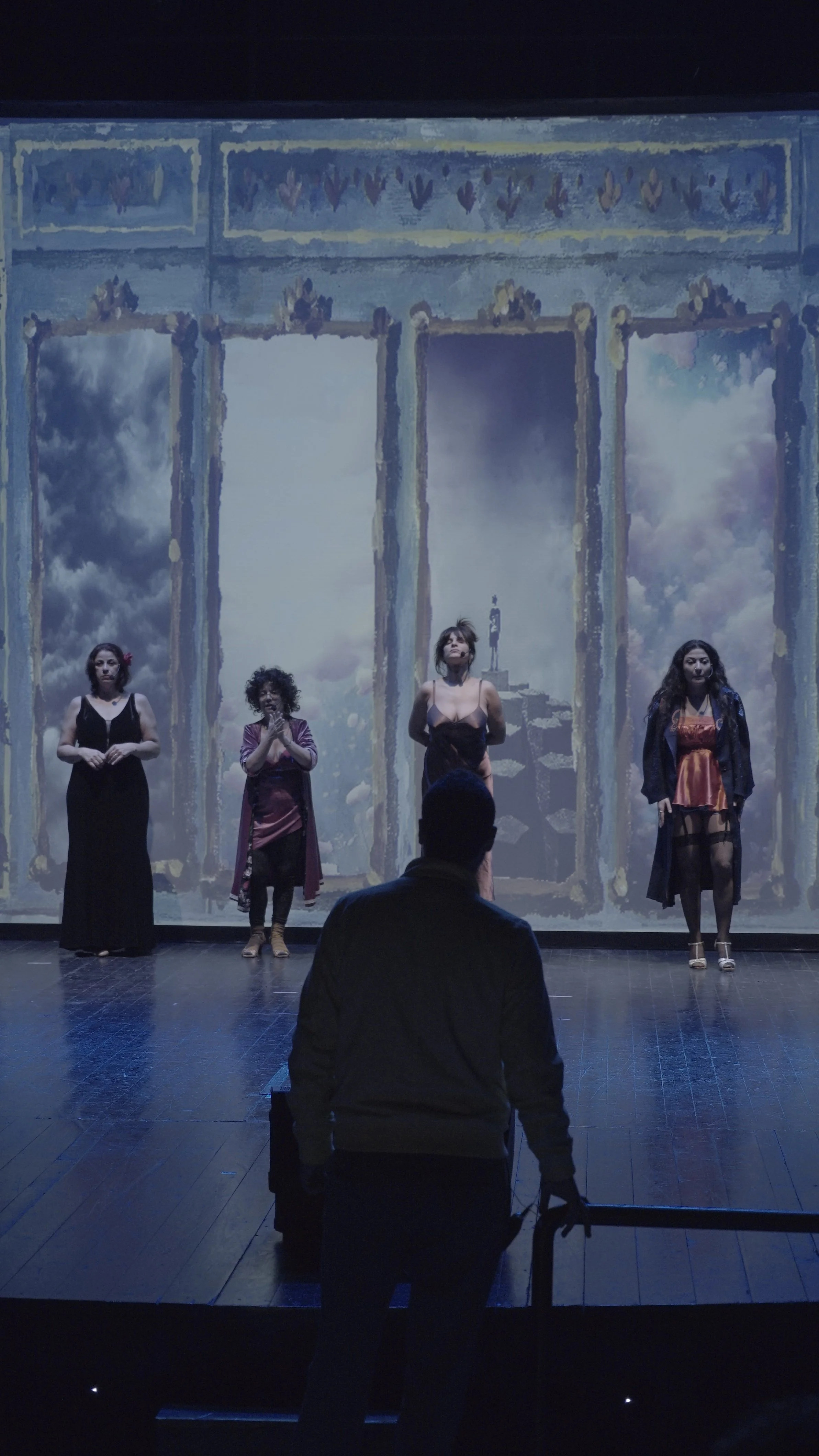
Who has been the main audience for it, and any interesting changes in the audiences over time?
It came as no surprise that the audience leaned toward an older generation. This was only natural, as the title itself evokes memory and recognition. They know the street; they understand what “Souq Oumoumi” or “Souq Al-Awadim” signifies. These words carry lived experience, unspoken histories, and cultural weight
Yet among the audience, the younger generation is also present. They come not out of familiarity, but out of curiosity—to excavate the past. For them, the show becomes a portal, a window opening onto old Beirut. It awakens the senses, stirring sight, sound, and emotion, and invites them to encounter a world they did not live, but can now momentarily feel.
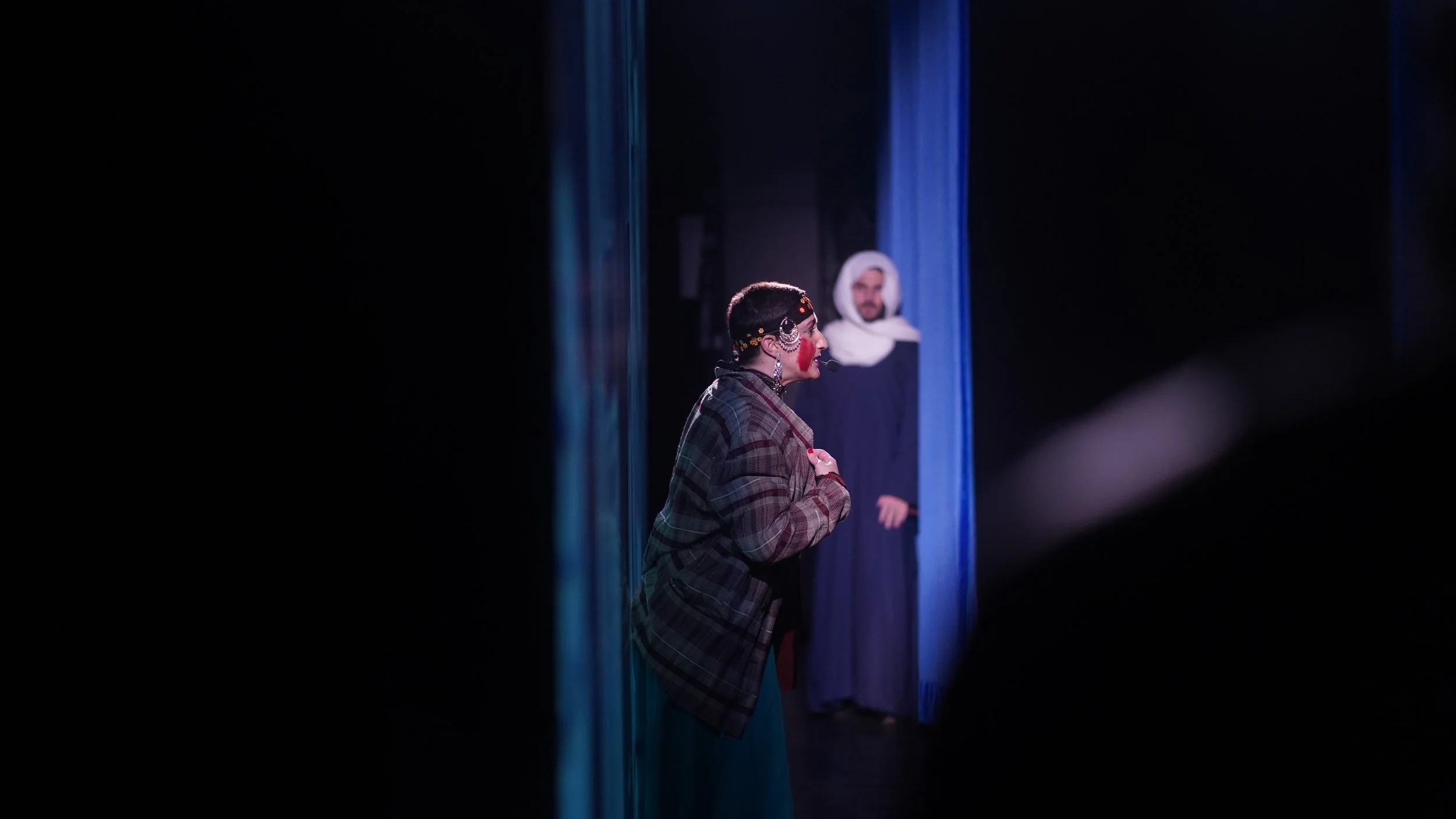
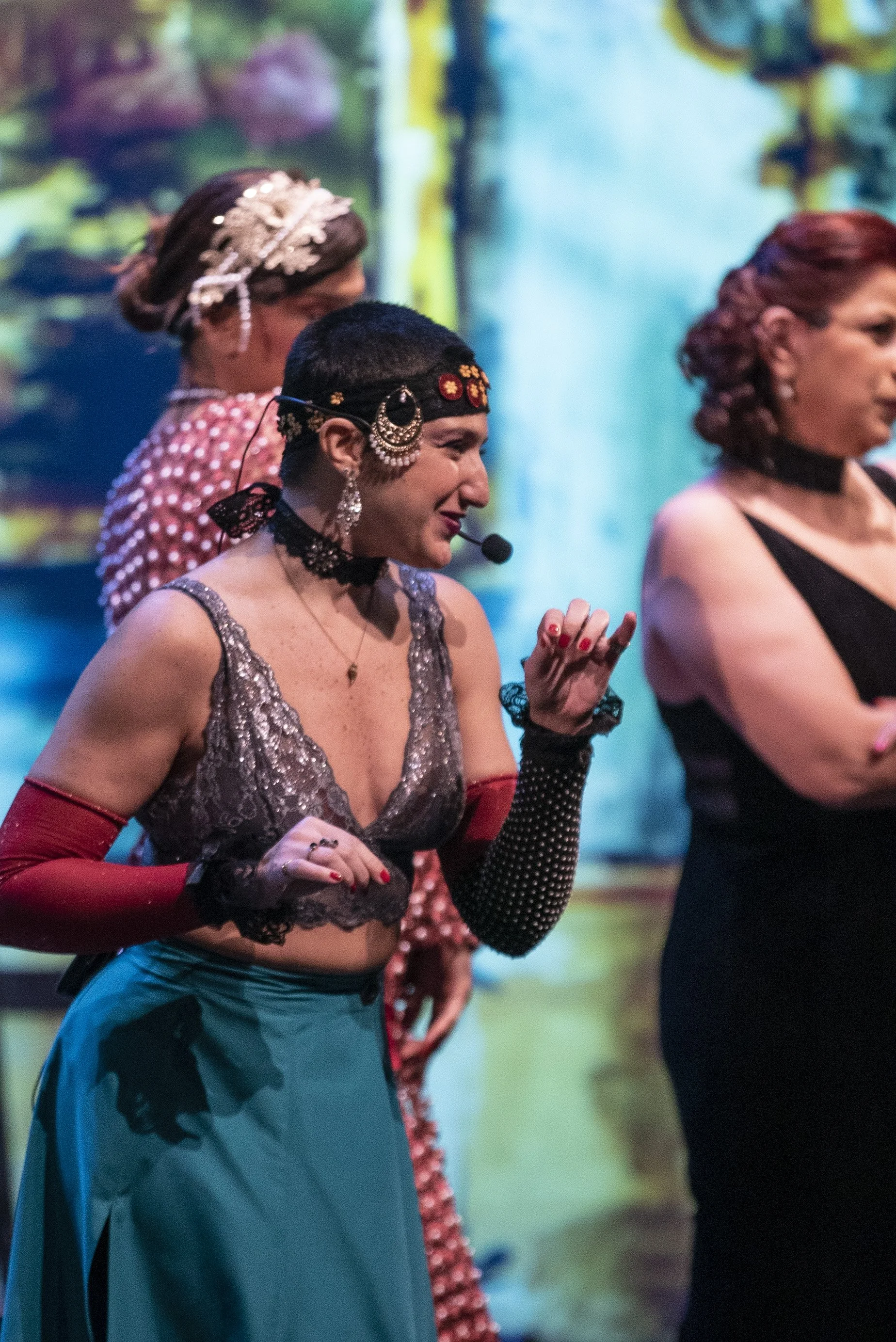
Yasmina Fayed as Afifé
Tell me about your character in the play.
Afifé is a businesswoman. She is a prostitute who understands her place in the world and the rules that govern it. She has come to terms with the reality she inhabits—she does not rebel against it, nor does she attempt to rewrite her fate. Her acceptance is not weakness, but survival.
Marked by a brutal childhood that pushed her onto the streets, Afifé learned early how to navigate a merciless environment. Rather than surrendering to it, she sought ascension within it, carving out power where little was offered. Disfigured by a father who was himself a serial killer, she grew up confronting fear head-on, refusing to let it define her.
Love, when it crossed her path, became her one moment of vulnerability. She lowered her defenses, only to find herself stripped back to nothing: she returned to zero. Yet it was the beast within her, forged by years of violence and endurance, that allowed her to rise once more. This same force guided her toward vengeance, not as an act of cruelty, but as a means of reclaiming agency. In a world populated by monsters, revenge becomes not a choice, but the last remaining form of hope.
Do you think that the audience can read into the complex layers of the show, or do they mostly register its entertainment value?
“The red-light district of Beirut” are words that carries a peculiar magic, instantly awakening curiosity. Audiences are drawn in by the promise of revelation—by the urge to glimpse what lies behind a subject long wrapped in taboo. It is an invitation to witness what was never openly spoken of, yet always existed.
Gradually, however, the experience becomes more intimate, particularly for the older audience. Memories begin to surface: some recall frequenting the “houses”, others remember the innocence of a first kiss. Nostalgia intertwines with confession. While the music captivates them, something deeper unfolds simultaneously—a growing emotional bond with the characters. Through them, the audience comes to understand their suffering, their humanity, and the weight of their lives. What emerges is the discovery of a parallel society, observed up close, no longer distant or abstract, but painfully real.
The play resurrects stories from Beirut’s past, specifically women’s whose lives were deeply shaped by their own bodies in social and economic systems. How does portraying these women make you reflect on your own body or the female body in Lebanon today?
The shape of a woman’s body was once treated as the defining measure of her worth—ranked, judged, and even tied to her income. And even today and in many spaces, the female body is still reduced to a tool rather than respected as part of a whole, complex individual. When I started performing, I felt a subtle but undeniable pressure, not because I was uncomfortable in my own skin – I never had issues with my body – but because the environment almost forces you to become aware of it, to analyze it, to see yourself through an external lens. It’s a quiet pressure, but it lingers. Among us, the female artists in Metro, we chose not to fit into a single mold. We showed that beauty isn’t a fixed standard; it’s fluid, diverse, and unapologetically personal. In doing so, we redefined beauty and performed it as we live it: something that exists in all sizes, all shapes, all expressions. More than anything, that is what deserves to be seen.
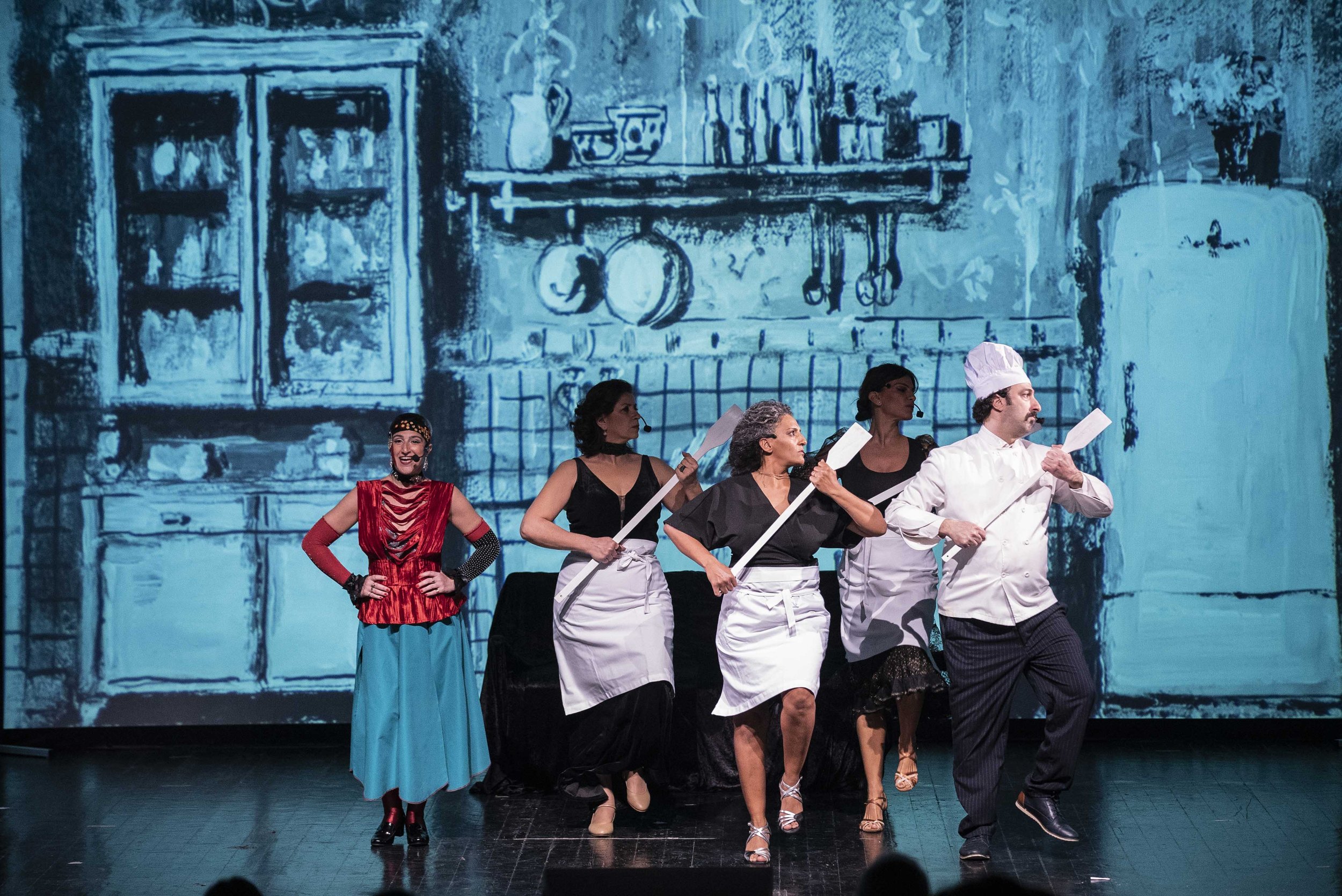
There are a few faces that are new to Metro Al Madina’s regular shows, yet ones that are established in the Beirut performing arts scene. How did the casting come about?
Hicham Jaber conducted a series of castings that attracted a wide range of performers from diverse backgrounds. Numerous stories and talents presented themselves, each bringing a distinct voice and presence. The selection process focused primarily on singing, acting, and dancing, as the production sought performers capable of embodying the richness, complexity, and emotional depth required by the show.
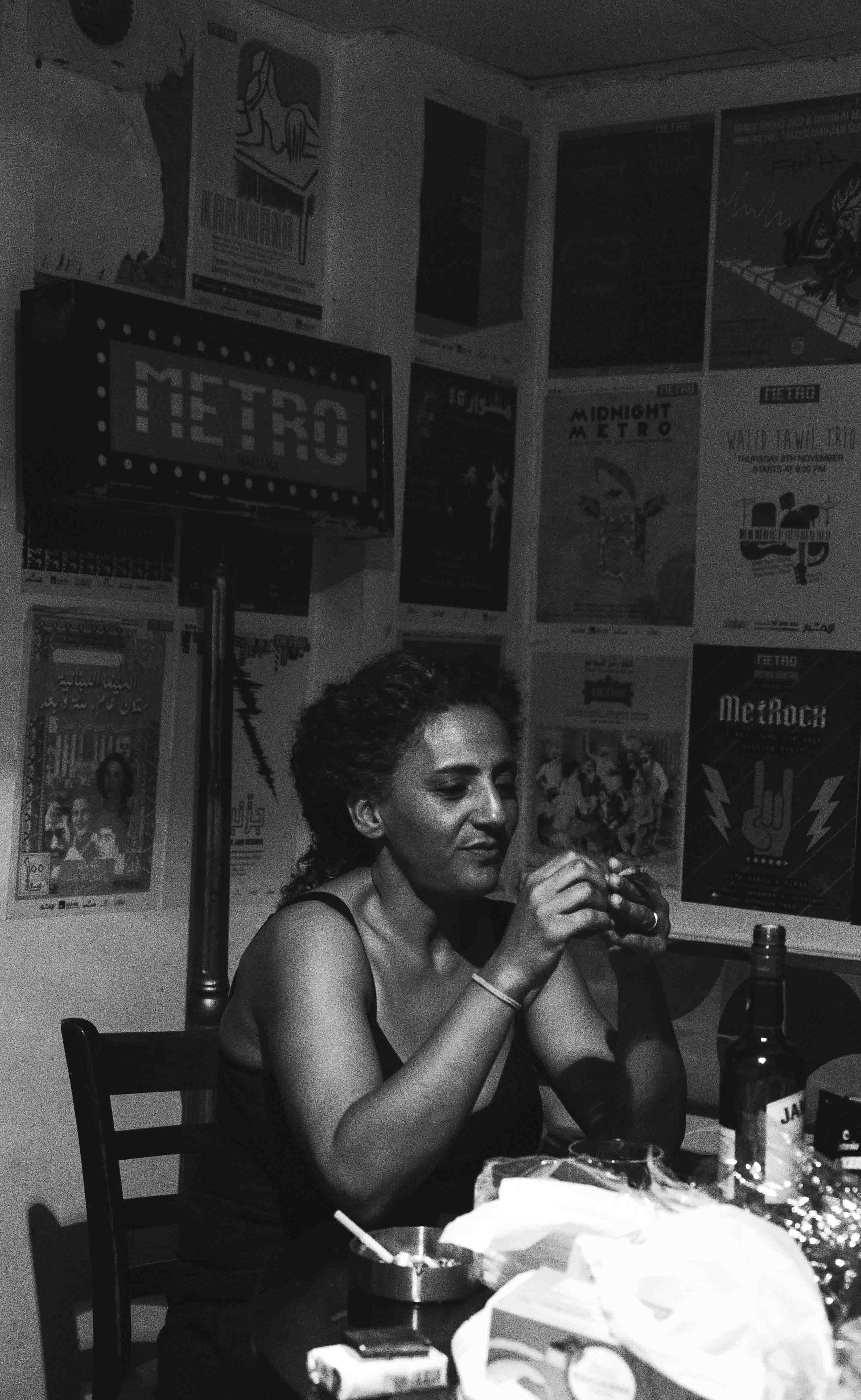
Khouloud Yassine backstage
The cast is quite large. It must be challenging to have a regular show of this size continue to run in Beirut.
It is, indeed, a large ensemble, bringing together performers on stage and musicians behind the scenes. The music, composed especially for the show by Makram Aboul Hosn, adds a distinct and cohesive identity to the production. This is a substantial undertaking—one that continues to attract audiences despite its scale.
Sustaining such ambitious productions is never easy, particularly in a country facing constant turmoil. Yet, we are fortunate to witness that, at every performance, audiences continue to gather—present, engaged, and responsive—finding joy in the experience and expressing genuine appreciation for the work.
You were involved in costume design as well. How did you approach that task?
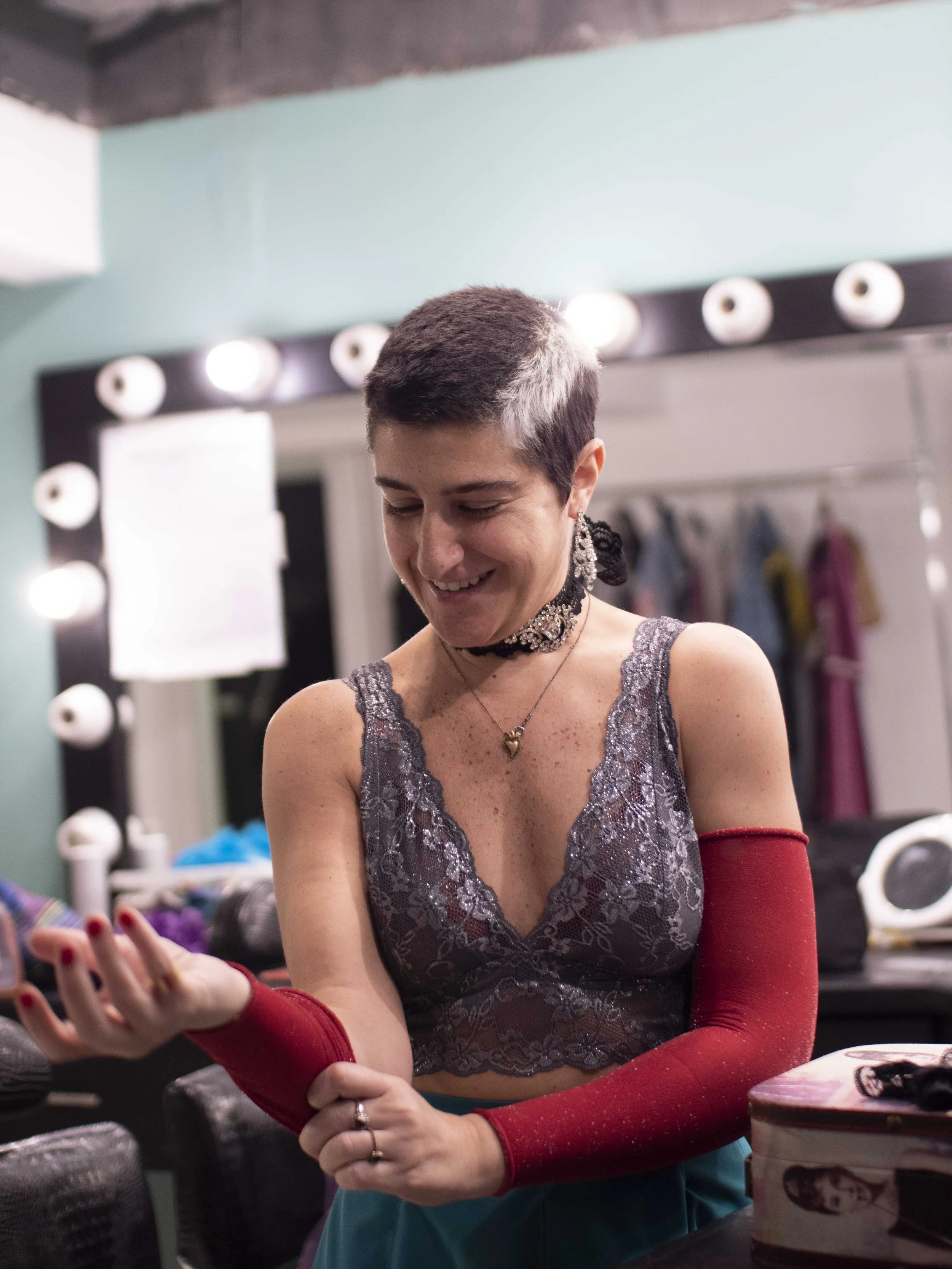
Designing the costumes proved to be a profoundly rewarding challenge. Until then, my experience had been limited to an individual level as I had designed only my own looks. Being entrusted with the costumes for Al Souq Al Oumoumi marked a significant step forward. Immersing myself in the process was essential. Reading the script, listening to the original compositions, and engaging in conversations with Hicham Jaber, the writer and director of the show, all contributed to shaping the characters in my mind. Gradually, their visual identities emerged: the colors they would wear, the textures and fabrics that would define them, and the silhouettes that best expressed their inner worlds. Above all, the designs needed to allow freedom of movement. These costumes were not merely to be worn; they were to be performed in. They had to support the body, enhance movement, and ultimately become an extension of the character itself—almost as though the garments were a natural continuation of the performer on stage.
The body really comes across as a strong theme in multiple layers (from casting to script) in this show. Can you tell us more about the conscious choices made around this?
The body stands at the heart of the work. One cannot speak of prostitution without inevitably invoking flesh. It is all present: tall and short bodies, full and slender forms. Human bodies—female bodies—each bearing its own truth, its own curves, its own presence. They are all here.
Yet the beauty of this show does not lie in exposing nudity or relying on profanity. Rather, it resides in what exists between words—how something is said, what is left unspoken, and, above all, how it is translated through movement. The choreography by Khouloud Yassine transforms sensuality into carefully crafted gestures and fluid steps. Here, sensuality is not defined by nakedness, but by a glance, a whispered phrase, a shift in tone.
Performance after performance, we come closer to understanding the true essence of sensuality in its most delicate and meaningful form—one that acknowledges vulnerability, restraint, and humanity. All of this unfolds with the awareness that these are underprivileged women, whose bodies are not displayed for spectacle, but expressed as vessels of lived experience, dignity, and survival.
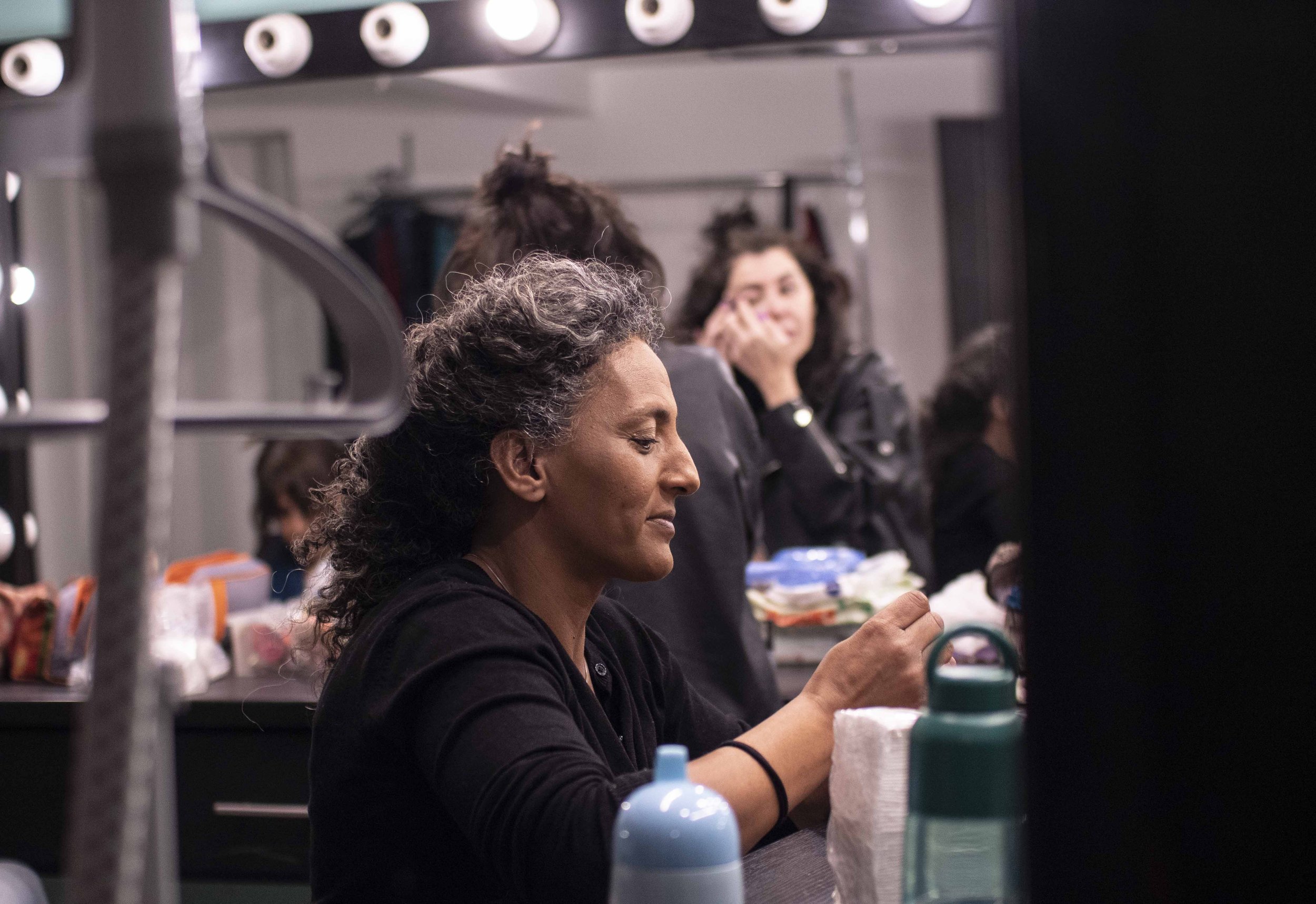
How do you take care of your body before, during, and after performances that deal with intense emotional or physical demands
Working out, working out, working out. It’s more than just a routine to me. It’s a ritual of preparation, an extension of my performances before I even step on stage. Every session feels intentional, almost like rehearsing without music. As I move, I become deeply aware of my body – every muscle, every stretch, every breath. It’s not just exercise. I find myself thinking, “this movement will give me the lift,” “I need that jump on stage,” “this one will ground me, strengthen my core so my voice can carry, so I can project, sustain, and even yodel with power and control.”
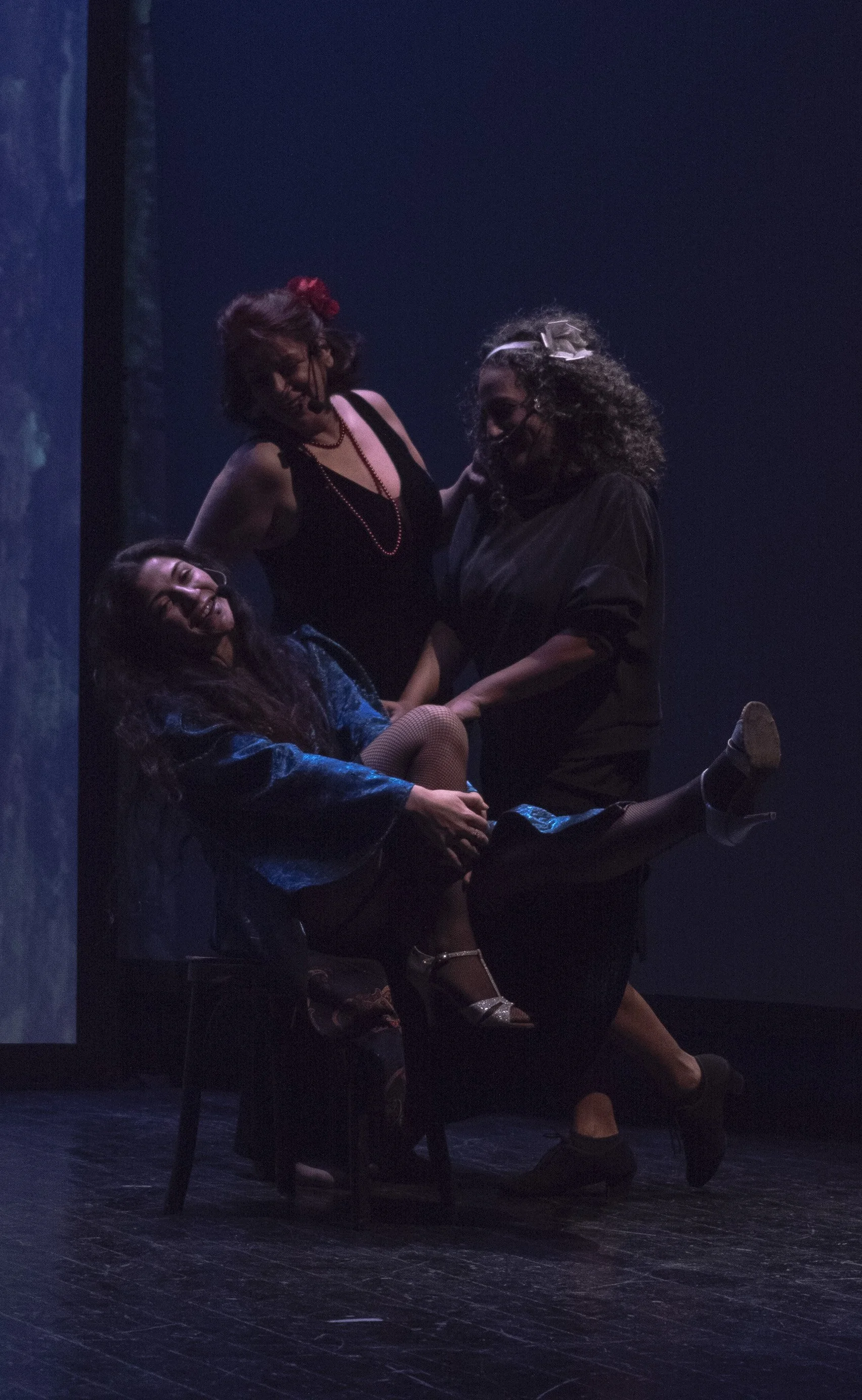
What kinds of conversations came up among you and your colleagues during rehearsals around bodily norms and personal agency in art and society?
Some of the conversations would make us laugh because, let’s be honest, humor, even around something as loaded as sex, can sometimes be disarmingly funny. It gave us brief moments of lightness, a way to breathe. But beneath that laughter, there was always something heavier – harder to hold. Behind every character, every girl we portrayed, was a story that wasn’t easy to carry. You’re expected to look “pretty” under the lights, to embody confidence and allure, while internally holding onto something far more fragile, sometimes even painful. There’s a strange duality in being asked to appear captivating, almost effortlessly, while keeping the weight of real-life struggles quietly present in the back of your mind. You have to remember what these girls have been through even as you perform. And that’s where the challenge lies. It’s not just about acting or singing; it’s about honoring those realities without letting them overwhelm you. Each rehearsal, each repetition of the script and songs, deepens that awareness. Over time, the words stop being just lines; they become images, fragments of lived experiences, glimpses into a harsher world that starts to take shape in your mind. These are the conversations we return to again and again; the push and pull between surface and depth, between performance and truth. And every time we step on stage, we carry that tension with us, trying to do justice to both.
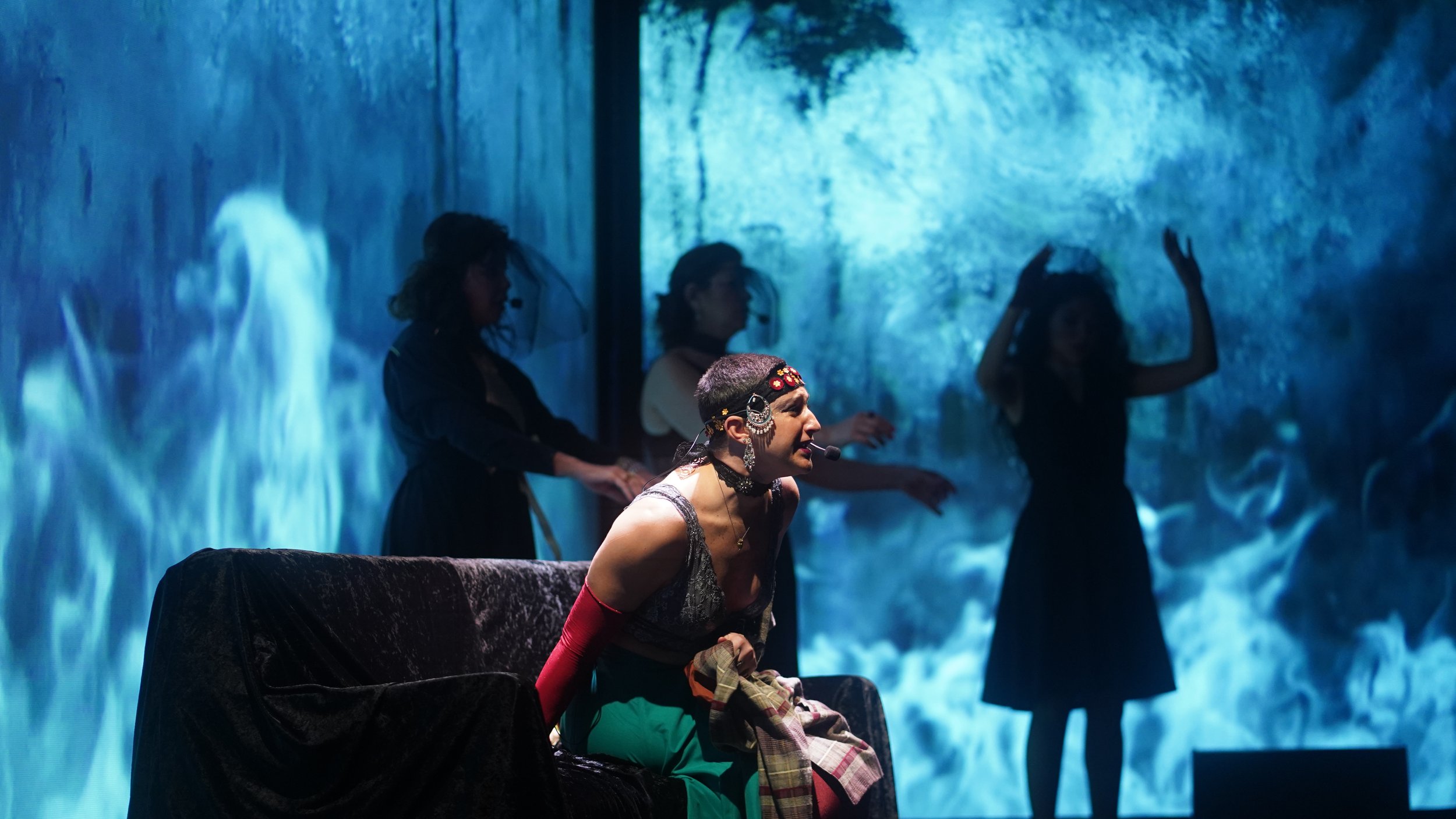
Book your tickets for Al Souq Al Oumoumi via metromadina.com