Words by Yasmine Nachabe Taan
Marie al-Khazen (1899–1983) was one of Lebanon’s pioneering women photographers. Through her camera, she documented the people, landscapes, and everyday life of her time, creating a remarkable visual record of Lebanese society during the mandate period.
Yet her photographs offer much more than a glimpse into the past. They invite us to look closely at how people presented themselves, how social identities were constructed, and how ideas about gender shaped everyday life. Among the recurring subjects in al-Khazen’s photographs are men. Fathers, brothers, village leaders, young boys, and men dressed as heroes or gentlemen appear in carefully arranged scenes. Their moustaches, clothes, hats, weapons, and body language are not simply personal choices or details of dress. They communicate authority, strength, social status, and what it meant (and what it still means today!) to be a man in early 20th-century Lebanon. Looking at these photographs today raises an interesting question: what did it mean to perform masculinity in front of a camera? And what happens when the person directing this performance is a woman?
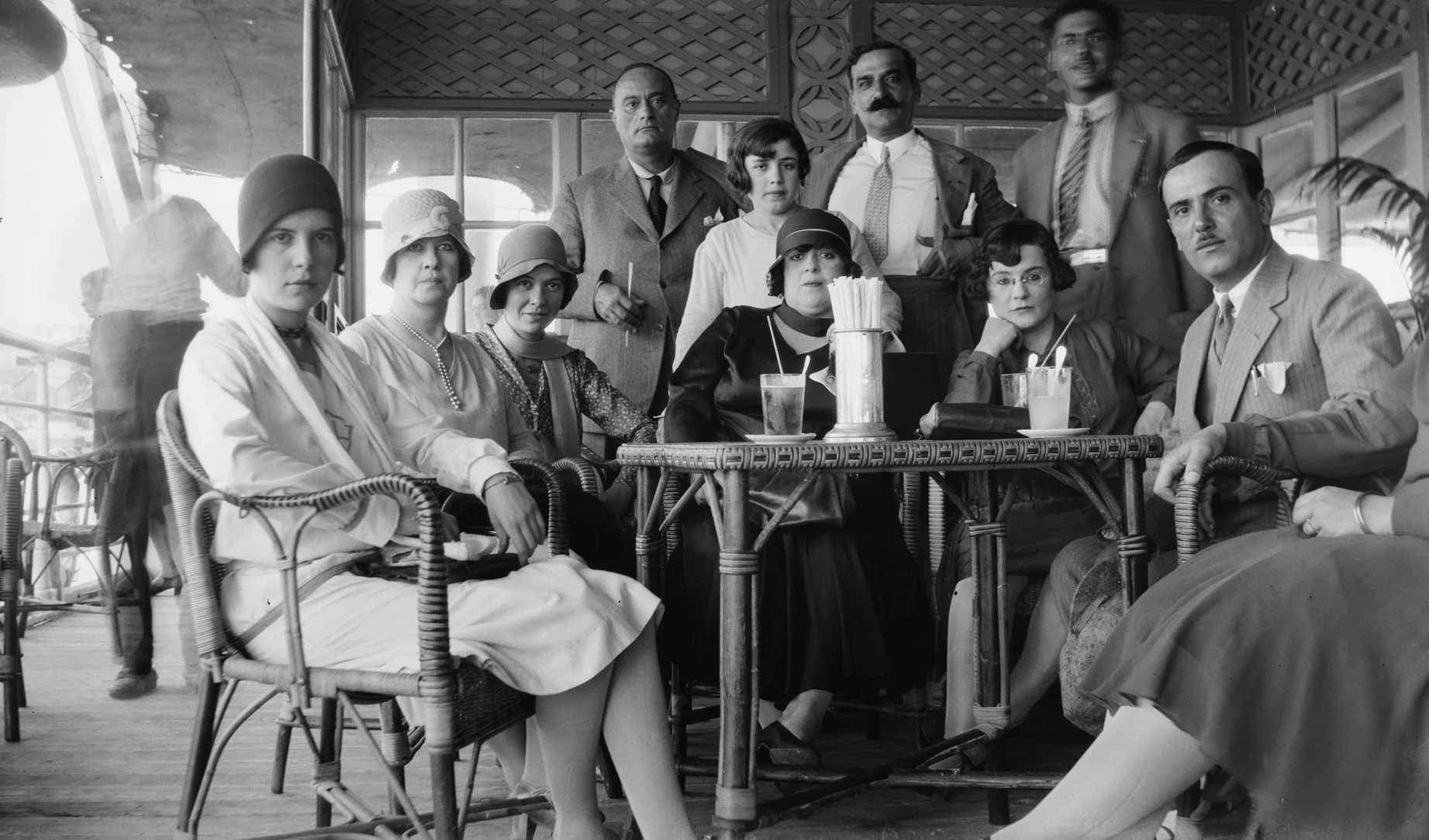
Indoor group portrait. photographed by Marie el Khazen. photographed by 1928. Zgharta. North Lebanon (governorate). Lebanon. Gelatin silver negative on cellulose acetate film . 7.7 x 12.8 cm. 0009ya - Mohsen Yammine Collection. Courtesy of the Arab Image Foundation.
Representation of Rujuliyya in the Photograph
In the society al-Khazen photographed, masculinity was closely connected to patriarchal authority. Men were generally represented as the heads of families, providers, protectors, and heirs. Boys, meanwhile, were celebrated as the future successors of the family. These expectations were reflected in family photographs, where men often occupied positions of importance and were presented as figures of strength and authority. Al-Khazen’s photographs reveal how masculinity was communicated through appearance and gesture. A moustache, a tarbush, a cigarette, a rifle, or even the way a man stood before the camera could become a statement about his identity and social position. Consider, for example in plate 1, the prominent moustache of Shaykh George Nassar, the third man standing from the left side. Shaykh Nassar served as the French consul in Cairo during the 1920s. Carefully shaped, with its ends dramatically turned upwards, his moustache commands attention. In Lebanese society, the moustache carried strong associations with manhood, honor, age, and authority. Writer Hassan Daoud has described the moustache, with some irony, as the ‘wings of manhood’. Its shape and direction could signal a man's rujuliyya (masculinity) or lack of it. An upward-pointing moustache suggested pride, courage, and strength, while a downward-pointing one, as seen in several famous caricatures by Palestinian cartoonist Naji al-Ali, could evoke defeat and vulnerability. In this sense, the moustache became a powerful marker of masculinity.
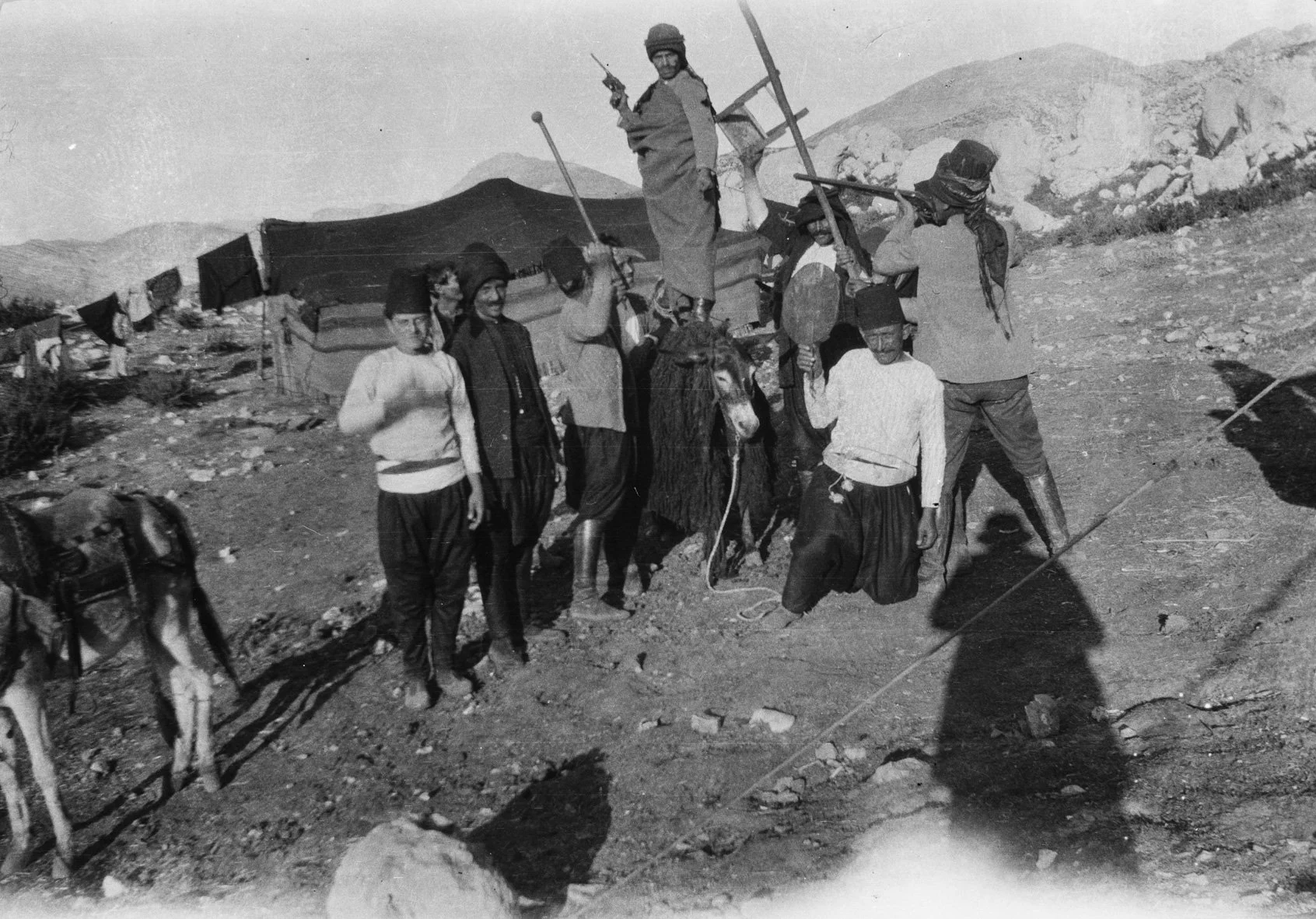
Outdoor snapshot photographed by Marie el Khazen. 1920 - 1930. Zgharta. North Lebanon (governorate). Lebanon. Gelatin silver negative on cellulose acetate film . 6 x 9.2 cm. 0009ya - Mohsen Yammine Collection. Courtesy of the Arab Image Foundation.
Staging the Hero in Marie’s Photo
Al-Khazen’s photographs also reveal how masculinity was performed through action. Men were not only expected to look authoritative; they were expected to demonstrate courage, physical strength, and bravery as well. Plate 2 depicts eight men gathered in a staged scene that resembles a battle or hunting expedition. Surrounded by mountains, a donkey, and a camel, the men appear to be acting out a dramatic confrontation. At the centre, one man stands above the others, holding a gun and looking down at a figure positioned below him. Another holds a rifle as if preparing to shoot, while a third raises a stick as though ready to strike. The scene feels almost theatrical. Each man appears to have been given by the photographer (here choreographer) a role to play, and their gestures suggest that the confrontation has been carefully arranged for the camera. Their moustaches, tarbushes, traditional trousers, and weapons reinforce the image of the brave and heroic man.
Yet there is another presence in this photograph: the photographer herself. Al-Khazen’s shadow stretches into the scene, reaching towards the men. It is a fascinating detail. While the men perform their roles as heroes, the photographer's shadow reminds us that a woman is directing and recording this display of masculine power. She is not simply observing from a distance. She is the person who has chosen the setting, arranged the figures, and decided how this performance will be preserved. Her shadow also offers a rare glimpse of her photographic practice. Its position suggests that she was using a box camera held around waist level, probably an Eastman Brownie or a similar Kodak model. The photographer is therefore present in the image in two ways: through the scene she has constructed and through her physical shadow. The photograph raises an intriguing question: who is really in control of this heroic performance? The men may occupy the centre of the scene, but it is al-Khazen who controls the camera and ultimately determines how their masculinity will be represented.
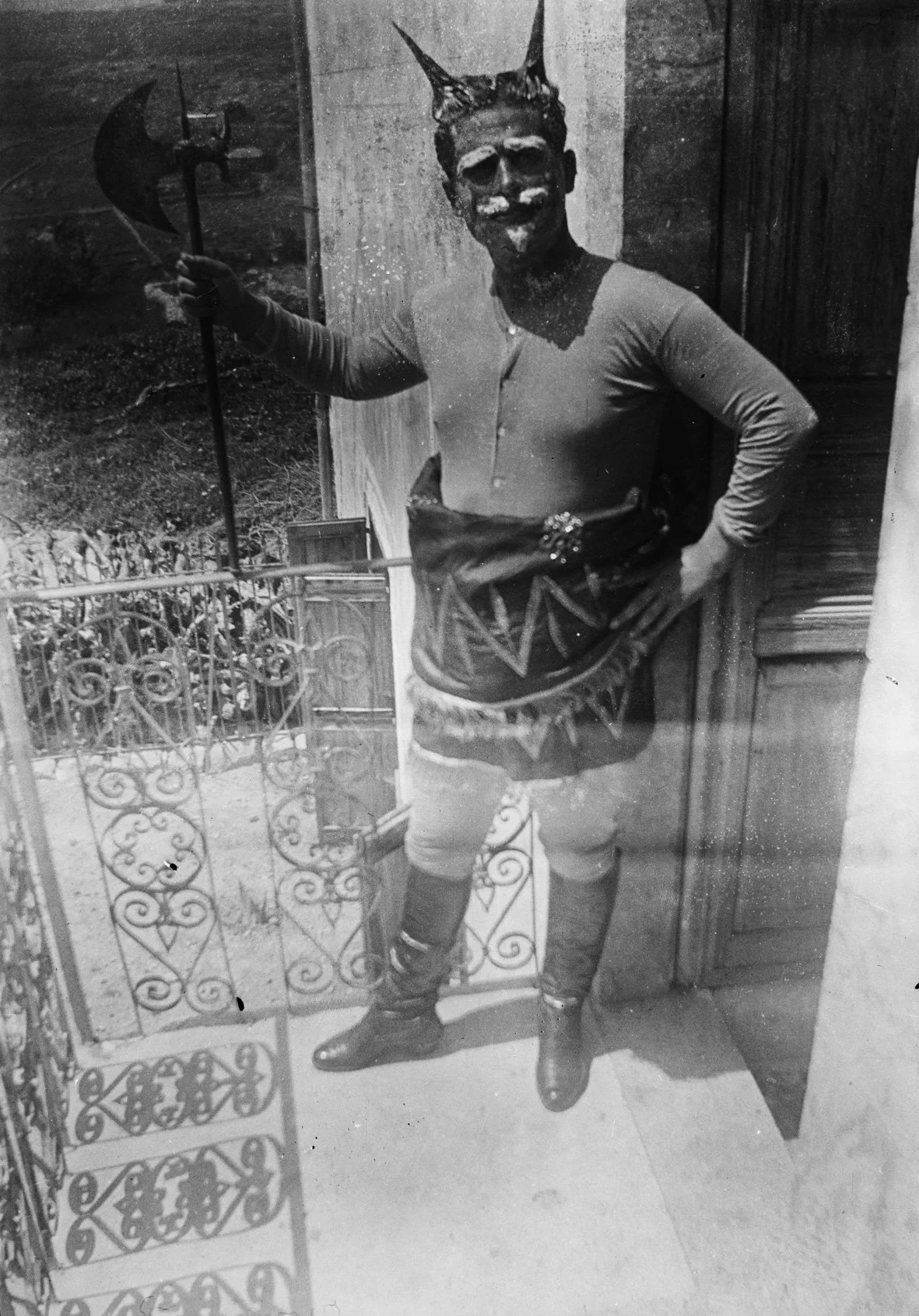
Outdoor portrait of a person dressed up as a devil photographed by Marie el Khazen. 1920 - 1930. -. Zgharta. North Lebanon (governorate). Lebanon. Gelatin silver negative on cellulose acetate film . 8.5 x 6 cm. 0009ya - Mohsen Yammine Collection. Courtesy of the Arab Image Foundation.
When the Patriarch Becomes the Devil
Perhaps the most playful and unexpected representation of masculinity appears in plate 3, a photograph of al-Khazen’s brother, Shaykh Khazen al-Khazen, dressed as the devil. Standing directly in front of the camera, his hair is styled in two pointed horns, with a false white beard, and he holds a long hammer. The image is theatrical and humorous, presenting a very different version of the respectable Ibn el Khazen male figure we encounter in the other photographs. The contrast is particularly striking. Elsewhere, men are portrayed as heroic figures, family protectors, and symbols of authority. Here, a man who occupies a position of patriarchal importance is transformed into a character traditionally associated with mischief. Was al-Khazen making fun of her brother? Was this simply a playful family performance? We cannot know for certain. But the photograph invites us to consider the possibility that she was experimenting with masculine identity, turning familiar symbols of authority into something unexpected. By placing her brother in this unusual costume, al-Khazen moves away from conventional representations of manhood. The strong, authoritative patriarch becomes a theatrical character, and the image introduces humor into a visual world otherwise dominated by masculine power and heroism.
Who Gets To Define Masculinity?
What makes Marie al-Khazen’s photographs so compelling is not simply that they document men and their social roles. It is that they reveal how masculinity was constructed, displayed, and sometimes exaggerated in everyday life. Her photographs reflect the patriarchal values of the society in which she lived, but they also offer moments of playfulness and ambiguity. Through her choices of subjects, poses, costumes, and settings, al-Khazen shaped how men appeared before the camera. She could present them as heroes, fathers, gentlemen, or even devils.
These photographs remind us that the camera does more than record reality: it helps construct it. And when a woman stands behind the camera, the familiar performance of masculine authority can be seen from a different perspective. Nearly a century later, al-Khazen’s images continue to ask us to look beyond appearances and question the roles that society assigns to men and women. Perhaps their greatest significance lies in this invitation to reconsider who holds the power to frame the image, tell the story, and define what it means to be a man.
© Copyright Yasmine Nachabe Taan. Any reproduction or use of this text requires the author's prior written permission.
Bibliography:
Aghacy, Samira. (2009). Masculine Identity in the Fiction of the Arab East since 1967. Syracuse, New York: Syracuse University Press.
al-Daif, Rashid. (1998). Learning English. Beirut: Dar al-Nahar.(1999). Dear Mr. Kawabata. London: Quartet Books.
Daoud, Hassan. (2006). Those Two Heavy Wings of Manhood: on moustaches. In May Ghoussoub, & Emma Sinclair-Webb (Eds.), Imagined Masculinities: male identity and culture in the modern Middle East. (273-282). London: Saqi.
Ford, Colin & Karl Steinorth eds. (1988). You Press the Button We Do the Rest: The Birth of Snapshot Photography. London: Nishen in association with the National Museum of Photography Film and Television.
Gilsenan, Michael. (1996). Lords of the Lebanese Marches: violence and narrative in an Arab society. London; New York: I.B. Tauris.
Ghoussoub, May, & Sinclair-Webb, Emma (Eds.). (2000). Imagined Masculinities: male identity and culture in the modern Middle East. London: Saqi.
Jacob, Wilson C. (2011). Working out Egypt: effendi masculinity and subject formation in colonial modernity, 1870–1940. Durham: Duke University Press.
Kandiyoti, Deniz. (1996). Gendering the Middle East: Emerging Perspectives. I.B. Tauris, London.
About the Author
Dr. Yasmine Nachabe Taan is Professor of Art and Design History and Director of the Institute of Art in the Arab World at the Lebanese American University. Her interdisciplinary research focuses on art, design, photography and gender politics, with a focus on Lebanon and Arab cultures. She authored over four books exploring the histories of art, design, and photography in the Arab region. In addition to her scholarly work, she has curated a number of exhibitions that highlight regional visual cultures and underrepresented narratives. Dr. Taan serves on the Advisory Board of the Design and Culture journal, and on the Board of Trustees of Design History Society (London) and she chairs the board of KHATT Foundation (Amsterdam).