Words by Lauren Alwan
The young woman, sisters-in-arms beside her, stood before the panel of Americans. Six men, one bearded, two bespectacled, dressed in stiff collars and suiting too heavy for the climate—the sole concession to the heat, their white vests and flannel trousers.
It was June, 1919, and in a hotel room on Martyr’s Square in Damascus, the King-Crane Commission was meeting with the city’s leaders and elites to gauge public opinion on self-rule in the former Ottoman territory. Charged by Woodrow Wilson to hear testimony across Syria, Lebanon, Palestine and Jordan—then Greater Syria—the commission included an eminent Lebanese physician, Dr. Sami Haddad, who served as translator. The room was low-ceilinged, too small for the assembled gathering. Maps were pinned to the walls, the heavy curtains on the windows were backlit with afternoon sun. The woman about to speak was Nazik al-Abid, leader of the Syrian women’s delegation, and being fluent in English, as well as French, German, and Turkish, she had no need of Haddad’s translation. In a turn that is well-documented, the striking point of the interview came not in Nazik’s pro-independence, anti-colonial statement, but in the moment she and the members of her delegation unexpectedly removed their veils.
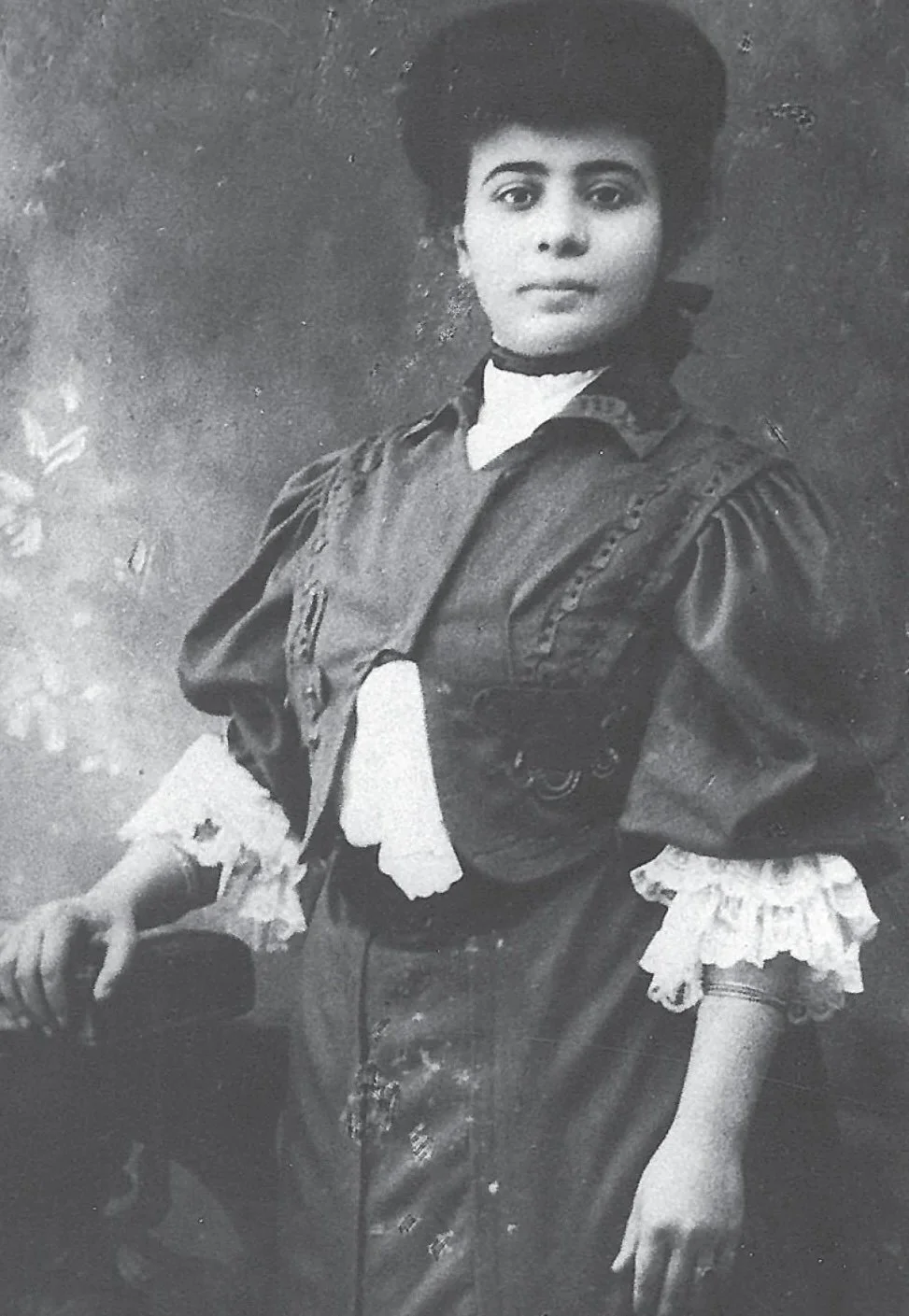
Mary Ajami, studio portrait circa 1915
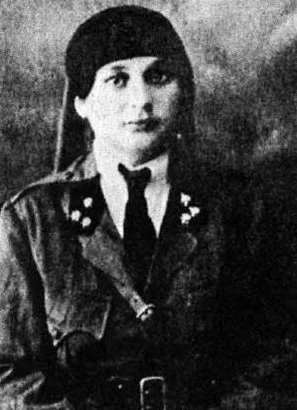
Nazik al-Abid, 1920
The gesture was less a rejection of Muslim tradition than one made in support of modernity. Theirs was an endorsement not strictly of Western ideas, but of modernist thought applied to the country’s traditional values—a vision in which Syrian culture was a constituent part of progressive reform. As professor of history Elizabeth Thompson writes, Nazik’s gesture “was intended to emphasize the enlightened political ambitions” of the emerging feminist movement, and the formation of a modern socio-political climate in which women could choose to veil or not.
Between the armistice of World War I and the onset of the French occupation—a period of 22 months—Syria saw a surge of social and political activism driven by the promise of self-government. The country’s de facto leader, the young Hejazi emir, Faisal bin Hussein, had led the war’s Arab Revolt and sought a unified state of Greater Syria. In that period of possibility, he negotiated with British and French forces, and argued against foreign control and an autonomous Syrian state. The same week Wilson’s Commission arrived in Damascus, Faisal convened the General Syrian Congress, a body that would later proclaim him King of Syria, a means to anchor the Syrian project. The monarch would ultimately lose most of his nationalist support, though his political relationship with Nazik remained sure. Syria would not achieve independence for another 27 years, yet the Faysali period would mark the beginnings of the feminist coalition brought by the collaboration of Nazik al-Abid, Mary Ajami, and their nationalist sisters.
In this postwar nexus of nationalism and feminist thought, these two exceptional women of conscience would become a force of activism, and in those 22 months, their formidable influence advanced the message of modernism as a means to uplift women and the nation of Syria. And though born 10 years apart at opposite ends of the Empire, Nazik and Mary’s biographies share much in common. Both were born to wealthy Arab families, and both showed prodigious talent at a young age. Both had a sense of purpose and ambition that ran against the grain of family tradition, yet they received unqualified encouragement. Most consequentially, in those months after the armistice, both would confront the colonial power structure in the cause of women’s equality and Syrian independence.
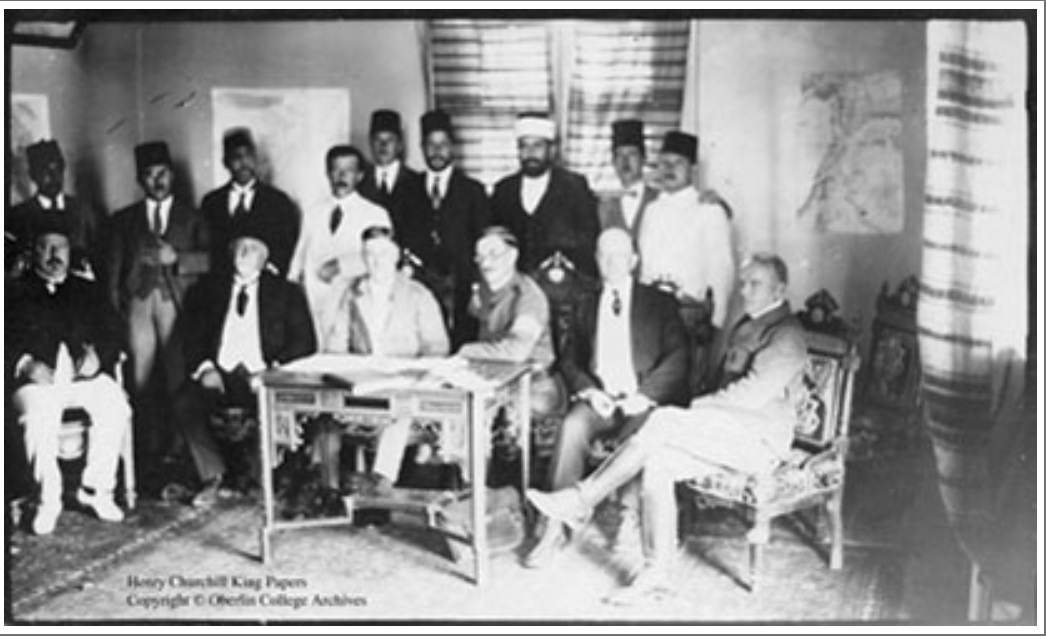
Damascus Delegation of the King-Crane Commission, July 1919.
Though young, Nazik was well-positioned to lead the women’s delegation at the King-Crane interviews. Born in Constantinople in 1898 into a wealthy Damascene family, she attended Ottoman, French, and English schools in then-Constantinople and in Mosul, where her father, Mustafa al-Abid, was envoy under Abdulhamid II. In 1908, when the Young Turks took power, her Ottomanist father was exiled, and the family migrated to Cairo. At that time, as historian Elizabeth Williams writes, Egypt was a center of women’s periodicals, and those Syrians who’d come for the intellectual and cultural setting “sowed seeds of Arab nationalism.” This was fertile ground for Nazik, a voracious reader who, Williams notes, was undaunted in being seen as eccentric for her scholarly pursuits. Some of Nazik’s first published articles, according to Sami Moubayed, were critical of the coup that ousted the Ottoman monarch, others argued for more representation of Arabs and Turks in the new Second Constitutional government. Nazik would go on to attend the Women’s College in Istanbul, where she received a bachelor’s degree in agriculture, a credential she intended to apply to her homeland’s economic development, though it would be her political convictions that shaped her role as a public intellectual. As Mohammed Bamyeh writes, the postwar world “suddenly opened itself up for novel reconstruction for which the script [was] not readily available.” When Nazik arrived in Damascus in 1918, the convergence of time, place, and political moment would quickly inform her own script.
A young Nazik would have been familiar with a groundbreaking publication of that time, Al-Arous (The Bride), cited by Ola Rifai as the “first feminist magazine in the Arab world.” The magazine was founded in Alexandria in 1910 by publisher and social reformer Mary Ajami, who chose its name as a metaphor for the movement’s devotion to the cause. Published monthly, excluding the war years of 1914-1918, the issues featured sections on history, health, child care, as well as new fiction, poetry, and a forum on topical issues. As Miriam Karim writes in Nasawiyyah, Mary’s ambition for the magazine was two-fold, to champion “the emancipation and education of women in her country,” and defend the cause of “the liberation of the Arab nation.”
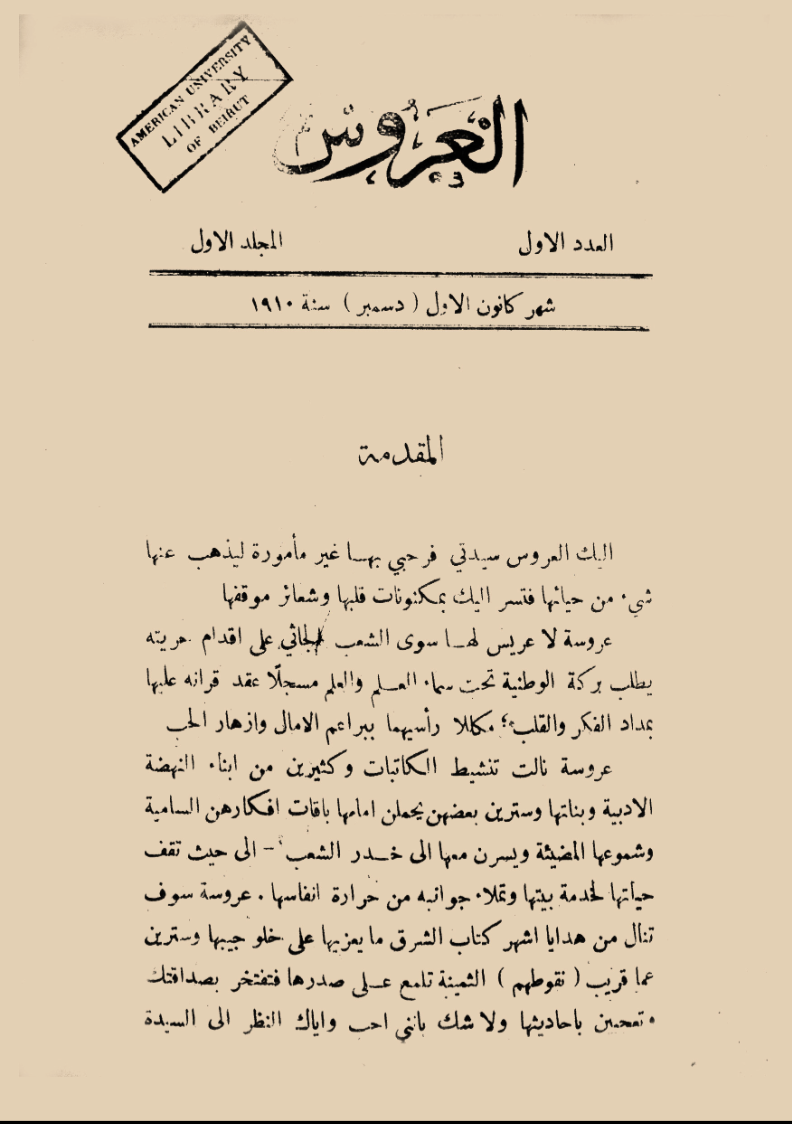
Al-Arous, Issue 1, Vol 1. December 1910.
Born in 1888 in Ottoman Damascus in the Christian quarter of Bab Touma, Mary Ajami came of age in the Arab Revolt, an era shaped by the struggle for a sovereign Syria. Raised in a large Christian Orthodox family, Mary was educated in the city’s Irish and Russian Mission schools, and would become the latter’s first female instructor. She studied nursing at the Syrian Protestant College in Beirut, now AUB, and like Nazik, her commitment to social reform would lead her to more activist roles. At 20, she served as a correspondent for nationalist and intellectual newspapers in Beirut and Damascus, and quickly earned a role of cultural and political prominence. As Thompson writes of the Damascus period, “Ajami’s salon in the early 1920s attracted prominent male writers and nationalists,” and broke “social convention by gathering a mixed group of men and women together in her home.”
In the possibility of the Faysali period, the hoped-for Arab Kingdom of Syria seemed within reach. The political and cultural climate, Thompson writes, was a favorable one for sisterhood in its synergy of “women’s charitable associations, the social crisis resulting from the First World War, and the reformist policies of King Faisal.” Women of the elite class had long been the primary force for social good in Damascus, and Nazik and Mary, innovating upon the model of traditional women’s associations, instituted a host of programs. In January 1919, over 100 of the city’s elite women were recruited as founding members of the Nur al-Fayha Society, or Light of Damascus, with a mission to “scatter darkness and enlighten the spirit with the luminous light of civilization.” Soon after came Nur al-Fayha’s school for Muslim girls orphaned in the anti-colonial rebellions, a means of providing housing, stipends, and training in trade skills. The formation of the Women’s Literary Society quickly followed, and its salons and opportunities advanced solidarity between the classes and challenged the educational privilege traditionally denied to middle-class women. Global studies scholar Fatima Chaar writes of the Society’s announcement in Al-Arous, in which editor-in-chief Mary “praised Abid’s initiative to ‘awaken the mettle of women and spread literature among them.’”
By the following year, Nazik founded a magazine of her own, and the first issue of Nur al-fayha was released in February 1920. Its mission: to center women’s expression, exposing injustice, and promoting women’s knowledge of their rights while serving “their beloved nation.” As Williams notes, the flagship issue received far more articles than could be published. Concern of reprisal for their opinions led most contributors to use only initials—both Mary and Nazik themselves often went by pseudonyms—yet anonymity didn’t weaken the message. The magazine had “its own voice, which ranged from strident to sardonic, pedantic to defensive, to those of the men who almost exclusively dominated the discourse of the public sphere.” This variety of discourse was unknown “in the Damascene public sphere prior to 1920,” and the magazine’s presence a statement against colonial domination.
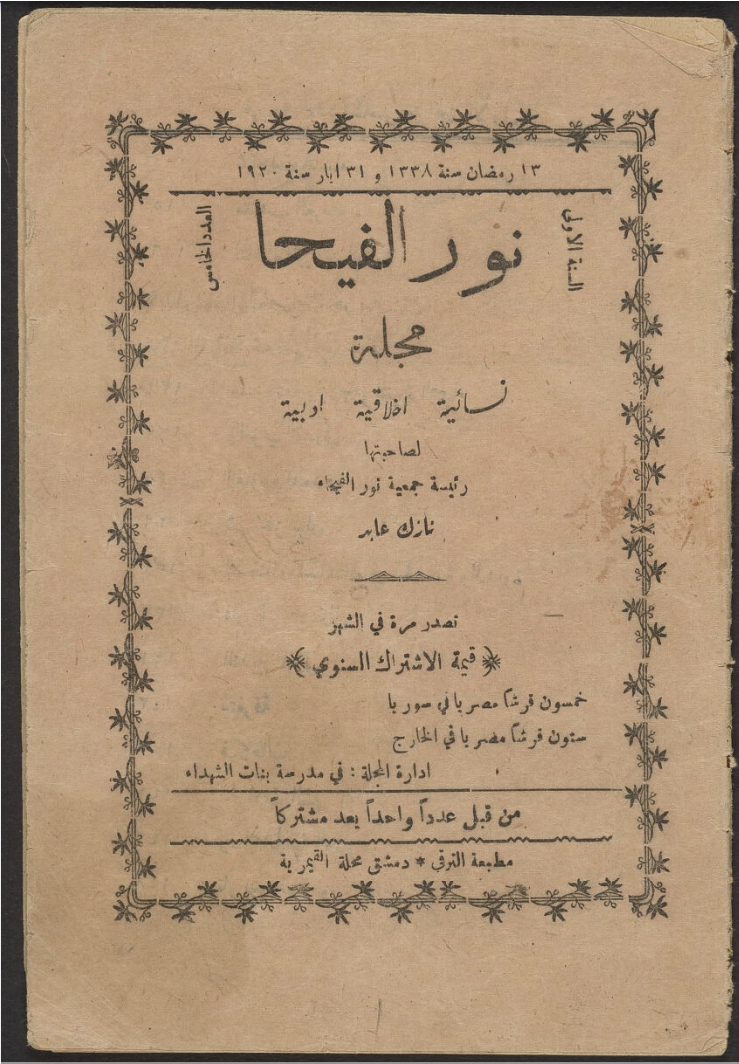
Nur-al-Fayha magazine, 31 May 1920.
Nur al-fayha’s activist mission can be seen in an issue from May 1920, which features op-eds such as, “Where are you, girl of the homeland?” and “The first female war correspondent.” The magazine and its feminist community, Thompson observes, embodied “an evolving and ambitious conception of the role they hope to play in producing the modern and independent Syrian nation.” It was an aim that would be hard-fought. That same year, the declaration of Faisal as king of Greater Syria was rejected by the British and French, and triggered the conference at San Remo that would authorize the mandates of Syria and Lebanon. By July, the French general Henri Gouraud issued an ultimatum to Faisal: disband the Syrian army or face invasion. Faisal would refuse and Syria’s anti-colonial resistance would come to a head at Maysalun, a strategic mountain pass west of Damascus, where Faisal’s army was defeated, and the city subsequently captured by the French.
One month before, Nazik mobilized a team of nurses as the core of the Red Star Association, a medical relief organization and precursor to today’s Red Crescent, to provide medical care for soldiers wounded on the front lines. On the field of battle at Maysalun, Nazik wore the uniform of a Syrian soldier. Yasmine Nachabe Taan writes of her military portrait, “Officer Nazik el-Abid—president of the Al-Najma al-Hamra [Red Star] association for women in Damascus…and daughter of Mustafa Basha el-Abid—looks firm, assured, and incontrovertibly determined in her military costume.” At Maysalun, Nazik commanded the medical battalion and treated the mortally wounded, as Williams writes, seeking “to perform the very roles so championed in their journal.” In an issue of Nur al-fayha during that time, the magazine urged the “‘children of the Syrian nation’ to claim ‘a future that is almost within reach.’”
Though the independent future envisioned in the Faysali period would fail, in the days following, with Faisal’s exile imminent, he awarded Nazik the rank of honorary general, an unprecedented distinction at that time. With the French administration installed in Damascus, the results of the King-Crane Commission’s survey were suppressed to advance the covert Sykes-Picot treaty, with its design to partition Greater Syria. For her role in the uprising, Nazik was exiled by the French and in 1920 returned to Istanbul, where she wrote and published under a pseudonym. In Damascus, without the backing of Faisal, the Nur al-Fayha organization and the magazine that bore its name were forced to cease operations, but Mary continued her advocacy for Syrian autonomy, equal voting rights, and the conditions of detained nationalists. Al-Arous would face heavy censorship and scrutiny under the mandatory government, and publication ceased in 1925, its funding, provided solely by Mary, depleted.
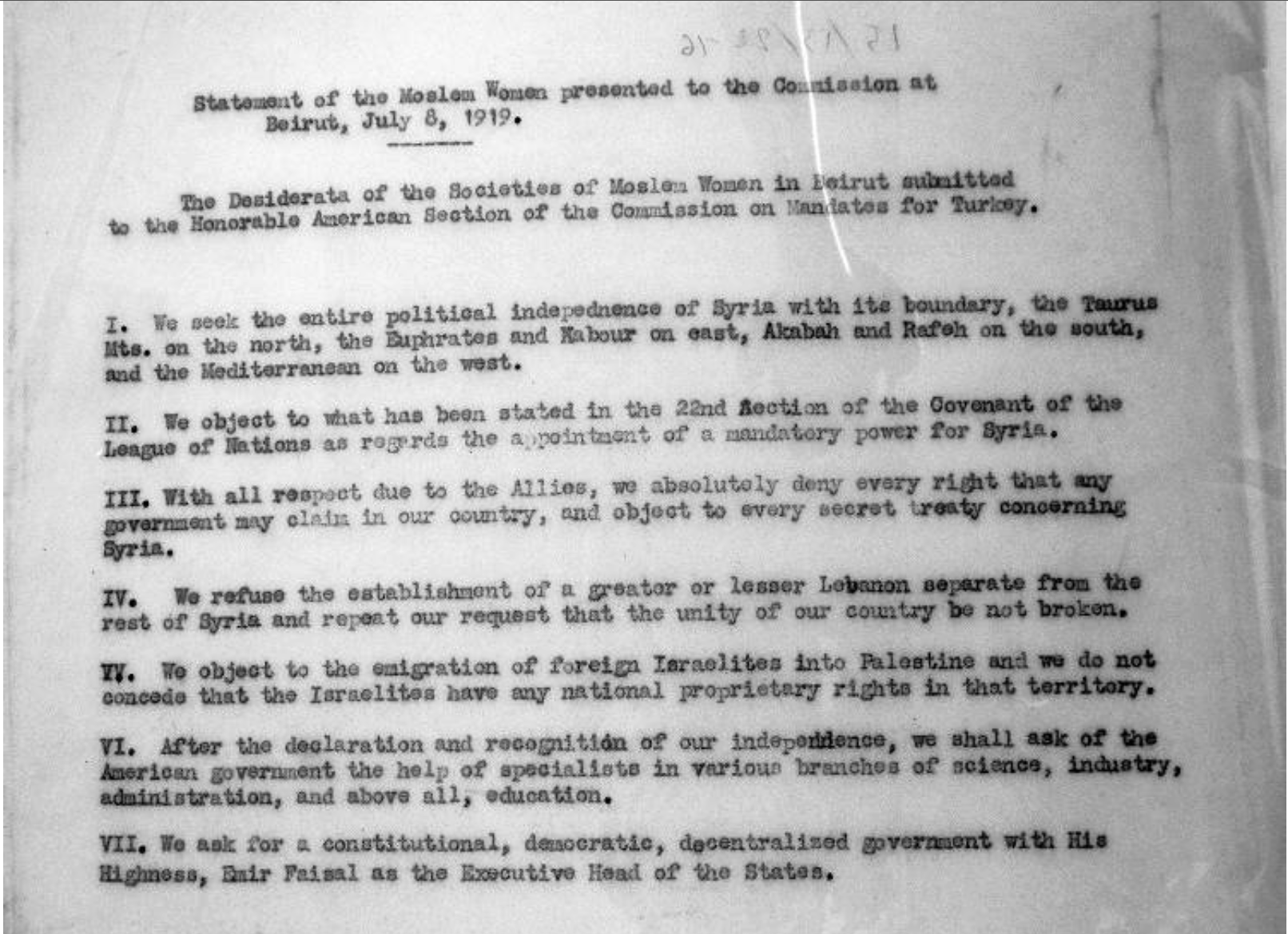
3. Excerpt, Petition from Muslim women of Beirut, 8 July 1919.
In 1922, the French granted Nazik amnesty on the condition that she refrain from political activity, and she returned to Syria. Both Nazik and Mary saw hope for the nation’s future in the fellahin, the subsistence farmers and village-dwellers in the agricultural districts surrounding Damascus. In a 2011 interview with Nazik’s third cousin, Burhan al-Abed, he recalled the family lore of that time. Nazik “lived alone on her farm in the Ghuta, a green area of Damascus fed by natural aqueducts,” and an anecdote recalls her gathering with the local farmers—it may have been in one of the villages north of the city along the Barada, or in the south, in a field adjacent to an apricot or walnut grove. It depicts a young woman, barefoot, playing the guitar, singing nationalist songs. Nazik continued to advocate for issues of mothers and children, but under threats of imprisonment by the French, she soon migrated to Lebanon. There, she continued her work and met a prominent Arab-Lebanese historian, Muhammad Jamil Bayhum, who became her partner in life and activism. The Faysali period would be behind her, but she would continue her work for both regional and women’s rights, an inherent defender of the cause, as she was that day in the Ghouta, barefoot, playing the guitar with the community she’d fought for, a comrade in arms.
About the author
Lauren Alwan’s fiction has appeared in journals and anthologies including the O. Henry Prize Stories, the Southern Review, Alaska Quarterly Review, Bellevue Literary Review, and StoryQuarterly. Her essays on literature and personal history have been featured in ZYZZYVA, Alta Journal, The Millions, Catapult, Rusted Radishes, World Literature Today, and others. She's currently at work on a historical novel of Arab-Turkish cross culture, The Dowry House, which was awarded a First Pages Prize by the de Groot Foundation. She lives in Northern California.