What Archaeology Intentionally Obscures: The Rahat Soap Factory and Palestinian Cultural Continuity
Words by Nadine Zaza
In 2020, archaeologists excavating a site designated for new development near the city of Rahat in the Naqab uncovered the remains of what is believed to be the oldest known soap factory in historic Palestine. Dating to the ninth century, during the Abbasid Caliphate, the workshop contained evidence of large-scale olive oil soap production, making it one of the earliest known examples of the craft in the region.
The excavation was part of an Israeli state-led development project carried out on ancestral Palestinian land amid the continuing demolition and displacement of Palestinian communities in the Naqab, often described as Bedouin communities. In 2018 alone, 2,326 Palestinian-owned structures were demolished across the Naqab; according to official figures, residents were coerced into demolishing 88 percent of these structures themselves to avoid police enforcement and additional penalties.1
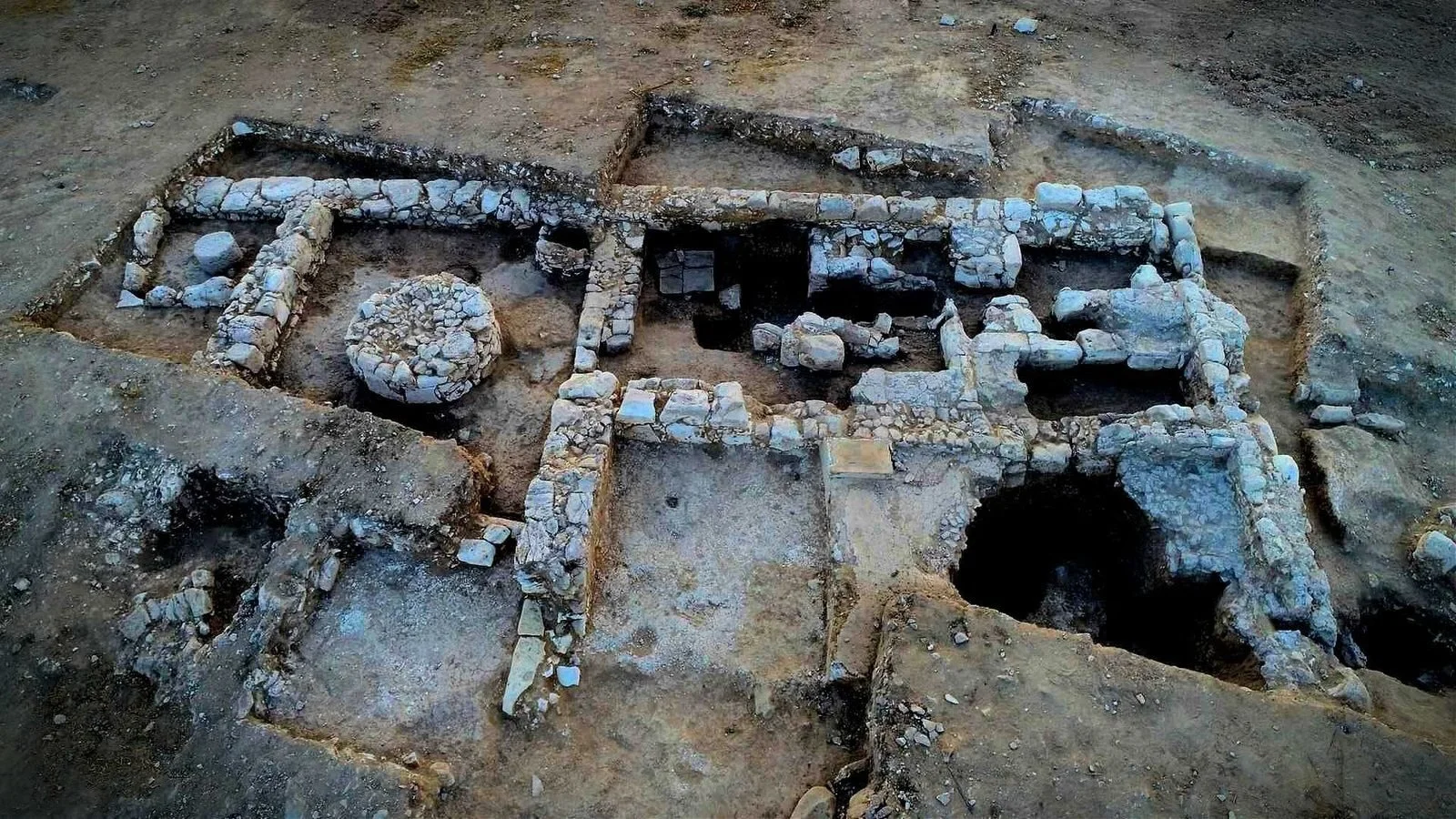
Excavation of the ninth-century soap factory near Rahat in the Naqab, Palestine, 2020. Photograph: Emil Aladjem / Israel Antiquities Authority.
The excavation was part of an Israeli state-led development project carried out on ancestral Palestinian land amid the continuing demolition and displacement of Palestinian communities in the Naqab, often described as Bedouin communities. In 2018 alone, 2,326 Palestinian-owned structures were demolished across the Naqab; according to official figures, residents were coerced into demolishing 88 percent of these structures themselves to avoid police enforcement and additional penalties.
As one layer of Palestinian existence was being erased from the land, another emerged from the soil beneath it.The excavation uncovered an extraordinary archaeological site, yet the narratives surrounding its discovery obscured the living Palestinian tradition that gave it meaning. This raises a broader question: Can the past truly be preserved if the people who carried it forward are written out of the story?

Workers pouring saboon across the floor of a Nablus soap factory, Palestine, circa 1940.

Soap seller in Yaffa, Palestine, circa 1922.
Before examining the Rahat excavation, an important limitation deserves acknowledgment. Much of the publicly available reporting and many of the primary archaeological summaries on excavations in historic Palestine are produced by Israeli state institutions. The archaeological evidence itself is invaluable, but the narratives through which it is presented are not neutral. They often privilege chronology, imperial periods, and the framework of the modern Israeli state construction, while giving comparatively little attention to the continuity of Palestinian cultural life. Reading these sources therefore requires attention not only to what they reveal, but also to what they omit: Palestine.
Reporting on the discovery emphasized the site's age, industrial sophistication, and what it revealed about daily life during the early Islamic period. Much of the reporting by Israeli state institutions and media, however, detached the excavation from the broader continuum of Palestinian cultural life. The Times of Israel, for example, described the discovery as revealing "Israel's first identifiable soap factory." The phrasing is historically, culturally, and intentionally inaccurate.
More strikingly, the archaeological methodology itself undermines the public framing of the discovery. Israel Antiquities Authority excavation director Dr. Elena Kogen Zehavi explained that the workshop was identified because its architectural plan closely resembled later soap workshops from the Ottoman period.2 They uncovered olive pits, ovens, and a shallow hardening basin that allowed them to 'reconstruct the soap-making process': olive oil mixed with potash, lime, and water, cooked over clay ovens, poured into basins to cure, cut into bars, stacked, and left to dry before export. In other words, archaeologists recognized the site because its architecture and production methods closely matched a soap-making tradition that remained documented and continuously practiced in Palestine, particularly in Nablus. The excavation therefore did not uncover a lost industry; it extended the documented history of Palestinian soap-making by several centuries.
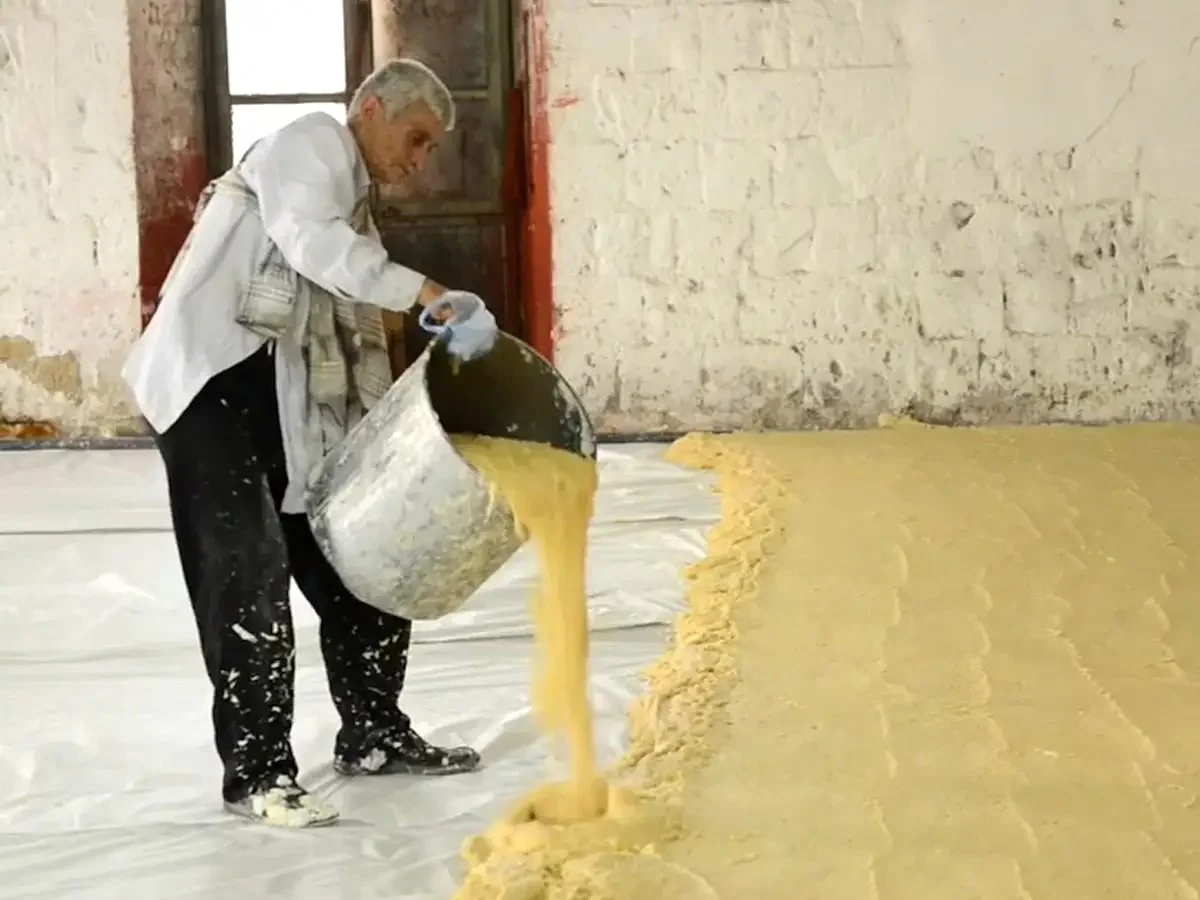
Worker pouring saboon across a factory floor, 2020. Still from What It’s Like for Workers at One of the Two Remaining West Bank Olive Oil Soap Businesses, Business Insider.
For generations, soap production has been central to Palestinian economic, agricultural, and social life. The most celebrated expression of this tradition is saboon nabulsi, or saboon baladi, crafted from locally harvested olive oil. Many Palestinians recognize it instantly: the weight of its pale ivory bar, the slightly cumbersome cube that slips between wet fingers, its unmistakable earthy scent carrying the memory of generations of olive harvests. There is a particular pride, especially among those from Nablus, when they speak of this centuries-old soap-- not simply because it is well made, but because it represents a craft that has endured through time and occupation.
Saboon Nabulsi embodies an entire Palestinian ecosystem. The land's olive groves provide the raw material, saboon artisans' technical mastery of its making passes from one generation to the next, and factories' mass production of saboon pours across broad stone floors to cool and harden before being cut by workers into cubes and stamped - often slightly askew - with the family seal. The bars were then stacked into towering drying formations, filling the factories before making their way across the eastern Mediterranean. Today, they can still be found on the shelves of a neighborhood dukkan or ordered online from Palestinian producers/suppliers.
In 2024, UNESCO inscribed traditional Nabulsi soap-making on the Representative List of the Intangible Cultural Heritage of Humanity,3 recognizing the craft and the generations of Palestinians who have sustained it despite occupation, displacement, land confiscation, and increasingly restricted access to olive groves.
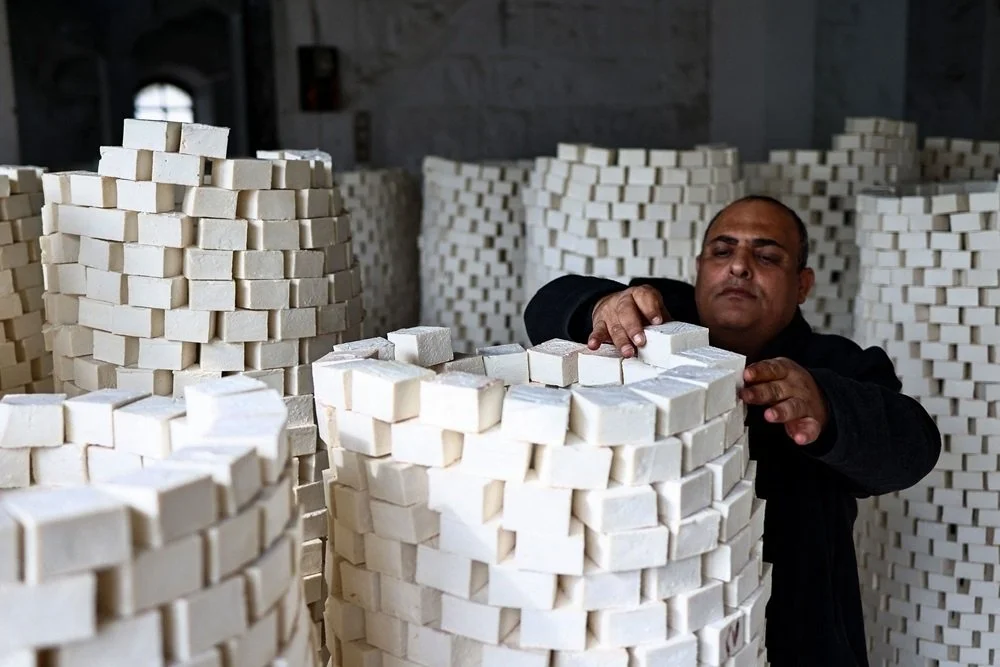
A worker arranging stacks of soap at a local factory in the Old City of Nablus, occupied West Bank, Palestine, November 28, 2024. Photograph: AFP.
Rahats Soap Factory is not an isolated case of cultural erasure from land and heritage. In Sebastia, an ancient Palestinian town northwest of Nablus that was inscribed on UNESCO's World Heritage List under the State of Palestine as recently as the summer of 20264—Israeli authorities have pursued the seizure of approximately 1,800 dunams (445 acres) of Palestinian land5 under the banner of preserving and developing the archaeological site while advancing plans to connect it to a nearby illegal settlement. As recently as the summer of 2026, Sebastia was inscribed on UNESCO's World Heritage List under the State of Palestine. The project threatens the displacement of Palestinian families, the destruction of agricultural land, and the fragmentation of a community that has long served as stewards of these cultural practices.
In both Rahat and Sebastia, archaeology is no longer simply a means of interpreting the past. It becomes implicated in reshaping the present, preserving artifacts and space while displacing the communities whose histories those artifacts and archaeology embody.
The significance of the Rahat excavation lies not in proving Palestinian history—as though archaeology were needed to validate a people's existence and connection to the land—but in revealing that the ruins themselves are only a fragment of the story. Archaeology uncovered the tangible remains, but Palestinian communities safeguarded the intangible knowledge that made them legible across more than a thousand years. The stones survived beneath the earth. The knowledge survived within a people. To separate one from the other is to erase the very history archaeology claims to preserve.
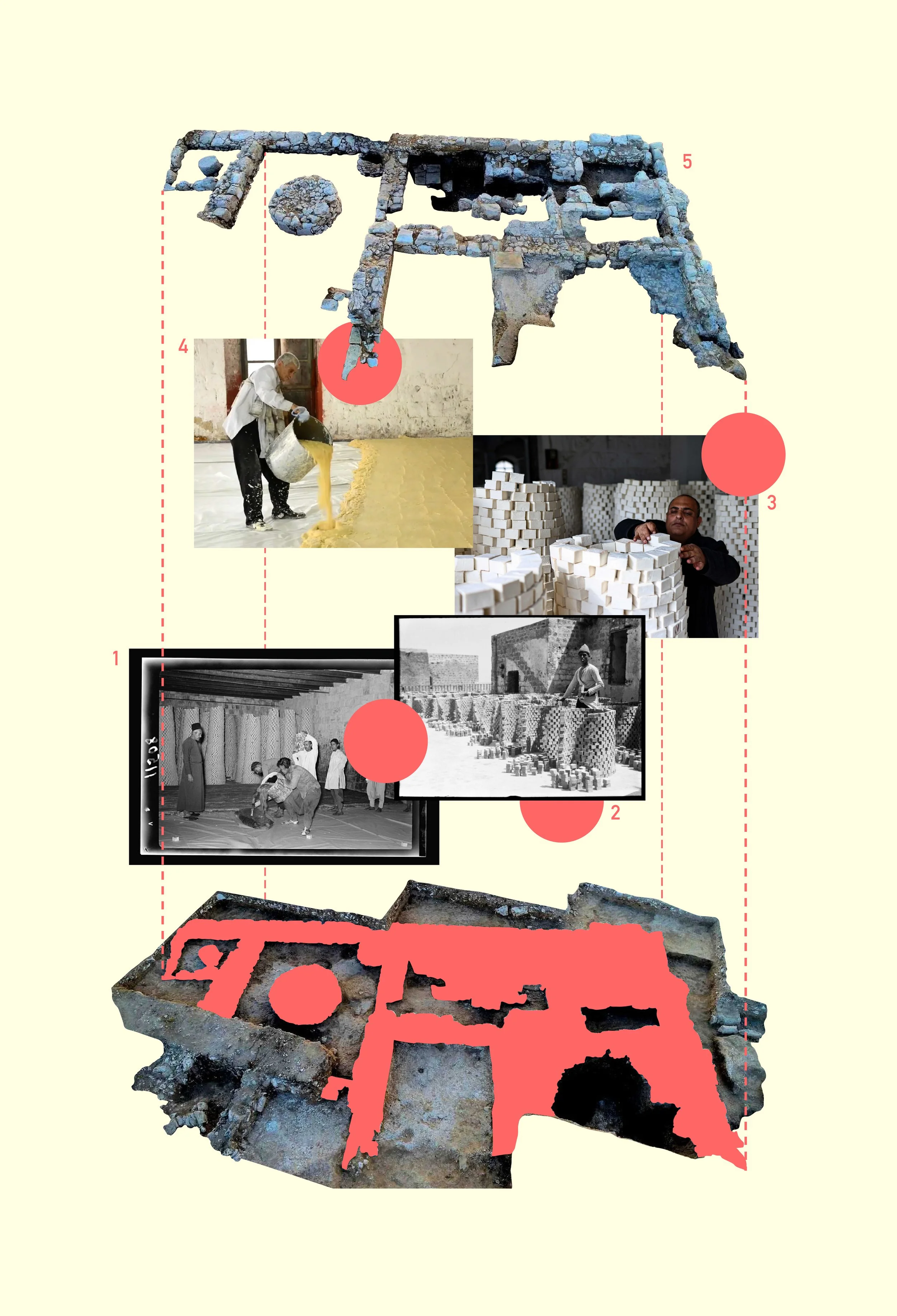
The Factory Is Not a Ruin, Nadine Zaza, 2026. Digital collage.
Image credits
1. Workers pouring saboon across the floor of a Nablus soap factory, Palestine, circa 1940.
2. Soap seller in Yaffa, Palestine, circa 1922.
3. A worker arranges stacks of soap at a local factory in the Old City of Nablus, occupied West Bank, Palestine, November 28, 2024. Photograph: AFP.
4. Worker pouring saboon across a factory floor, 2020. Still from What It’s Like for Workers at One of the Two Remaining West Bank Olive Oil Soap Businesses, Business Insider.
5. Excavation of the ninth-century soap factory near Rahat in Naqab, Palestine, 2020.
1 Okbi, Yasser. "Bedouins Forced to Destroy Their Own Homes in the Negev." The Jerusalem Post, July 2, 2019.
2 Press, Michael. Comments quoted in Voon, Claire. "Found: A 1200-Year-Old Olive Oil Soap Factory in the Negev Desert." Atlas Obscura, August 27, 2020.
3 UNESCO. "Tradition of Nabulsi Soap Making in Palestine." Representative List of the Intangible Cultural Heritage of Humanity. 2024.
4 UNESCO World Heritage Centre. "Sebastia." World Heritage List, inscribed 2026, dossier no. 1809. https://whc.unesco.org/en/list/1809
5 Shti, Dania. "Seizing the Archaeological Site of Sebastia: Expropriation Order of 2025." The West Bank in the Shadow of Genocide, December 3, 2025.
About the Author:
Nadine Zaza is a Jordanian American designer, educator, and researcher whose work explores cultural preservation and participatory human centered design across the Arab world. She holds a Master of Science in Engineering and Management from MIT and a Bachelor of Architecture from the Rhode Island School of Design. Nadine is the founder of Culture Crate, an educational initiative and social enterprise dedicated to preserving and reimagining endangered cultural practices through hands-on making and storytelling. Her recent work includes Gaza Molds, a collaborative project with Palestinian students that will be exhibited at Amman Design Week 2026.