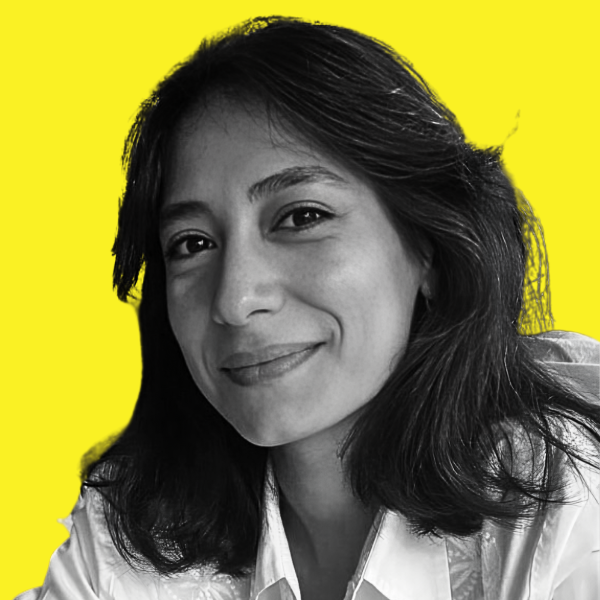
Interview by Nour Daher
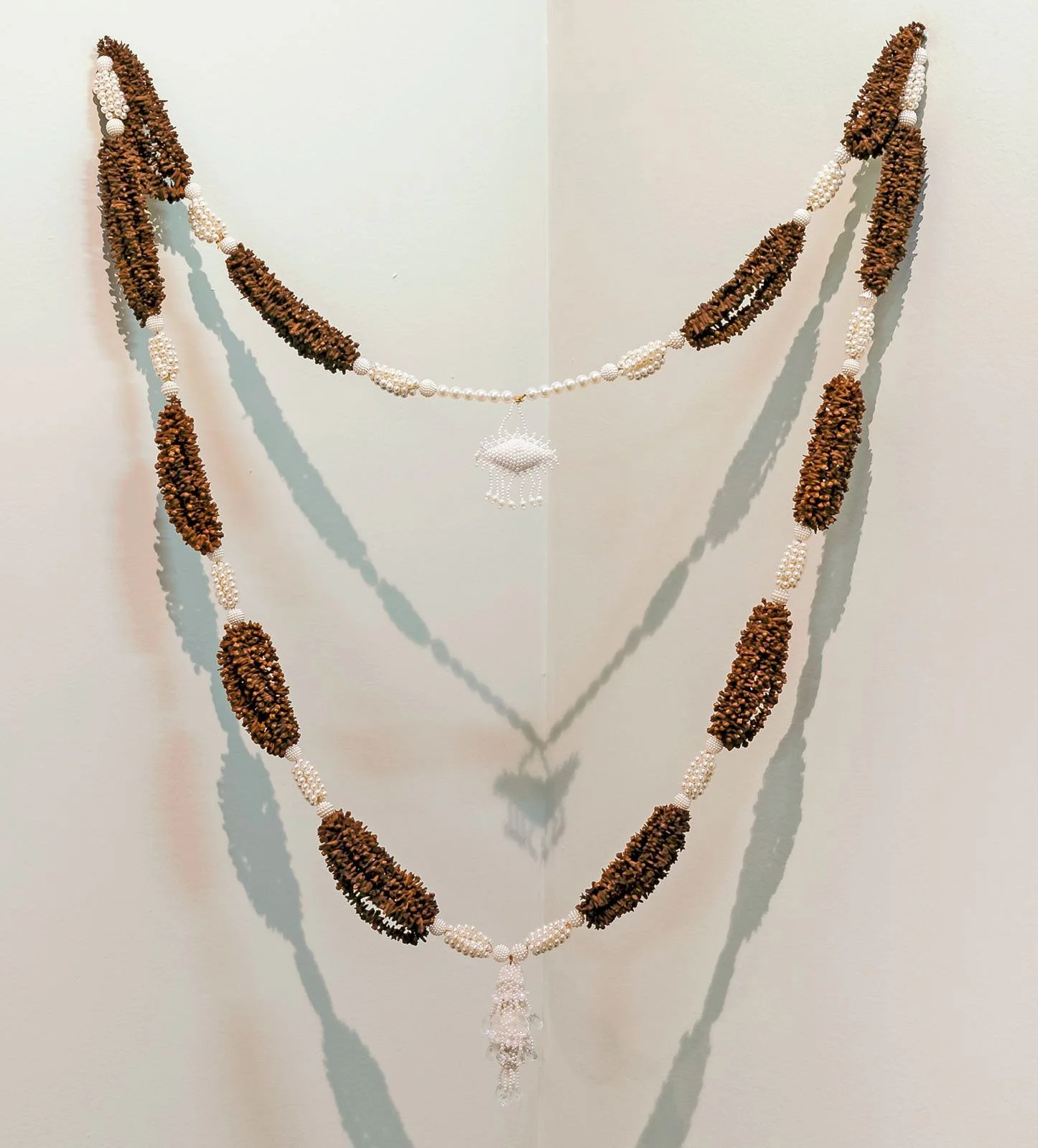
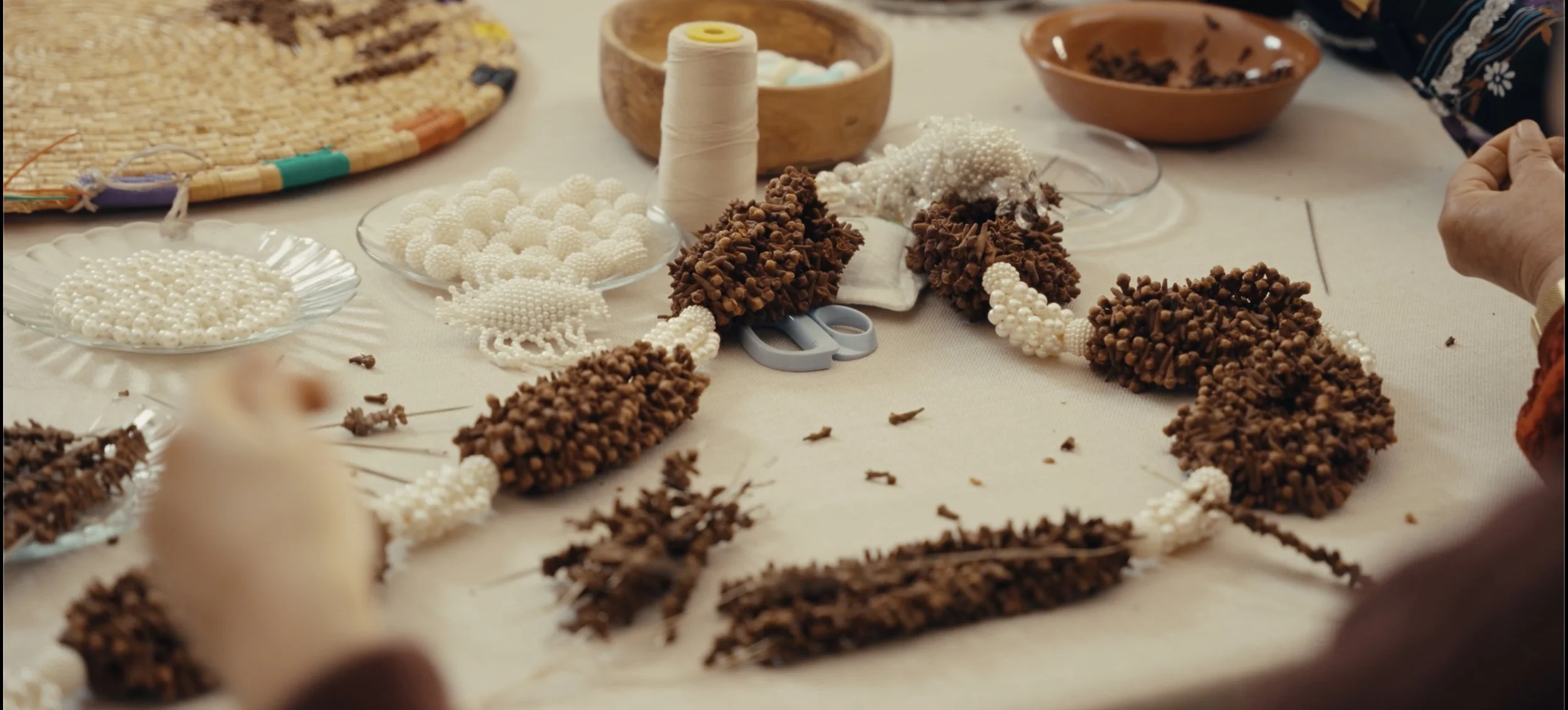
In many parts of Palestine, before a bride leaves her family home, the women of her community gather for a henna celebration and make her a necklace of cloves. The necklace holds an enclosed prayer, a beaded lantern symbolizing the light she will carry into her future, and cloves, once prized as the "gold of spices" for their medicinal and preservative qualities. Made collectively, it is both a keepsake and a gift, and its value lies in what it sets in motion between people. The tradition survives in only a few villages today, though the songs that mention it are still sung across Palestine.
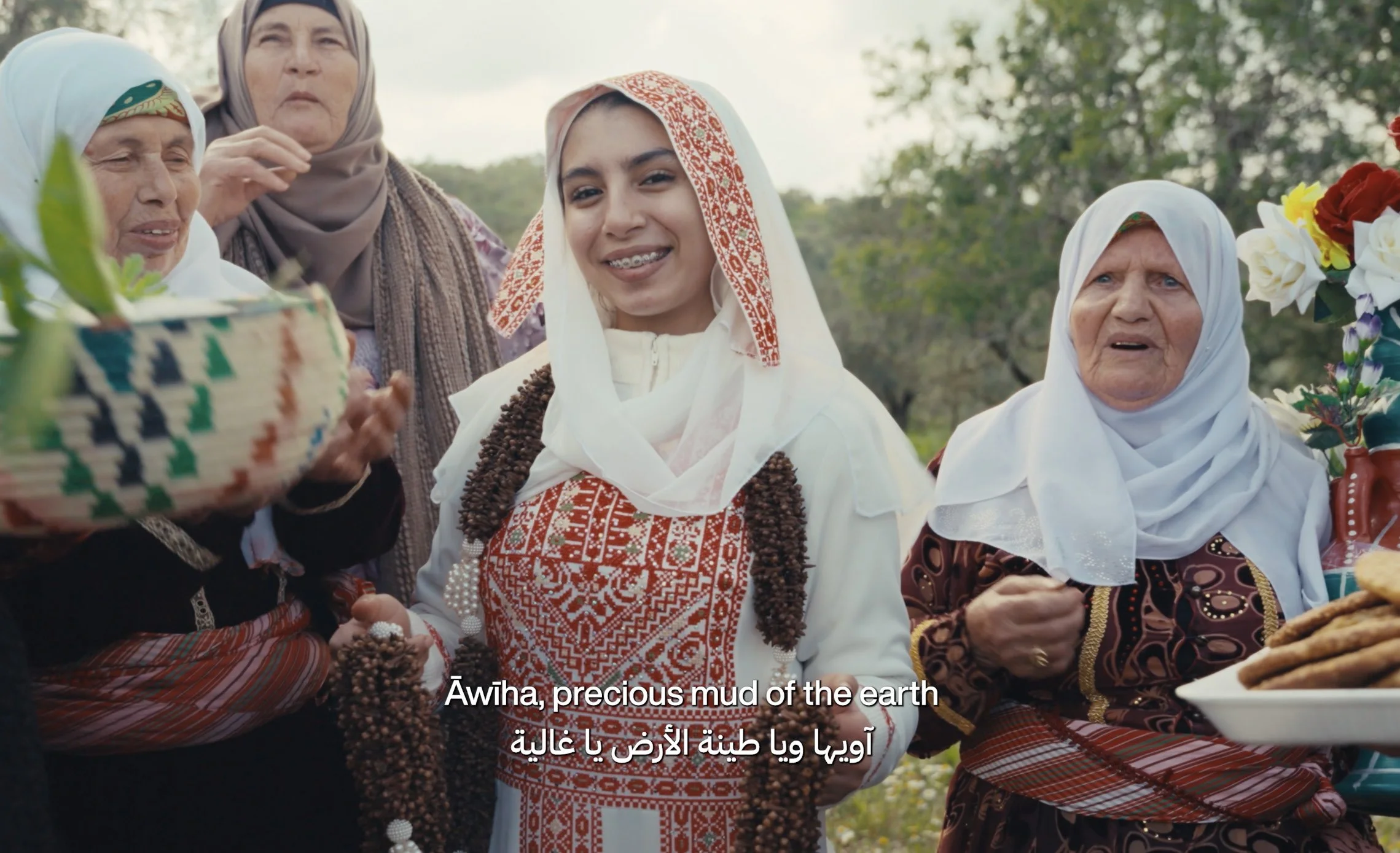
Kabsh Qrunfol – Wearing Cloves, Mirna Bamieh's new installation, presented at Hangar in Lisbon, takes this disappearing ritual as its starting point. The work comprises large suspended ceramic sculptures in stoneware and porcelain, paintings made with watercolor, ink, and clove water, and the twenty-minute film Āwīha, clusters of cloves. Shot in Palestine, the film follows women as they thread the necklace together, singing new mhaha, the improvised ceremonial chants that move between lament and celebration. The sculptures do not reproduce the necklace literally. They enlarge it and shift its scale, material, and structure while keeping its ceremonial presence, and they echo the prayer beads found across many faiths.
The project grows out of Bamieh's long-term exploration of the politics of disappearance and memory production. Born in Jerusalem in 1983, she lives and works between Lisbon and Ramallah. Trained in psychology, fine arts, and culinary arts, she uses food as a way to trace what is lost: gestures, skills, recipes, and the communities that carry them. In 2018 she founded Palestine Hosting Society, a live art project of dinner performances and interventions that revives traditional Palestinian food cultures at risk of vanishing. Since 2019 she has also worked with fermentation through text, ceramics, and video.
In this conversation, Bamieh speaks about the making of the film, the writing of new songs inside an old form, and the thinking behind the scale of the sculptures.
You've described your practice as being about "the politics of disappearance." What made the clove necklace specifically the tradition you wanted to work with, out of everything that's disappearing?
I've been preoccupied with disappearance since the early years of my art practice in 2009. I think of disappearance in its most direct sense: as absence, as what is rendered absent, or as what chooses to be absent. It is also a form of inaccessibility, whether it happens gradually or as a rupture. For almost a decade now, I have focused on food as a medium and practice through which to trace these forms of disappearance: the loss of gestures, skills, memories, recipes, and different forms of knowledge. I try to look at these disappearances horizontally, within the contexts in which they were once meaningful and purposeful, rather than treating them as isolated spheres of loss.
In Palestine, disappearance cannot be separated from the systematic erasure of bodies, places, histories, and entire typologies of life. This has been horrendously amplified by the genocide, but it did not begin there. It has been unfolding through successive and overlapping eras of colonialism for decades. There is therefore a material and existential disappearance at work in Palestine: a colonial machine that has long been operational and that exists beyond the discourse of cultural disappearance and material culture as it is often discussed within the relative comfort of the intellectual or art sphere.
The bridal clove necklaces worn for henna ceremonies came to me as one of those very precise forms of disappearance: a practice belonging to collective body and memory, which has itself witnessed oppression in different forms. The clove necklace sits within the intimate, domestic, and ephemeral rituals of gathering, and within a much larger machinery of disappearance acting upon collective and individual bodies. It also points toward the disabling and dismantling of the structures and conditions that allow those bodies to mend, heal, and survive.
Tell us about the moment Ghada Boulus brought this tradition to the women in Nablus. What was it like to witness and to film two groups of women essentially completing each other's memory of the same ritual?
I met Ghada Boulus when I was researching food practices and disappearing recipes in the north of Palestine. I spent time with her and her family and learned precious stories and recipes I hadn't known before. With her mother, may she rest in peace, I learned very old recipes from the north, like Rasaset Uzrael, an interesting name for a winter dish of bulghur kibbeh cooked in yogurt. We also cooked Mhammara together, a variation of Msakhan from the north, and seven years later I still use her techniques whenever I make Msakhan. Recipes bend time and place in this way, and I will forever find solace in that.
Ghada later told me how she had encountered the bridal clove necklace by chance during one of her cultural tours in Hurfeish. She saw the long necklace hanging on a wall and learned that it had been made for the woman who lived there when she got married. The two families had gathered to make a necklace corresponding to her height, singing henna and clove songs. The bride would keep it hanging in her house. When she wanted to activate the properties of the cloves, to ward off evil and bring light into the present and future, she would soak it in water, allowing the cloves to become plump and aromatic again.
I had wanted to make this film with Ghada for some time. The necklace-making tradition has survived in very few villages in the north, although songs mentioning it have survived much more widely across Palestine.
We found a group of women in Assira, near Nablus in the West Bank, who have sung together for many years at henna ceremonies and weddings. They were excited to learn the tradition from Ghada. As they began making the necklace, something beautiful happened: Ghada shared songs from the north, and the women taught her songs in return. They were essentially completing each other's memory.
It was particularly meaningful to film because the camera wasn't documenting a tradition that still existed intact. It was witnessing a tradition being reconstructed through exchange. The act of filming became part of that transmission.
Getting everyone there was itself difficult. Filming had been delayed because of the escalation of the war between Iran and Israel, which made it unsafe for Ghada to travel from Nazareth. When a brief هدنة (truce) was announced on April 11, we decided to seize the moment. Ghada drove to Assira and stayed overnight, while we organized the rest of the team from Ramallah to Nablus.
Once we were finally together, the filming became a moment of gathering that we had all been looking forward to. Em Ayman, the woman I had been organizing with, later called to tell me how special it had been to have a Palestinian from the north come and share this knowledge and these songs with them. These kinds of encounters have become increasingly rare with the road blockages and checkpoints. So the film is not simply about recovering a disappearing ritual. It is about what happens when fragments of knowledge come together after becoming dispersed between places, and about the gathering of people to do this mending.
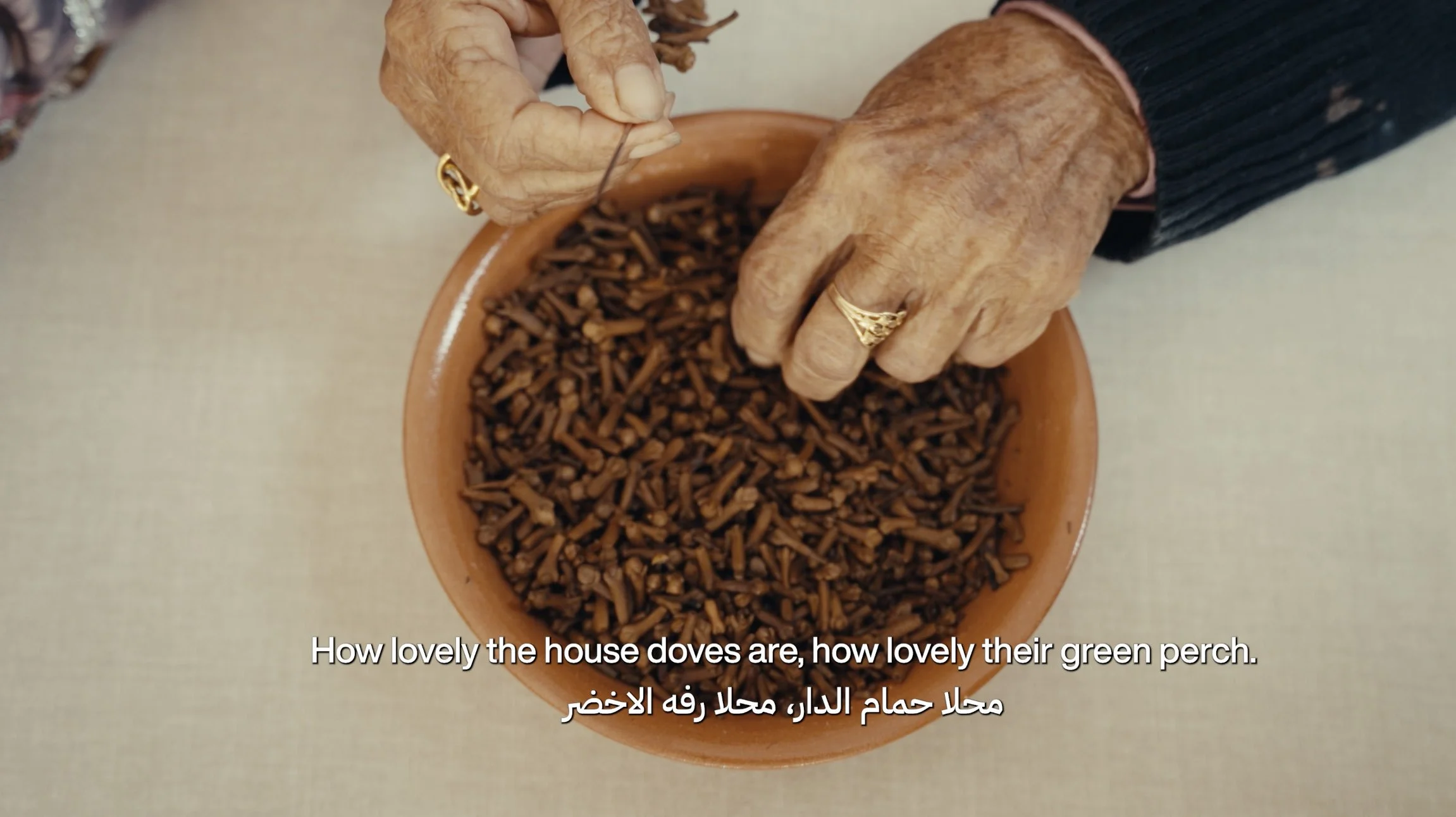
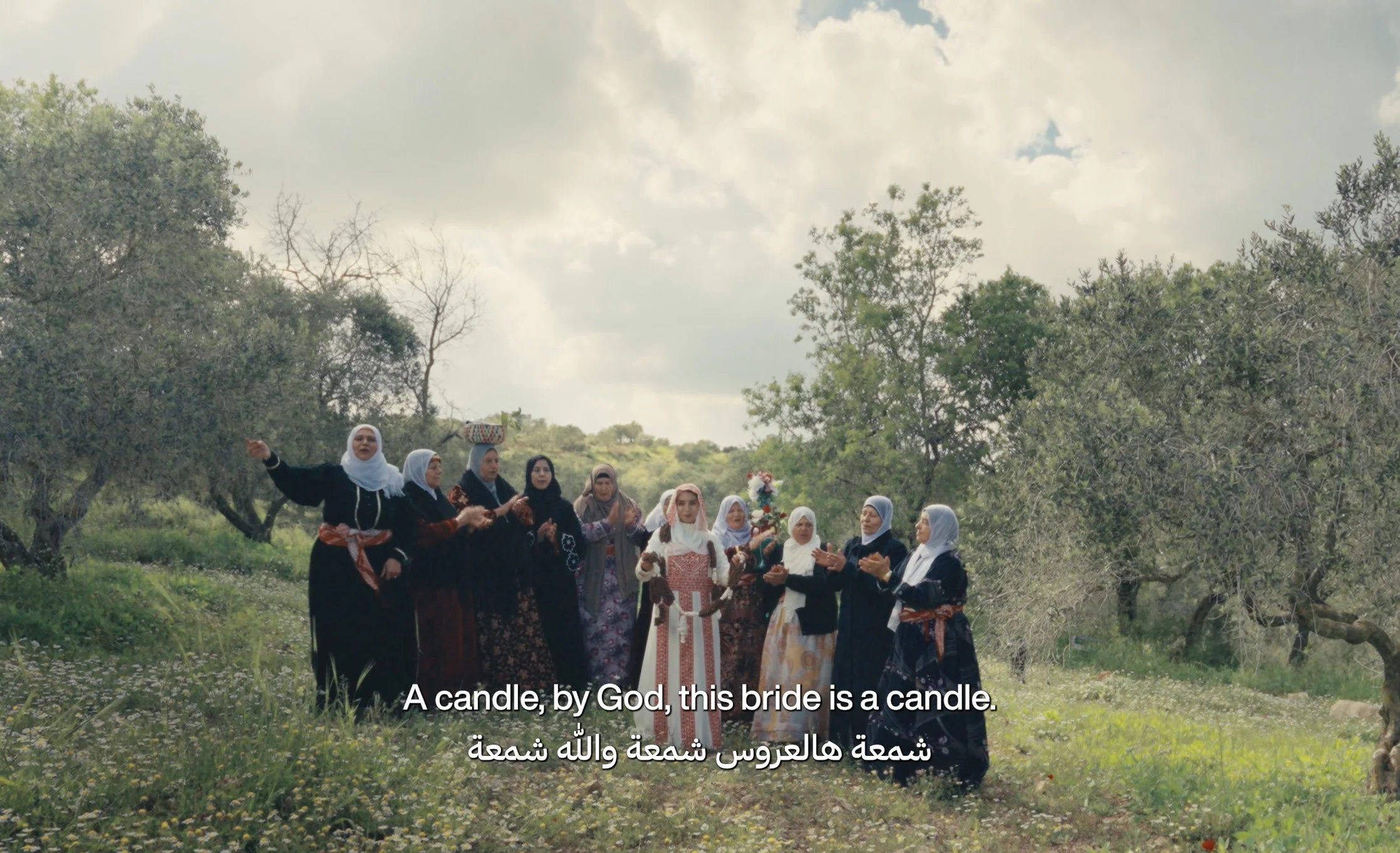
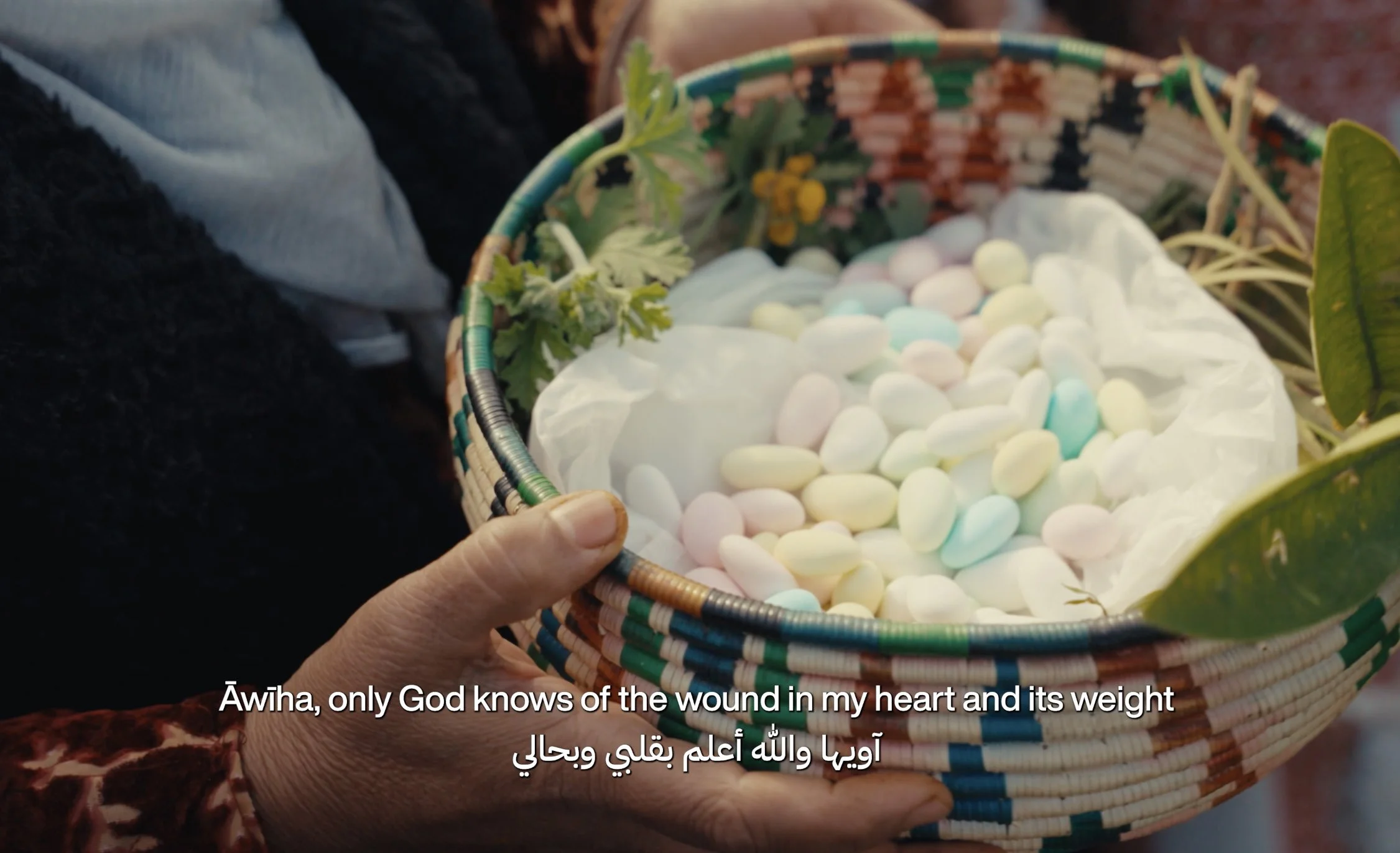
You wrote new mhaha specifically for this film, addressed to the cloves and to "the dark time we are living through now." How did you approach writing new verses inside a form that's centuries old, without it feeling like an imitation rather than an extension?
Mhaha, as a form, has always been improvisational; it is ever-changing depending on the occasion. Traditionally, the women who performed mhaha were not valued for having beautiful voices. Their talent and gift lay in the power of their voices to draw attention and in their ability to improvise. Mhaha is centuries old, and it is still very much alive because of this. Writing new mhaha, calling on the cloves to bring us light in the dark time we are living through now, is therefore at the heart of the practice.
For the new songs, I worked with the wonderful poet Asmaa Azaizh and the powerful singer Maya Khalidi. I chose them because I always try to build a platform for other researchers to join mine: Maya has done extensive research on mhaha, wedding, and wailing songs, and Asmaa has been exploring colloquial poetry that speaks to current times. We need to write our own songs and have them speak about our times for the future. I deeply believe that, and I try to make it happen in my practice.
What did scaling the object up let you say that a faithful, wearable reproduction wouldn't have?
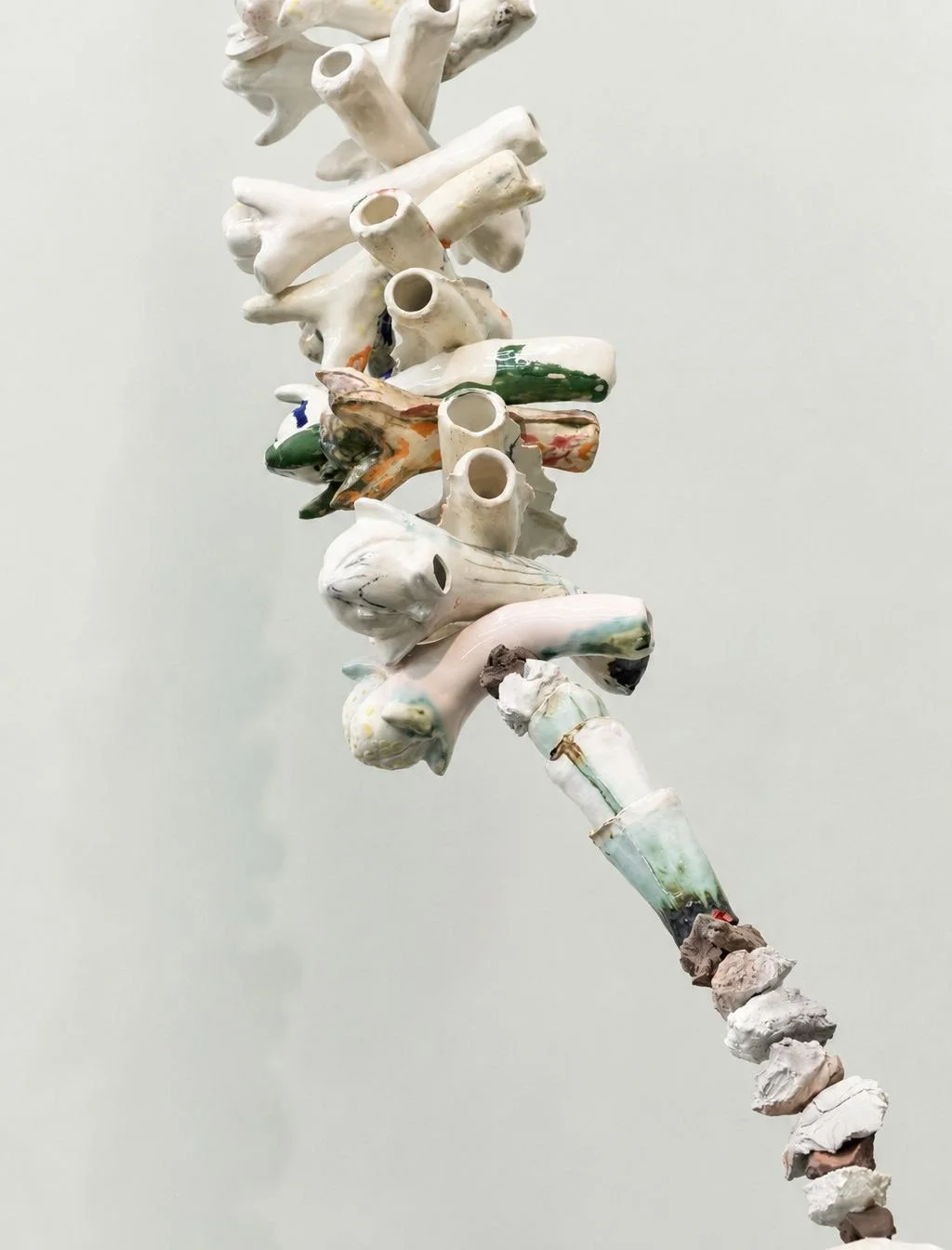
Scaling the necklace up was important because I wanted to move it away from the category of a wearable artifact. The original form of the clove necklaces, as we documented and highlighted, is already an enlarged scale. Yet it still belonged to the body, since the necklaces were made by measuring the bride from neck to feet and creating a very long necklace accordingly.
With my ceramic sculptures, I amplified this enlargement even further, so that the work no longer belonged to the physical body and became almost monumental. The ceramic and porcelain cloves were larger than life, and the actual clove threads that are part of the sculptures were exaggerated in length and number. I also wanted the sculptures to evoke prayer beads and to demand another mode of encounter, while still retaining the intimacy of something made by hand, with time and care.
What has working across food, ceramics, film, and now these bridal rituals taught you about what actually keeps a tradition alive: the object, the recipe, the song, or something else entirely?
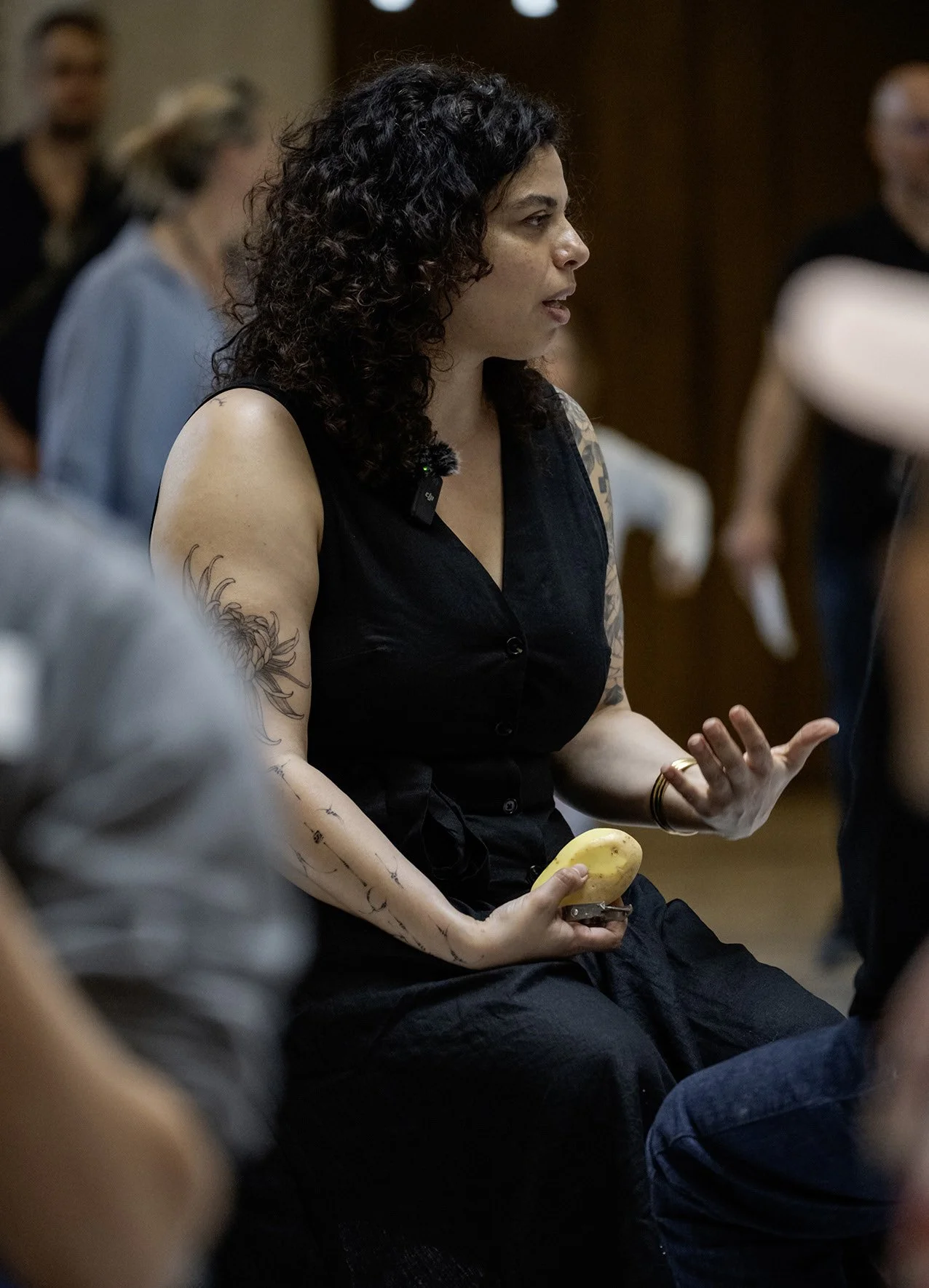
The people who continue to give those things meaning are what keep traditions alive. A vessel without use becomes an object, a song without someone to sing it is notation, and a recipe without someone who cooks it becomes an archive. But when they are activated, when they are poured from, sung, cooked, embroidered, or worn, they become living knowledge, able to be transmitted, received, and carried forward by people who find reasons to keep the process of meaning-making around these traditions alive.
That's why, in my work around disappearing traditions, I focus on creating activations and spaces for that knowledge to be shared and carried by people.