Tsawwar… Suhayb Al Jawhari
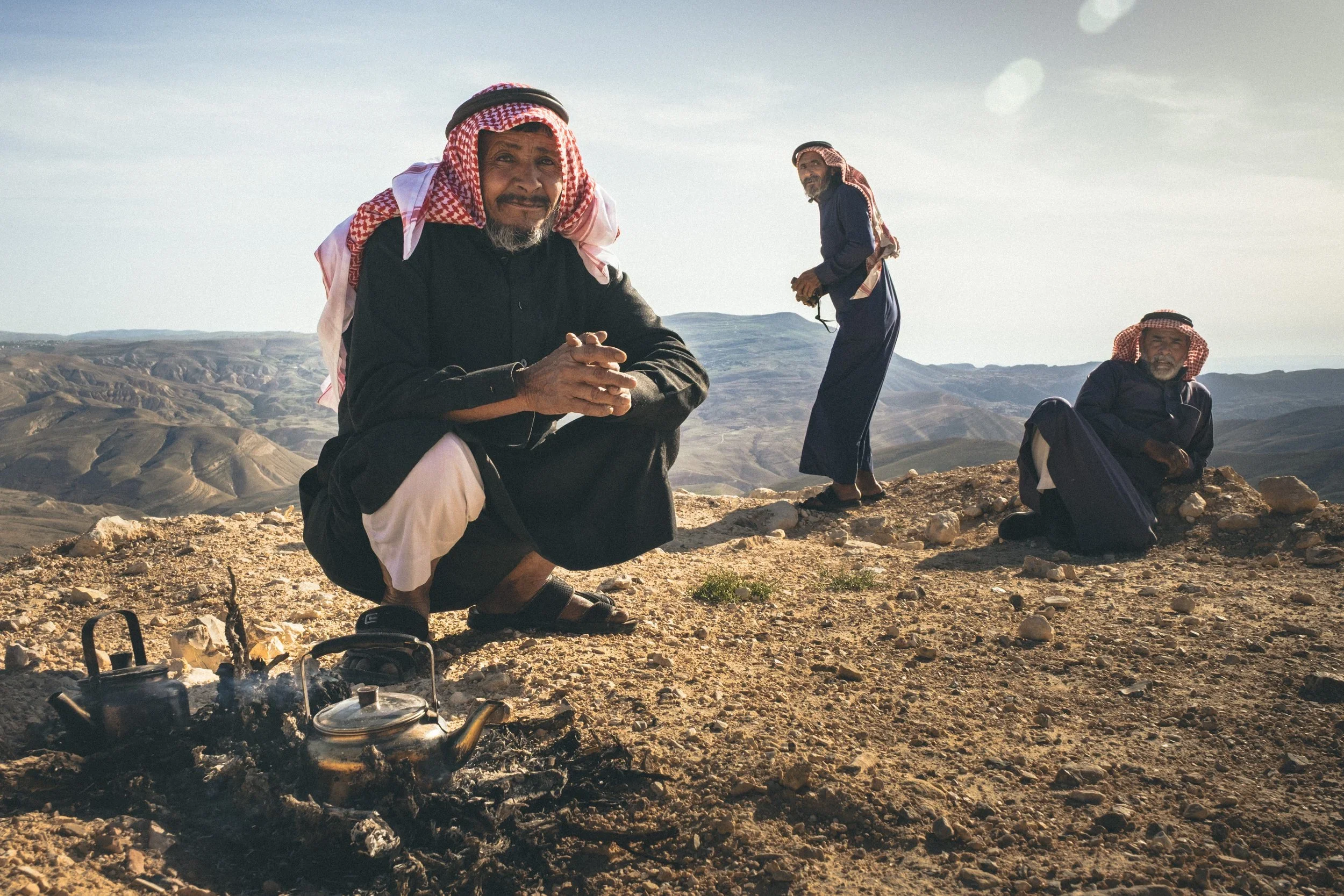
“We drove towards the edge of the mountain. Three men in hattas and dishdashes awaited us. One was squatting, preparing tea on the wood fire. The second man was standing, face towards the valley, hands on his binoculars encasing his eyes. And the third was, like any sheikh would do, sitting, leaning on their elbow, his legs creating a triangular shape, the most stable shape, waiting for the tea to boil, and ready to welcome us.
The wood from the fire appeared to be from an ancient tree, twisted and turned, thick and short. The quiet embers of the fire slowly heated the tea. They made sure to have two kettles to always have one hot and ready for seconds or thirds.
I said hello to the three men. They all stood up to greet me. We exchanged firm handshakes, and we looked straight into each other's eyes, and we said, “Peace be upon you, " and “upon you be peace”.
The valleys of Dana, located in Southern Jordan, carry secrets in the ancient waterways leading to the deserts of Wadi Araba to the west. And from the east, histories of antiquity traverse the mountains of Petra and Wadi Musa.
Dana is not known to many.
They invite us to tea. The man takes the large bag of sugar and lifts the bottom of the bag high, aiming the sugar towards the teapot. 1 second. 2 seconds. 3 seconds, 4. The sweetness is essential to the black tea with sage.
I sit down with the lounging sheikh. I wish them all a Happy Eid. They agreed to use their day off to meet after Eid prayer and their family breakfasts to check on their camels in the valley.
The man with the binoculars points far away. To find the tiny dromedary speckles in the valley, he guides my eyes to the windmills of Tafileh. “The third one from the left, yes?” “Yes.” “Follow the trail at the bottom of it to the valley; you will find our camels.”
The camels roam free. About 50 of them. They recently purchased them from a herder for a large sum. They’ve been in the valley for several weeks now. No one to tell them where to go. No one to direct their day. Camels being camels.
I take my first sip of the viscous, syrupy tea. The flavor, bold. The sweetness, surprisingly just right. I am engulfed by the strong flavor of the tea and wild sage. This is the drink of the Bedouins.
Right before my second sip, I look around my surroundings. For a moment, we sat in silence. The wind took its turn to speak. The musky and dusty aroma of the land brought itself to our attention.”
Suhayb Al Jawhari is a Palestinian-Jordanian documentary photographer based between Amman and the United States. Suhayb’s latest work explores the themes of personal histories, masculinity, and nature in the Arab world, using images as a narrative tool. His practice is often retrospective and reflective, offering a style of storytelling that weaves pen and camera to offer contextual and cultural depth to his images.
Tsawwar is an ongoing visual series in Daftar that explores the stories behind a photograph, taken in the region or by an Arab photographer, written in their own words.