Words By Amine Elmecheri
On a recent trip to the National Museum of Martyrs in Algiers, I was struck by how little exhibition space is devoted to honouring the women who served on the revolutionary frontlines. Having studied my country’s revolutionary past, I was expecting the exhibition to be full of the rich stories of both mujahidat and moussebilate. Instead, among the plethora of memorials, photos, and models of revolutionary men, only a small corner at the end of the exhibition is dedicated to women, a handful at most.
Two decades ago, historian Natalya Vince noted that the museum’s section for women was shamefully small, and visiting today, very little has changed. As we left, my parents asked for my thoughts on the museum, and all I could critique was the absence of appreciation for our noble women, who gave their lives for our country’s independence, yet seem to have been systematically erased from our history.
Algerian women were present in every layer of the resistance. Mujahidat, translating roughly to 'female warriors', occupied roles on the military front as nurses, bomb carriers and doctors. More importantly, the revolution was not just fought in the mountains but also in domestic spaces. Moussebilate, meaning 'those who volunteer', were grassroots women who redefined wartime space, turning kitchens into safehouses and the folds of the haik into weapon-smuggling tools. Their private homes became a frontline for the resistance, and their bodies became battlefields, in which both mental and physical conflicts unfolded.1 However, these sacrifices have not earned them equal commemoration in present memory.
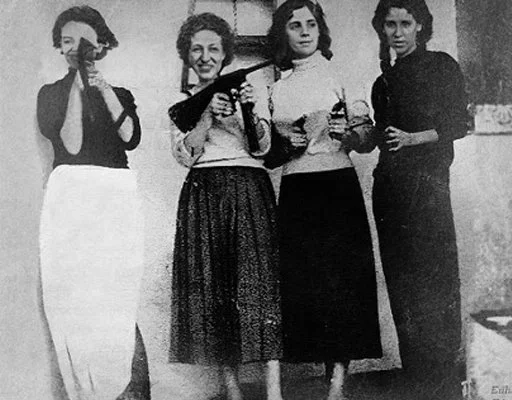
Mujahidat. Sami Lakhdari, Zohra Drif, Djamila Bouhired and Hassiba Ben Bouali, members of the National Liberation Front c. 1956
Unfortunately, for many women who resisted French colonialism, traumatic memories linger. "Some forgetting is necessary," and as victims of systematic torture and sexual violence, these stories are withheld. Such trauma fostered a growing internal erasure that cloaked a generation of Algerian women. In conversation with Natalya Vince, Fatima Benhomand Berci says she avoids watching documentaries. 'I refuse to watch them because it hurts too much to remember bad times'.2 When independent survivors like Louisette Ighilahriz have bravely broken that silence to recount the horrific torture she endured, she was met with isolation rather than support from her fellow mujahidat.3 These atrocities that women endured during the Algerian War of Independence remain undiscussed due to restrictive social and cultural taboos.4 Concepts such as 'ayb' (shame or disgrace), often dictate social decorum and family norms in Algerian society. For many, speaking of these sensitive incidents would be bringing ayb to the family as a collective. Consequently, this wall of silence has caused a large void in Algerian women's revolutionary past, and it has allowed for their crucial role to be reshaped and minimized post-independence.
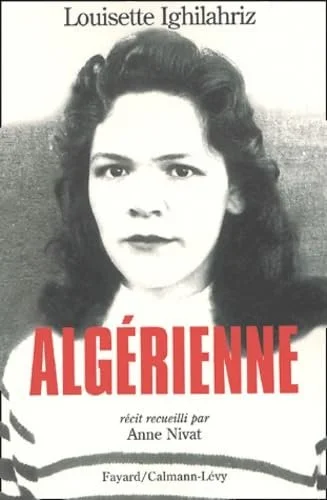
Louisette Ighilahriz’s book 2001
During the National Liberation Front's campaign, gender equality was largely insinuated. After all, women fought alongside their fellow brothers to ensure the liberation of their country. During the liberation movement, the FLN would describe the condition of women as one that needed to be changed but treated it as an afterthought that could be resolved after the war.5 Hypocritically, the new post-independence regime, to appease conservative backlash, would define the woman by her maternal duties. Women were legally ushered back into the confines of their home. The 1984 Family Code would solidify this contradiction and signal to women that their role in the revolution was viewed as 'an extension of their nurturing responsibilities'.6 This code effectively mirrored what the National Museum of Martyrs displays today: a society where a woman's contribution is tucked away into a dark corner, defined entirely by her relation to the men on the center stage. Still today, this policy remains a point of controversy and, although revised, still contributes to the absence of Algerian women within spaces in which they belong.
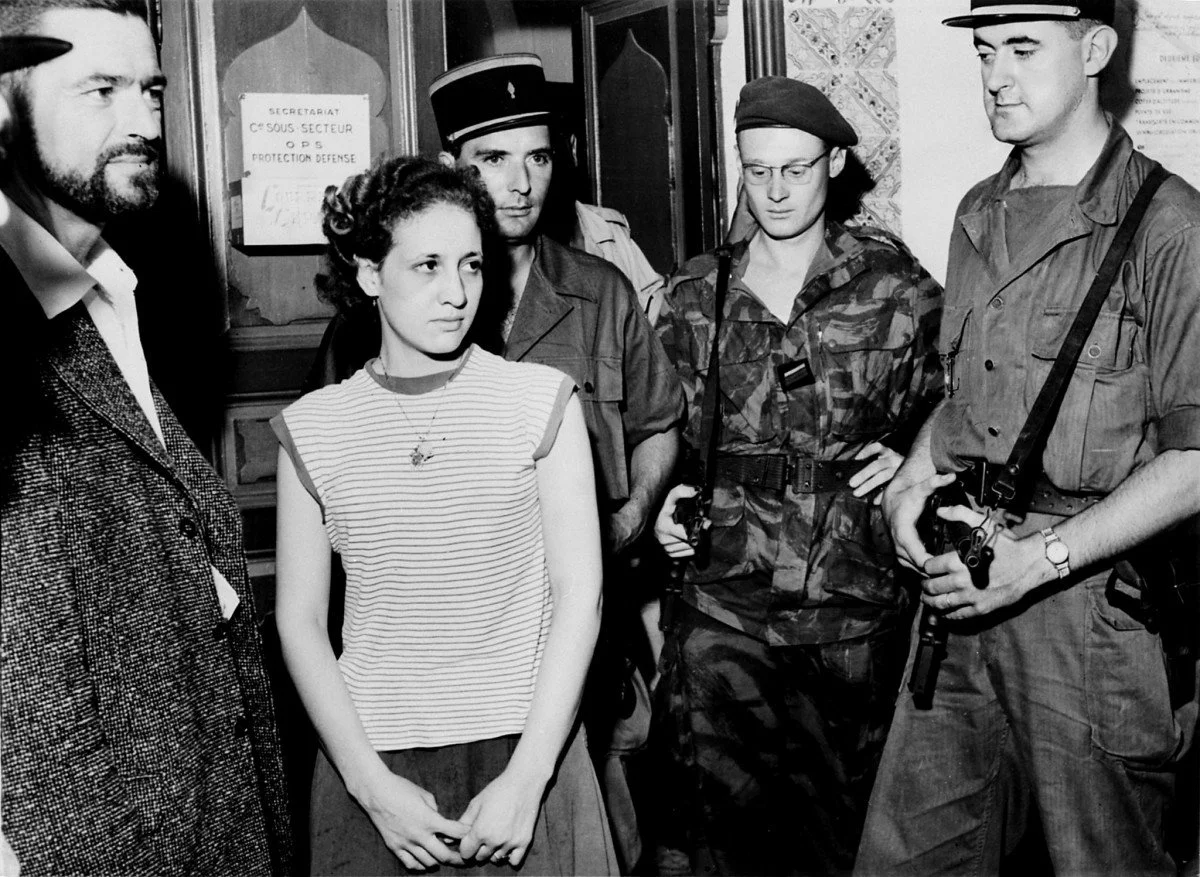
Zohra Drif’s arrest and the photo she chose as a cover for her memoir “Inside the Battle of Algiers”
This state-manufactured silencing has created a new sense of urgency for Algerian women to share their stories. Zohra Drif released her visceral memoir titled Inside the Battle of Algiers in 2017. She explained her surprise to find out how Algerian youth did not know about their country's revolutionary past. When looking deeper into the school curriculums I was appalled at how 'minimal' the history really was.7 The stories and sacrifices of mujahidat are not only absent in historical spaces, but educational too, as the state turns a blind eye. However, Zohra Drif represents only a handful of mujahidat who have been brave enough to come out and tell their stories.
Chipping at this wall of silence, grassroots actors have taken initiative, refusing to allow the spatial erasure of Algeria's mujahidat. Their work has crafted vibrant spaces for their histories both in the physical and digital plane. In 2020, Nadja Makhlouf launched a digital exhibition titled 'El Moudjahidate, Invisible to Visible'. Her work aims to address the growing gaps, as her photos explore themes of female agency, historical experience and, most importantly, the role of memory within contemporary Algeria.8 The exhibition features a collection of photographs, presented in white and black diptychs, from the past and present of Algerian women who lived through the revolution. Their faces are etched with the topography of a lifetime. Each woman is given her own digital sanctuary, where their stories are engraved. This exhibition reminds us that the modest, matronly women of Algeria have untold histories.
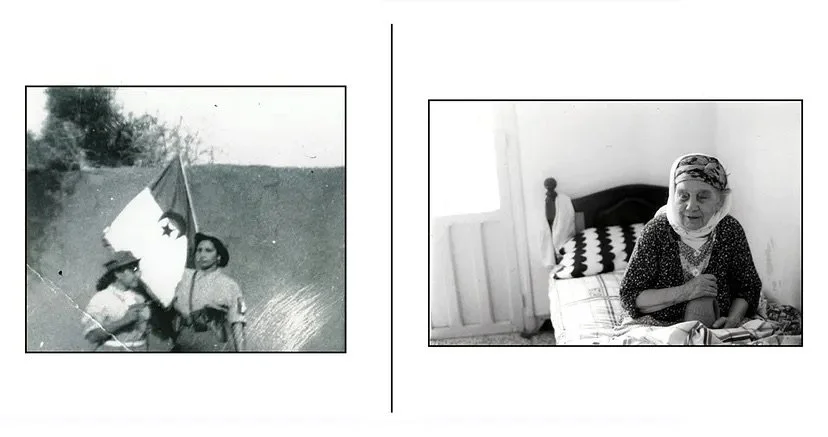
Moudjahidate, femmes combattantes — Fatima Kade © Nadja Makhlouf
In collaboration with Katarzyna Falecka, Nadja's work alongside Katia Kameli, Zineb Sedira, Kader Attia and Marwa Arsanios, has been presented in a physical art exhibit in New York in 2021. Named Beyond Metaphor: Women and War, this exhibition showcases the reality of Algerian women's complex history which are "not entirely forgotten, but also not fully remembered".9 It creates a powerful space in which these artists have come together as a collective to curate a hall for Algeria's unsung heroes. Beyond the physical space, a digital one remains accessible through the apexart website.
Digital curation has become a leading tool of resistance against Algerian women's spatial erasure from state-curated spaces, like the National Museum of Martyrs. It is an ever-expanding space that not only uncovers and preserves history but also forges a platform for women's voices. A prime example is La Place, a forward-looking magazine that aims to ensure Algerian women's stories are heard. Run by a collective of young Algerians, the magazine combats the male-dominant media. In an interview with Jinha Agency, Saadi Gacem said "Some press outlets do not show the reality of women; they only show the images of women based on stereotypes and traditions. We decided to launch the magazine La Place to be a place for women."10
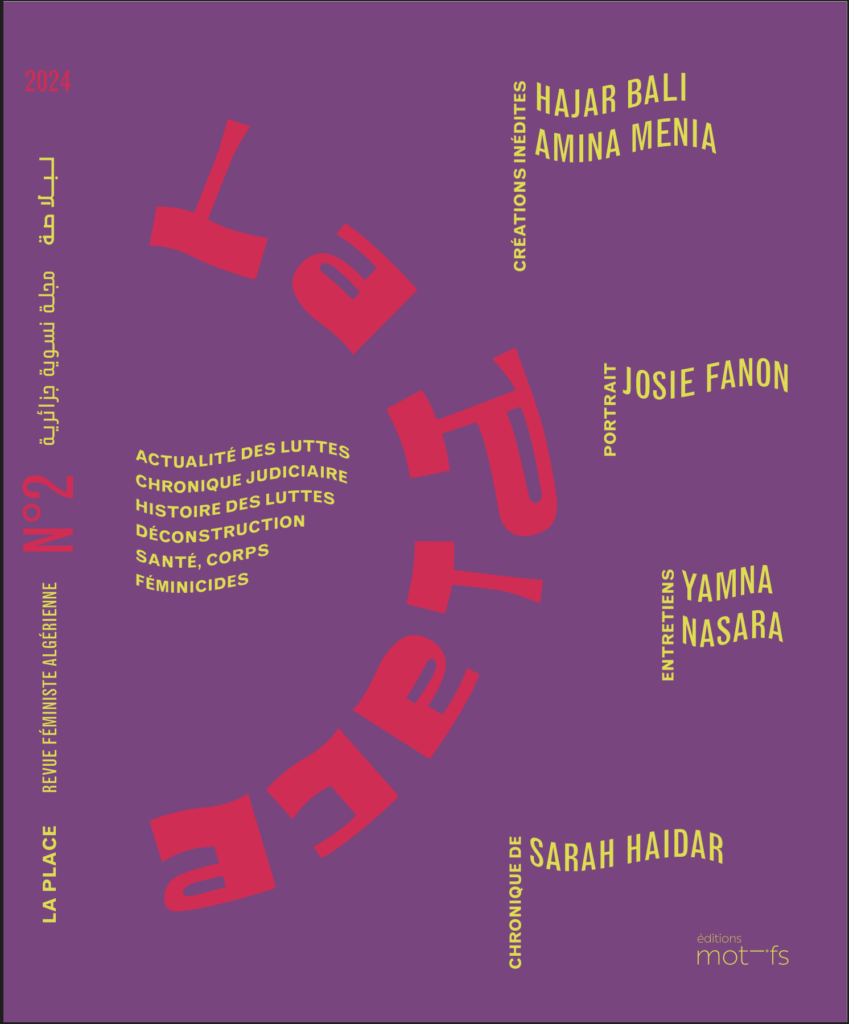
Cover for the 2nd edition of La Place magazine
Revolutionary women of Algeria have long been stifled by spatial erasure. Their non-appearance in spaces like the National Museum of Martyrs reveals how state-led curation and policy have led to the minimisation of the role of women, who formed the spine of the struggle against French colonialism. However, through memoirs, digital diptychs, and youth-led media, a new generation is actively building spaces that safeguard these testimonies against silencing.
Footnotes
1 Anissa Daoudi, "Sexual Violence in Conflict 2019: Insights from Sudan and Algeria," Oxford Human Rights Hub, July 7, 2019. https://ohrh.law.ox.ac.uk/sexual-violence-in-conflict-2019-insights-from-sudan-and-algeria/
2 Vince, Our Fighting Sisters, p. 240.
3 Ryme Seferdjeli, "Rethinking the History of the Mujahidat during the Algerian War: Competing Voices, Reconstructed Memories and Contrasting Historiographies," Interventions 14, no. 2 (2012): 238–255. https://doi.org/10.1080/1369801X.2012.687902
4 Matilda Lasseko-Phooko, "Listening for Silences in Algeria: Eliminating the Structural Silencing of Survivors of Conflict-Related Rape as Entrenched in Africa during Colonisation," African Human Rights Yearbook 9 (2025). https://www.scielo.org.za/scielo.php?pid=S2663-323X2025000100017&script=sci_arttext&tlng=en
5 Wenqin Zhang, "To Veil or to Unveil: The Dilemma of Feminism in the Algerian Anti-Colonialist Struggle," Graduate Institute of International and Development Studies, September 25, 2023. https://www.graduateinstitute.ch/communications/news/veil-or-unveil-dilemma-feminism-algerian-anti-colonialist-struggle
6 Imane Ait-Kaci, "The Making of La Nouvelle Femme in Post-Independence Algeria," Identity Hunters, April 5, 2025. https://identityhunters.org/2025/04/05/the-making-of-la-nouvelle-femme-in-post-independence-algeria/
7 Sarah Grey, "Inside the Battle of Algiers: An Evening with Zohra Drif," Review of African Political Economy (ROAPE), September 26, 2017. https://roape.net/2017/09/26/inside-battle-algiers-evening-zohra-drif/
8 El Moudjahidate: Invisible to Visible, "Copy of Nadja Makhlouf," accessed June 19, 2026. https://www.elmoudjahidateinvisibletovisible.com/copy-of-nadja-makhlouf/
9 apexart, "Falecka," accessed June 19, 2026. https://apexart.org/falecka.php
10 Necwa Rahim, "Algerian Feminist Magazine 'La Place' to Launch Its Third Issue," JINHAGENCY, June 30, 2023. https://jinhaagency.com/en/community-life/algerian-feminist-magazine-la-place-to-launch-its-third-issue-33486
About the Author
Amine Elmecheri (pronounced El-Meh-Shuh-Ree) was born in the United Kingdom to Algerian parents. He is currently pursuing a BA (Hons) in History at the University of Nottingham, where much of his academic work has focused on Algeria's rich history, with particular interests in the French colonisation of Algeria, the Algerian War of Independence, and contemporary socioeconomic affairs.