Review: Hala Alyan’s I’ll Tell You When I’m Home
Review by Ilham Essalih
Surrogacy and exile have something in common in Hala Alyan’s Pulitzer Prize-finalist memoir, I’ll Tell You When I’m Home: they both involve the unbearable waiting and longing for something far away. After years of trying for a child and struggling with miscarriages, Hala and her husband embark on a surrogacy journey. She anxiously tracks the weeks and watches from afar as her baby grows, while she also watches Palestine and Lebanon, her ancestral homelands, come under fire since October 2023. She is exiled from these lands, and she is exiled from her baby.
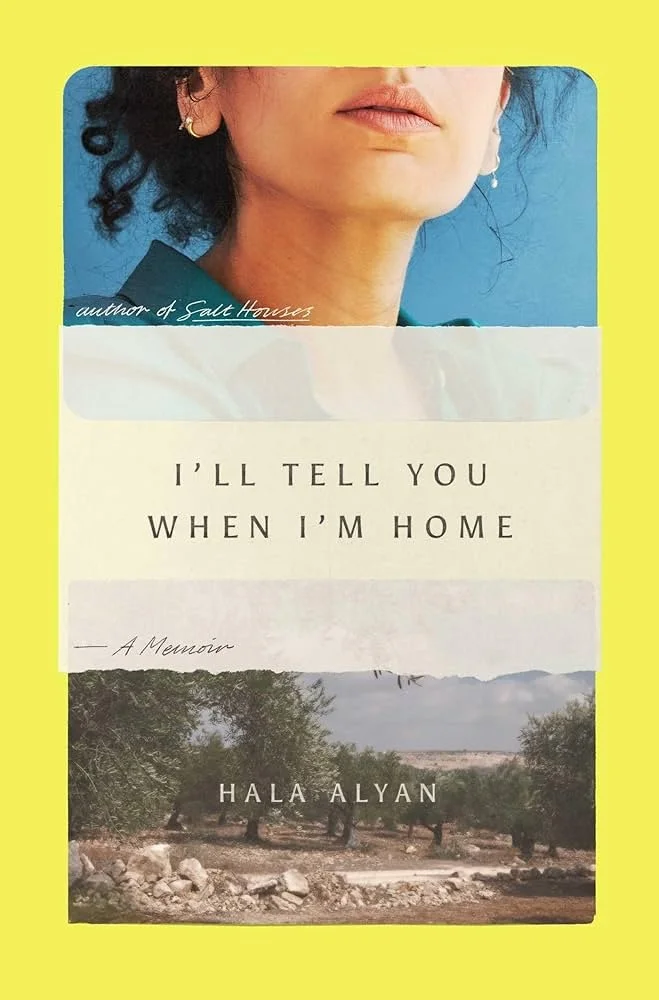
Hala Alyan is an award-winning Palestinian-American writer, poet, and the author of the widely read and celebrated novels The Arsonists’ City and Salt Houses. She also works as a clinical psychologist and professor at New York University.
She revealed in a Palfest podcast that I’ll Tell You When I’m Home was initially meant to be a collection of essays, which eventually morphed into a memoir. Rather than a traditional memoir, she writes it in the style of a pregnancy journal, weaving together the anxiety and the unknown of childbearing with that of war, but also attempting a reckoning with a difficult past of addiction, relationship and intergenerational trauma.
Pregnant women are often urged to write a pregnancy journal to record their symptoms as the months go by, as well as their changing emotions, cravings, and baby kicks. They are told to savor the journey, to document it, and cherish it like a keepsake, and perhaps even let the child read it someday. Hala takes this concept and gives it a dramatic twist: rather than documenting bodily changes, she writes a story of unravelling and piecing back together; in 11 chapters, each one corresponding to a month of pregnancy (including preconception and postpartum).
Each chapter starts with generic information about foetal development (“your baby is the size of a grain of rice”), but instead of the usual list of obstetric symptoms that would normally follow, we get to read about her past infertility, miscarriages, alcoholism, identity and belonging struggles, the trauma of her family’s multiple displacements, and a past relationship that left very deep wounds. Interspersed among these are the updates about the surrogate’s and the baby’s health, which are essential because they serve to keep the story grounded in the now (and here rather than there?) of the pregnancy journey.
The chapters are not arranged in any sort of neat or linear structure, instead we have a very fragmented narrative: it’s basically a juxtaposition of what look like haphazard thought paragraphs. Some of these paragraphs are historical and scientific facts; they feel disjointed and out of place, as though they are penned down anxiously like notes, to be remembered by a scattered mind trying to fill time or trying not to forget – perhaps an attempt to mirror the experience of waiting?
The choice of structure somewhat makes sense as it tries to emulate diaristic entries of a pregnancy journal, but this kind of writing can be divisive; readers with a short attention span will love it, while those who crave a more polished structure might hate it. It takes getting used to, but the emotional reveals and ending are worth the laborious read.
The first entry in the journal is a page-long description of Hala’s grandmothers as teenagers in their respective countries. Siham in al-Majdal, Palestine, and Fatima, 200 miles north in Damascus. The year is 1948, and the month is May, at the start of the Nakba. Siham is on the cusp of forever leaving her hometown, and Fatima is a decade away from leaving Syria, before ending up in Lebanon, Kuwait, and the United States. This first entry introduces two intertwined major themes of the memoir: mothers and exile. Further than that, it introduces the idea of the inherited trauma passed down from daughter to daughter.
The grandmothers, mothers, aunts, daughters, nieces, are everything in Alyan’s world: they are strong, patient, anxious, nostalgic, and self-sufficient. They have what it takes to survive displacement and tragedy, and there is almost a palpable urge to give birth to daughters to pass this on. Men are strikingly absent from this equation: they are technically there, but the women do not rely on them.
Alyan yearns to continue the matriarchal tradition, and her struggle to naturally conceive is a source of existential anxiety: what will she do (and be) if she can’t fulfil this? The desire to “plant seeds” and find a sense of stability is crucial in exile, because what else did her mother, aunts, and grandmothers have besides that? Away from their indigenous lands and their own families, they had to create something they could have control over and could not be taken away.
When Alyan can conceive through surrogacy, she is not rid of her anxiety. She asks the reader, “Is it tiresome to say I lie at night and feel exiled from her body? Her body inside another? I imagine it bopping around like a little red dot on a map. And mine? Hundreds of miles away.” Hala is forced to live a new (familiar?) form of exile while the baby grows inside another woman’s womb, starting her life in exile from inception. To cope with the exile from her baby, she writes the memoir: as the baby grows, the writing grows, as a parallel form of creating. Perhaps to assert ownership over a process she is excluded from, an anxious need to produce something in a society that preaches productivity above all else, or to quench a desire for control.
As the memoir comes to an end and the due date approaches, the narrative progressively shifts to a different addressee: the daughter. Alyan no longer talks to an imagined reader, but to her unborn child, whom she dedicates the book to. She writes, “This is your birthright, Leila. You will have to hunt for many things. Excavate them in others or yourself. But not your mother’s truth. I’ll leave that right in the open for you to see.” With the memoir, Alyan offers her daughter her entire story, without leaving anything out, breaking the tradition of silence and shame, and to break free and heal from the family’s inherited trauma.
I’ll Tell You When I’m Home is a genuine and sincere memoir that lays bare the wounds of infertility while weaving in themes of generational trauma, addiction, and exile. Like a talking (or writing) cure, the experience of reading it feels cathartic, like an unburdening of the heart, to finally start anew. The writer’s background in psychology is evident here and is perhaps a reason for the unconventional structure: like a therapy journal, it is a bit incoherent and chaotic, but it is poetic, reflective, and authentic.
About the Author:
Ilham Essalih is a book reviewer and researcher in literary criticism, specialising in literature from the SWANA region and its diasporas. She is also an educator in postcolonial studies and a freelance literary curator.