Publishing in times of revolution: The spatialization of radical Arab publishing practices in the 1980s
Words by AHMED MORSI
Media is fluid, as are the spaces in which it is conceived and produced. Across the Arab world and its transnational solidarities, dissident print cultures, shaped by multiple anticolonial and anti-imperialist currents, once moved with remarkable spatial and geographical fluidity. Despite censorship regimes and other constraints choreographed by violent imperialist intervention — that have effectively severed these networks — they nonetheless persist, even if they have to go through more complex geographical (and virtual) channels. From poetry and calls to action, comic strips and interviews, anticolonial sentiment has consistently found ways to circulate through the cracks of mainstream broadcasting and publishing machines. This curated vertical leporello looks back, tracing these circularities through a nonlinear timeline of stitched-together fragments, with brief forays into film stills.
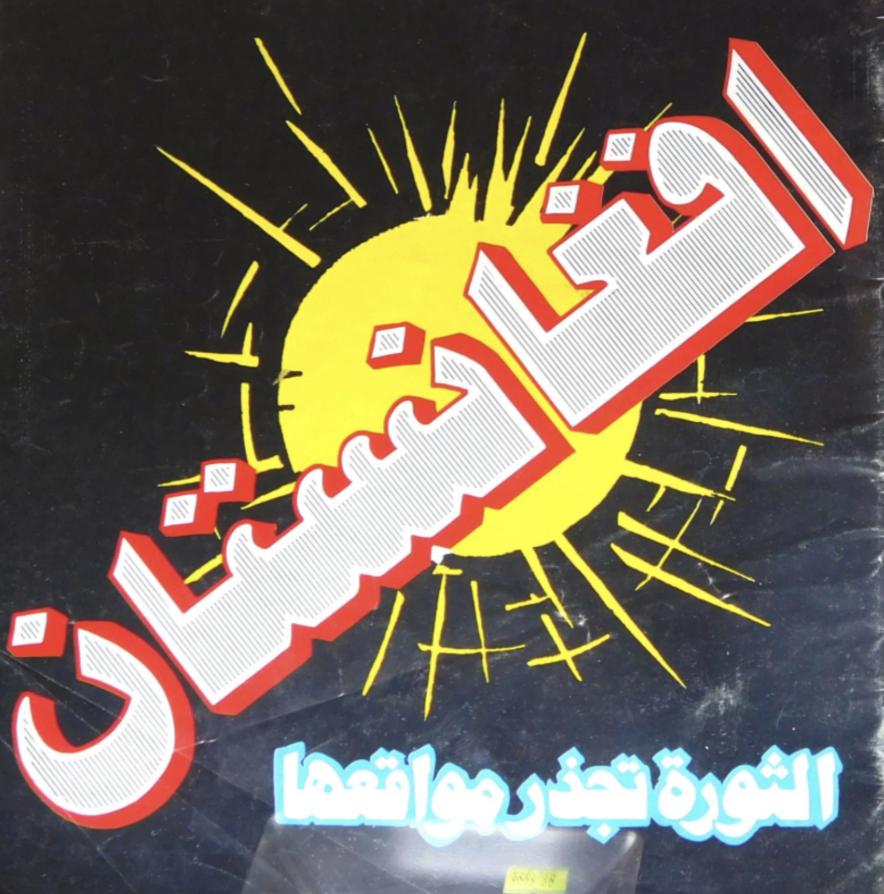
Panic over what is in the house. Panic to shut the door. The shutter comes off and the wall crashes down behind it.
It's 1884. Muḥammad ʿAbduh is in exile in Paris along with Jamāl al-Dīn al-Afghānī. They co-edit and publish al-ʿUrwa al-wuthqa (trans. The Firmest Bond). Abduh describes Britain's approach to India and the Suez Canal.1
[Voltaire] rested his head on his arm and thought to himself: “Who knows whether the light of the West might one day be eclipsed like the light of the East was. Perhaps one day a traveler like me will stand on the ruins of London and Paris, wandering along the banks of the Seine and the Thames calling on the remnants of Western urbanity and its traces.” [It is as if] the West, with the weevils gnawing at the heart of its tree bit by bit, is far from the condition Voltaire described in a distant age. Rather it appears to us full of youth and vitality. Its sons now surge toward the East with the force of a lion upon his prey, caring only to reach it and to sink his claws deep within it.
25 years old, Farah Antūn, born in Tripoli on the Levantine coast, publishes al-Jāmiʿa's (trans. The University) first issue in Alexandria in March 1899. As editor and sole contributor, he includes a piece titled Al-Sharq wa-l-Gharb: Al-Dawāʾ al-Khāriji (trans. The East and the West: The External Remedy).2
You’re on the road and a fierce beast attacks you. What do you do?
I shoot it.
You don’t have a weapon.
I climb the nearest tree.
There are no trees.
I hide behind a rock.
There are no rocks.
I dig a hole in the ground and hide in it.
The ground is hard and you don’t have any digging tools.
Say that you want the beast to eat me…Now, are you with me or with the beast?
Syrian poet Mamdouh ʿAdwān's al-Hiwār al-nuqta (trans. Joke-Dialogue) appears in al-Hadaf's August 1983 issue published in Beirut.3 Al-Hadaf was founded by Ghassan Kanafani in 1969 as a political weekly for the Popular Front for the Liberation of Palestine (PFLP). He remained Editor-in-Chief until his assassination in 1972. Al-Hadaf's headquarters moved from Beirut to Damascus in 1986 and then later to Gaza.
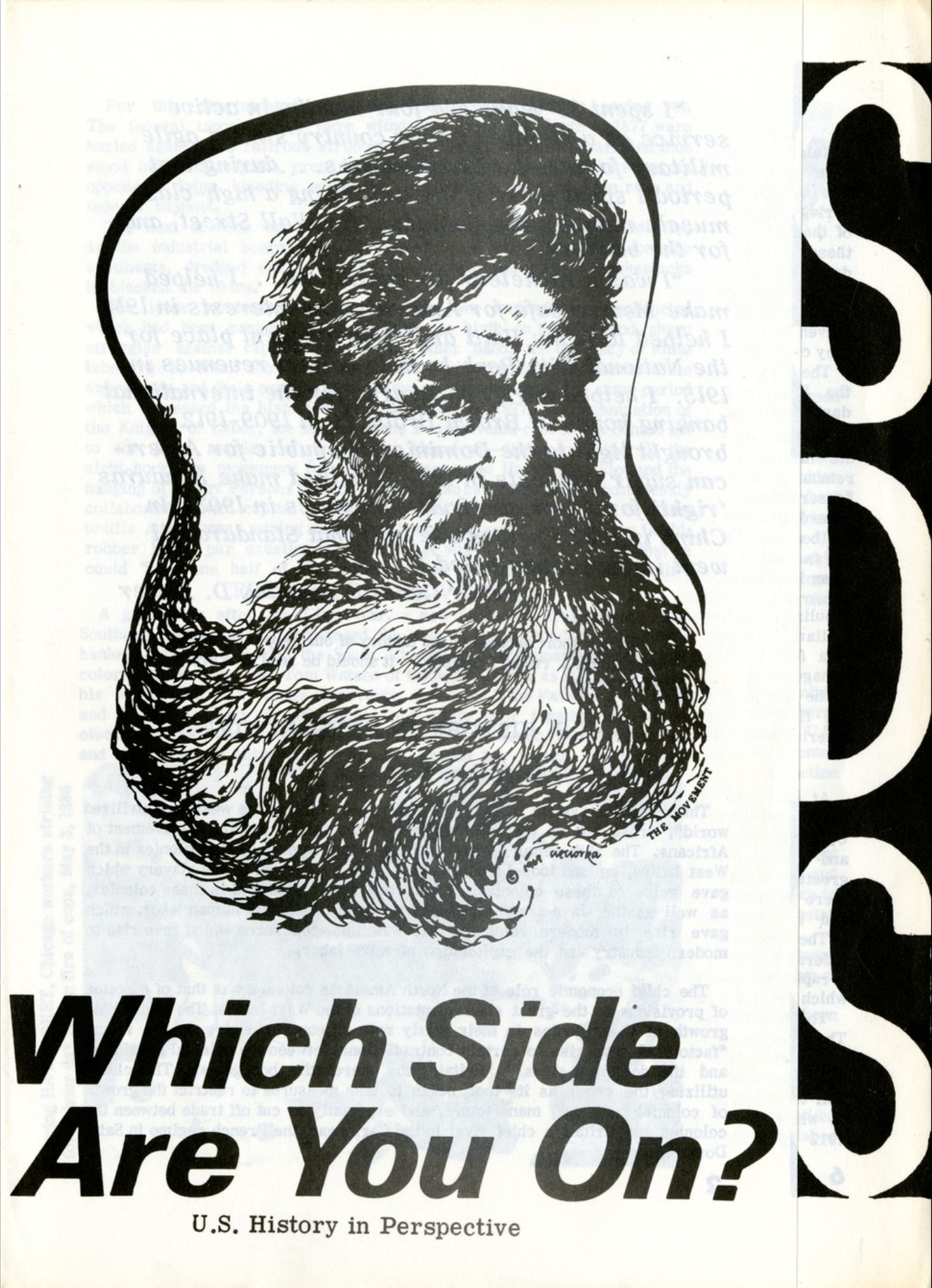
Cover of Which Side Are You On? by Noel Ignatiev, published by Students for a Democratic Society in Chicago, c. 1968.4
The Arab nation is living through a great and painful labor experience. This is because the military setback (naksa) that has befallen our nation was not an endpoint in itself. But it was the exorbitant price for standing up to the naked truth. And this truth is the solid ground on which we stand with our feet today, awaiting the moment of glorious birth.
Almost a year after the 1967 Naksa, Ahmed Morsi, born in Alexandria, sets out to write the editor's note for Galerie 68's first issue.5 The collective was started by Morsi and included writers like Ibrahim Mansour and Edwar al-Kharrat with the orbit including other literary countercultural figures like Sonallah Ibrahim. Galerie 68's last print was in 1971 and three years later, Morsi moves to New York City.6
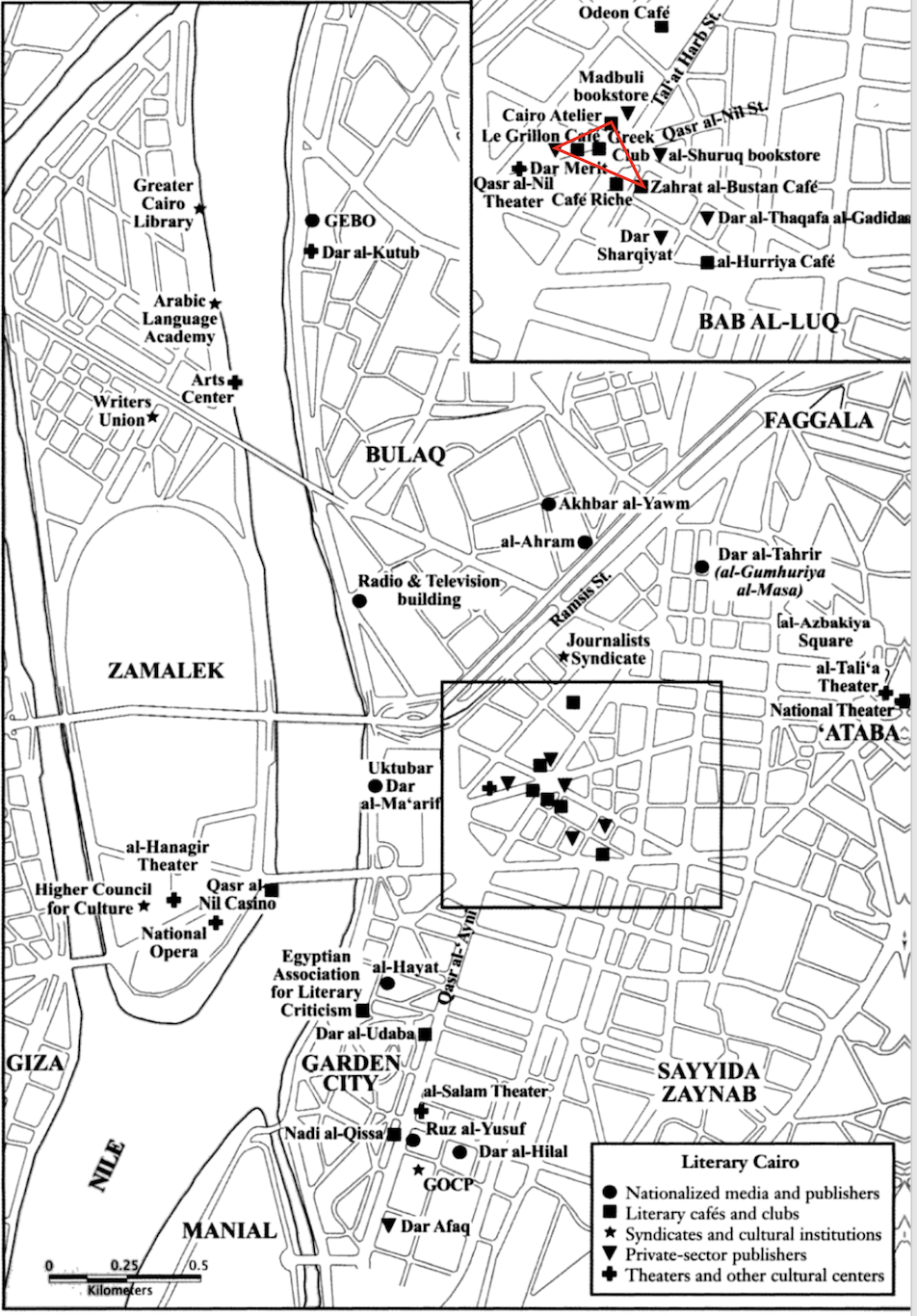
Richard Jacquemond maps out the "Triangle of Horror" denoted by Sonallah Ibrahim as the area formed by the Cairo Atelier, Le Grillon, and the Zahrat al-Bustan cafés in Conscience of the Nation: Writers, State, and Society in Modern Egypt (translated by David Tresilian), 2008, Cairo.7 Triangle overlaid.
From whichever direction the writer tries to penetrate this triangle, he or she will arrive in the midst of storms and burning flames that confer upon the area its well-deserved description of the Triangle of Horror. Further, it is armed by a broadcasting service that is stronger than CNN. Like CNN it has all-day coverage of the various literary and artistic battles, with their accompanying pacts, besides the daily news: that is, what even the opposition papers have not published with regard to the secrets of political events, the latest political scandals, the astonishing deals, and the dubious projects, all topped with the necessary dressing of marital betrayals and sexual relations.
Sonallah Ibrahim describes the Triangle of Horror in Cairo from Edge to Edge, 1998, Cairo.8
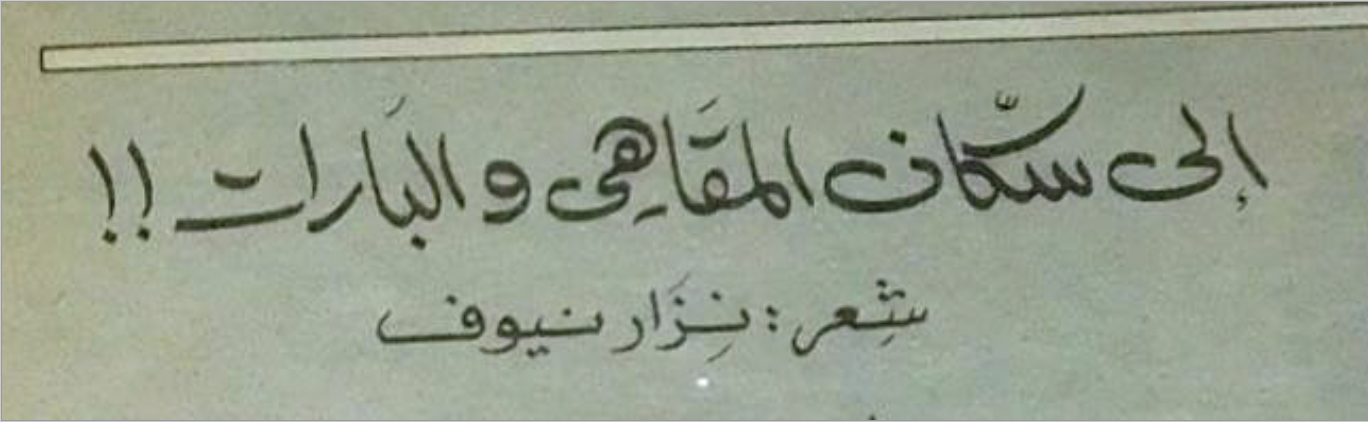
Poem titled "To the Residents of Cafés and Bars!!" by Syrian dissident Nizār Nayouf, Al-Hadaf, September 1980, Beirut.9
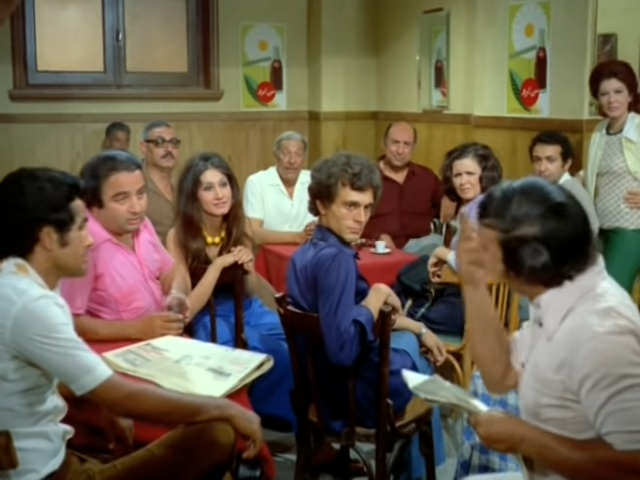
Depiction of 1960s gathering of dissidents in the film Al-Karnak (Ali Badrakhan, 1975) based on Naguib Mahfouz's novel by the same name, written in 1970 and published in 1974.
Poem From India
Homage to Vietnam
When you see your dear tiny tots,
Sleeping, the sleep of bliss!
When you in leisure hours
Sit among circle of friends
converse about this and about that,
inconsequential, interesting talk;
When the sound of your heart-beats
Is echoed back from that other heart
Like the finest music of this earth
And you feel that all the gates of Heaven
Are open,
And you are suddenly engulfed
in celestial effulgence;
Or again, when in peaceful surroundings,
You see men's effort and labour
transformed into green fields
and golden sheafs of swaying wheat,
Or in mills and factories
And in the laboratories — where till late hours of morning
work scientists, labour changed and made
Into objects and things;
Or when
the creations of poets and writers and artists
Fill your heart
with waves of colour and music and scent.
Then, in those hours
Think of that small land of Asia, Vietnam, also —
the land to which
From our own land of India,
went emissaries of the mendicant prince, the Buddha.
with the message of love, peace and compassion,
And where today
Accursed militarists’ feet
Poem by Sajjad Zaheer, born in Lucknow, British India, appearing in the October 1971 issue of Lotus (original language).10 Extensive research on the impact and circulation has been done by Rafeef Ziadeh and Sara Marzagora.11
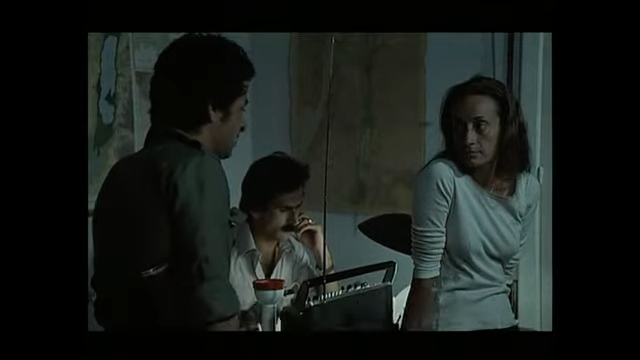
Still frame from the film Nahla (1979) by Algerian director Farouk Beloufa. The film's first public screening took place in Moscow in 1979. The film was effectively lost due to decades of censorship and limited distribution. It has recently seen a resurgence, including having its first public screening in the United States in September 2024 at Anthology Film Archives in New York City.
Leaders change, and individuals will pass away, but the cause remains greater than leaders and individuals. Everyone must dissolve into the revolution before it collapses, as it did in the recent past — along with the parts that are unworthy of survival.
Al-Nidāʾ (trans. The Call) was a monthly Arabic-language newspaper published in New York and New Jersey by the Arab Students Organization. The front headline of this May 1973 issue reads "Al-dōr al-Amriīki fi jarīmit Beirut" (trans. The American Role in the Beirut Crime). At the top of the front page, this quote by Kamal Nasser appears. He was assassinated the previous month during the attack on Beirut.12
1972
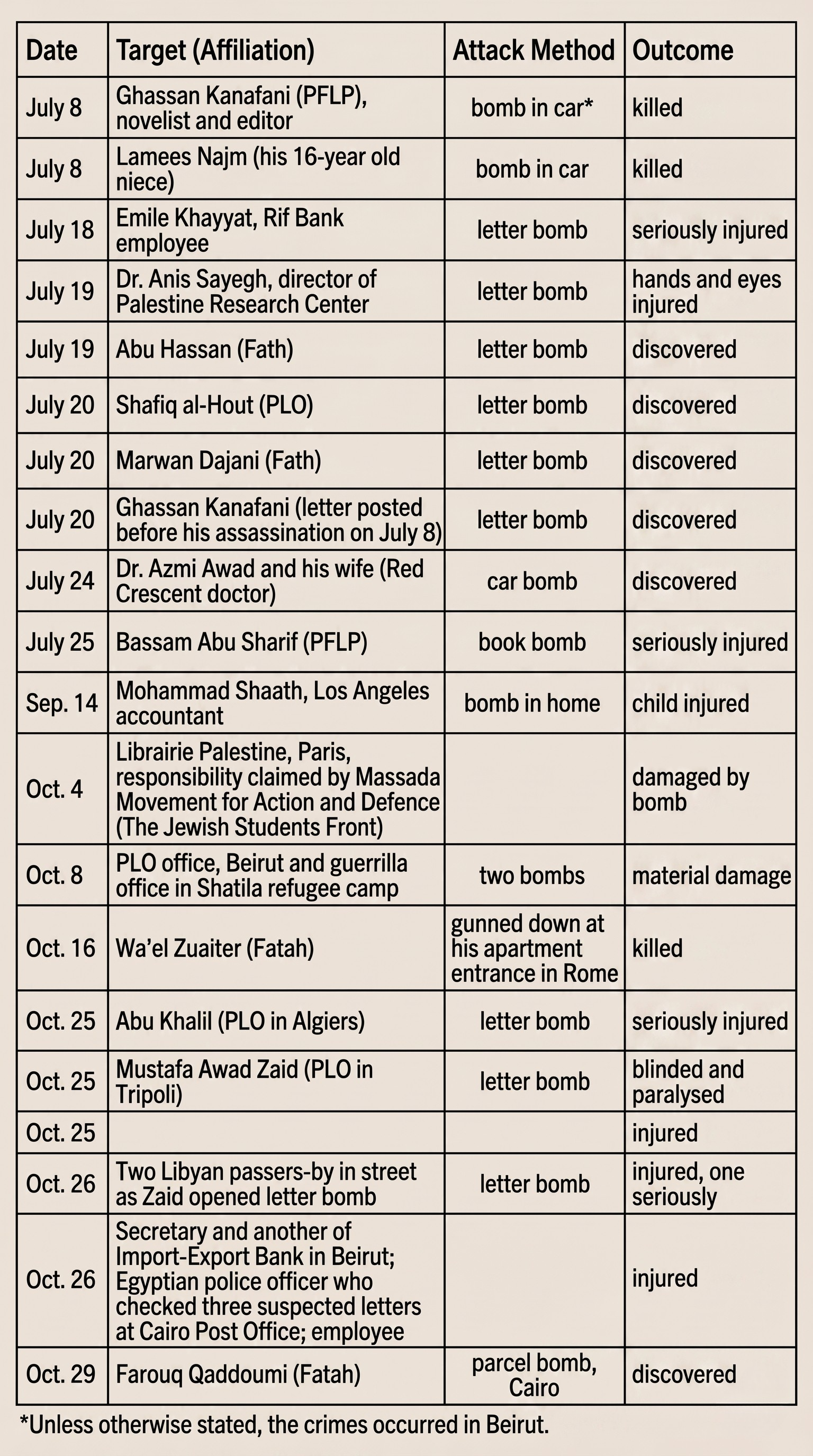
Arab Information Center, Israel's Silent War, October 1973, New York.13
A Call for Solidarity with the Palestinian Press in the Occupied Land
Regarding the recent Zionist measures against the Palestinian national press in the Occupied Land, represented in a series of harassments, the detention of workers, the prevention of newspaper distribution, and most recently, the closure of Al-Sherāʿ magazine and the arrest and interrogation of a number of its journalists, the Palestinian media workers in the factions of the Palestinian revolution issued a solidarity appeal, the text of which follows:
In recent days, the Israeli occupation authorities have moved to shut down Al-Sherāʿ magazine in the Occupied Land, revoke its license, and arrest a number of its journalists, in a step that constitutes a blatant challenge to the United Nations Charter and to all international norms. It is an expression of their persistence in taking every measure that ensures the liquidation of national platforms that contribute to exposing Israeli aggression and its policies of terror, expulsion, and colonial settlement, as well as attempts to manufacture a reactionary alternative to the Palestine Liberation Organization, the sole legitimate representative of the Palestinian people.
These unlawful measures also seek, moreover, to deprive the Palestinian people of the most basic means of defending their existence in the face of the fascist settlement onslaught that receives full support and endorsement from United States imperialism. They come as a continuation of the wars of aggressive invasion waged by Israel against our Palestinian people and the other Arab peoples in the region.
Call for international solidarity with Palestinian journalists after recent crackdown and closure of Al-Sherāʿ magazine in Jerusalem, Al-Hadaf, August 1983, Beirut.14
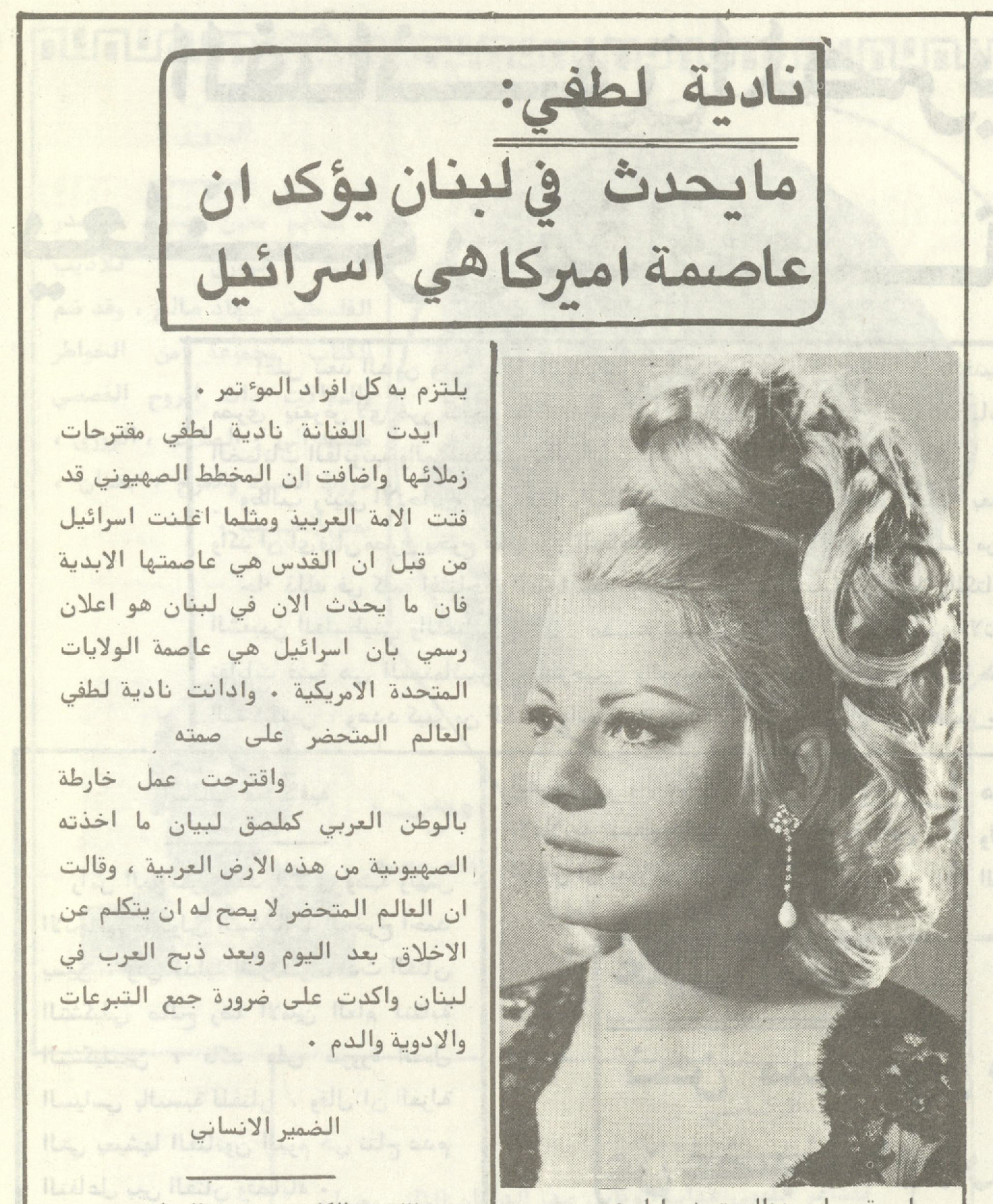
Egyptian actress Nadia Lotfy, "What is happening in Lebanon proves that the capital of America is Israel", Al-Sherāʿ magazine, September 1982, Jerusalem.15
The speed with which efforts have been made to complete the normalization of relations [with Israel] against the clear will of the Egyptian people, and against the will of the Arab nation and all the liberation forces in the world, can only be explained by one thing: the eagerness of American imperialism to begin, as quickly as possible, forming a military alliance between its two principal agents in the Middle East today, as compensation for the previous alliance between the Shah’s regime and Israel.
Excerpt from a statement by the Central Committee of the Egyptian Communist Party in al-Hadaf's March 1980 issue.16
Why? History has taught Big Oil that surpluses of oil and free-swinging competition mean lower prices and lower profits. But by agreeing among themselves to limit the amount of production, prices can be kept artificially high.
The big companies have an additional reason for limiting U.S. oil output. It is far more profitable to import foreign oil and gasoline. Production costs in the Middle East average 12 cents a barrel (42 gallons), twenty times cheaper than in the U.S.
Refineries, too, are cheaper to build and operate overseas, because wages and taxes are lower and they can operate without expensive pollution controls.
The "Energy Crisis" and the REAL Cri$i$ Behind It!, United Front Press, San Francisco, 1974 (original language).17
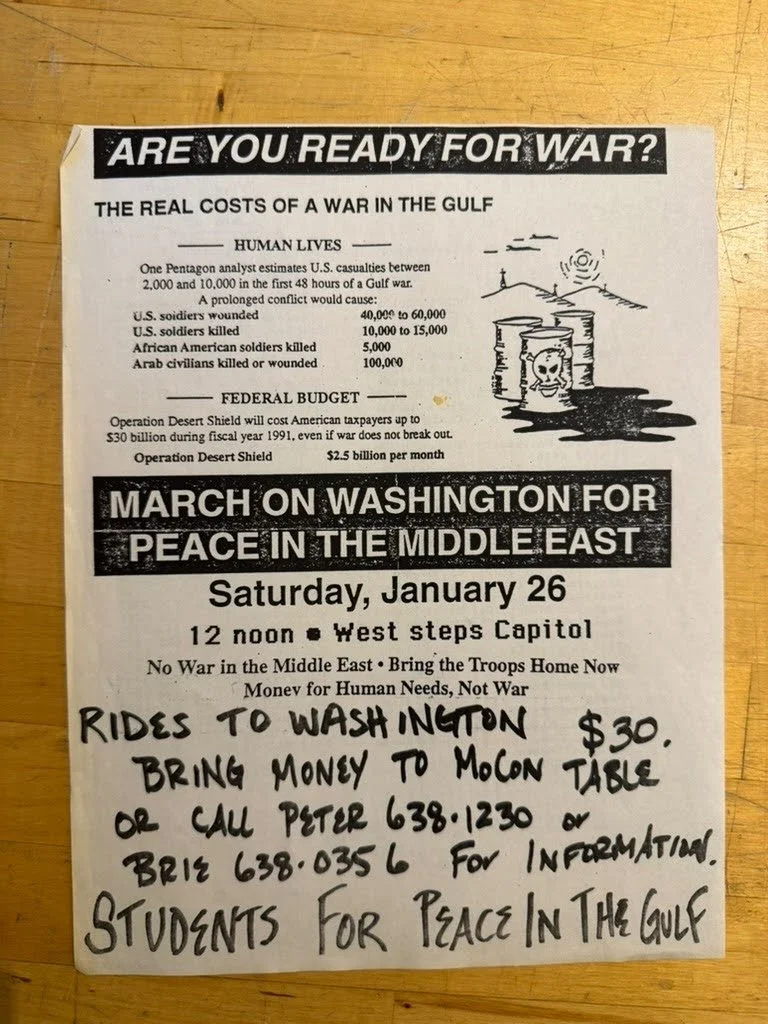
Handout found at Interference Archive in Brooklyn: A call for a march on Washington from January 26, 1991 overlaid with an offer for rides from New York during the Gulf War and 9 days after US-led aerial and naval bombardment began.
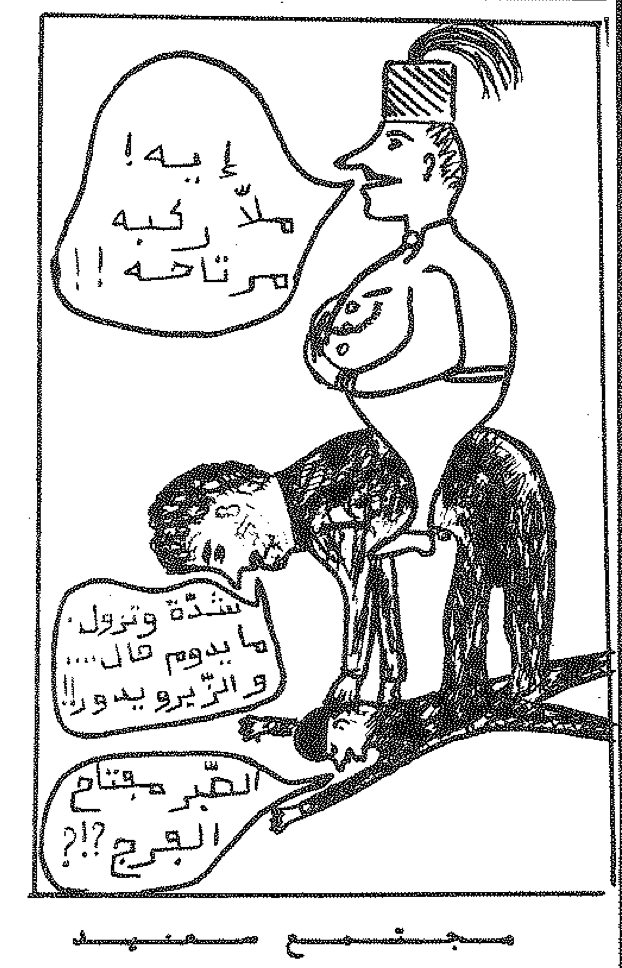
Uncredited comic from the February 1971 issue of Al-ʿāmil al-tūnsī (trans. The Tunisian Worker). After the Israeli invasion of Beirut in 1982, cultural publications such as Lotus (which had already relocated from Cairo to Beirut in the late 1970s around Sadat's signing of the peace treaty with Israel) as well as PLO-related periodicals relocated to Tunis.18
Nassar Abdallah, Galerie 68, February 1969, Cairo.19
A Passage from the Memoirs of an Old Fighter
I learned not to read my fate until the concealed descended
upon the roads of my besieged city.
Then I take off my tattered garment,
I draw my tainted sword,
fueled by an appetite for battle and adventure.
Then I read my revealed fate,
I reject the concealed,
and I begin the dialogue.
This is the fate of the Arab writer. He (she) cannot ignore what is happening around him (her), or pretend not to see the humiliation of the nation from the ocean to the gulf, the oppression and corruption, the Israeli flagrancy and the American Occupation, and the shameful collusion of Arab regimes and governments in all that is happening.
At this very moment, as we are gathering here, Israeli forces are raiding what is left of Palestinian land, killing pregnant women and children and rendering thousands homeless, thereby implementing, with an obviously accurate methodology, a plan of genocide against the Palestinian people and forcing it out of its country. Arab capitals, however, open their arms to receive Israeli leaders. A few steps away from here lives the Israeli ambassador in full security, and another few steps away, the American Ambassador is occupying a whole district while his soldiers are in each and every corner of a homeland that was once Arab.
I have no doubt that every Egyptian here realizes the extent of the disaster that has befallen our nation. The matter is not only restricted to the actual Israeli military threat to our eastern borders, nor to the American dictates and the apparent helplessness in our government’s external policy, but extends to all aspects of our lives.
We no longer have any theater, cinema, scientific research, or education. We only have festivals, conferences, and a parcel full of lies. We no longer have any industry, agriculture, health, or justice. Corruption and plundering are widespread, and any protester is faced with humiliation, beating, and torture. The exploitative minority has deprived us of our souls. The reality is frightening. And within that reality, a writer cannot pretend not to see or keep silent or give up on his (her) responsibility.
I shall not ask you to issue a statement of protest or condemnation. This is no longer useful. I shall not ask you to do anything, for you know better than me what should be done.
All I can do is to once again thank my honorable teachers who have honored me by choosing me for this award. I declare my apologies for not accepting it, since it is given by a government that does not have the credibility to award it.
Thank you.
*Unless otherwise noted, all translations were carried out by the author.
It's October 2003. Sonallah Ibrahim is awarded the Cairo Arab Creative Writing Forum Award granted by Egypt's Supreme Council of Culture. Sonallah gives this rejection speech, which appears a few weeks later transcribed and translated to English in As'ad AbuKhalil's blog Angry Arab News. He notes that the transcript was provided by someone named Bassem. The text is included as is with some minor copyediting.20
1 al-Afghānī, Jamāl al-Dīn, and ʿAbduh, Muhammad. al-ʿUrwa al-wuthqa. Paris, 1884.
2 Antūn, Farah. "Al-Sharq wa-l-Gharb: Al-Dawāʾ al-Khāriji". al-Jāmiʿa al-ʿUthmāniyya. No. 1. Alexandria, March 1899.
3 ʿAdwān, Mamdouh. "al-Hiwār al-nuqta". al-Hadaf. Beirut, August 1983.
4 Ignatiev, Noel. Which Side Are You On? Students for a Democratic Society: Chicago, c. 1968.
5 Morsi, Ahmed. Galerie 68. No. 1 (editor's note). Cairo, June 1968.
6 Halim, Hala and Morsi, Ahmed. "Intermediality and Cultural Journalism" (interview). Alif: Journal of Comparative Poetics, no. 37. 2017. 288–312.
7 Jacquemond, Richard. Conscience of the Nation: Writers, State, and Society in Modern Egypt. Translated from French by David Tresilian. Cairo and New York: The American University in Cairo Press, 2008.
8 Ibrahim, Sonallah, and Ribière, Jean Pierre. Cairo from Edge to Edge. Cairo: American University in Cairo Press, 1998.
9 Nayouf, Nizār. "Ila sukān al-maqāhi wa-l-bārāt". al-Hadaf. Beirut, September 1980.
10 Zaheer, Sajjad. "Homage to Vietnam". Lotus, Cairo, October 1971.
11 Ziadeh, Rafeef and Marzagora, Sara. "Teaching Lotus". Revolutionary Papers. September 2023. https://revolutionarypapers.org/teaching-tool/teaching-lotus/
12 Nasser, Kamal. Al-Nidāʾ (header, newspaper). New York and New Jersey, May 1973.
13 Israel's Silent War (pamphlet). Arab Information Center: New York, October 1973.
14 Nidāʾ tadāmunī maʿ al-ṣaḥāfa al-filasṭīnīya fī al-arḍ al-muḥtalla. al-Hadaf. Beirut, August 1983.
15 Al-Sherāʿ. Al-Sharq Al-Arabiya Press: Jerusalem, September 1982.
16 "Sanunādil bi kāfat al-asliḥa l-iskāt al-niẓām al-khāʾin". al-Hadaf. Beirut, March 1980.
17 The "Energy Crisis" and the REAL Cri$i$ Behind It! United Front Press: San Francisco, 1974.
18 Al-ʿāmil al-tūnsī. No. 9. Tunis, February 1971.
19 Abdallah, Nassar. Galerie 68. Cairo, February 1969.
20 Ibrahim, Sonallah. "Rejection Speech, Cairo Arab Creative Writing Forum Award." October 2003. English transcript published on Angry Arab News (blog), posted by As'ad AbuKhalil, 2003. https://angryarab.blogspot.com/2003/10/
About the Writer
Ahmed Morsi works across architecture, exhibitions, writing, publishing, and video. He orbits real estate development, preservation, dissident cultural production, and the arts infrastructures that mediate between them. In 2021, he co-founded Dataland Publications in Cairo, through which he has commissioned and edited material on underutilized buildings — questioning the terms on which buildings are deemed worth preserving, and what they get turned into. He completed a graduate degree in architectural history and preservation, followed by postgraduate curatorial studies at Zurich University of the Arts (ZHdK) and a fellowship at Fondazione Prada in Milan, where he went on to join the curatorial team for a year. He keeps ties to Cairo and New York.