Even My Colours Are Rebellious: On Translating Inji Efflatoun
Word by Avery Gonzales & Ahmed Gobba
In a cramped lecture hall at Yale University in the Spring of 2019, Sultan Sooud Al-Qassemi, one of the leading scholars and patrons of modern Arab art, blazed through his lecture slides for The Politics of Middle Eastern Art. When he reached Inji Efflatoun, he reached into his bag and raised his Arabic-language copy of The Memoir of Inji Efflatoun:From Childhood to Prison, saying, “Somebody needs to translate this!” Ahmed Gobba and I accepted the challenge, translating her Memoir from 2020-2022 with the support of Barjeel Art Foundation. That seminar marked the beginning of a multi-year project with an artist whose life was more complex than her reputation would suggest.

Self-portrait, 1958, oil on canvas, 71.7 × 50.5 cm. Image courtesy of Mathaf: Arab Museum of Modern Art, Doha. Photograph: Naifa Hamad Almarri.
Inji Efflatoun (b. 1924 - d. 1989) was an Egyptian activist and Surrealist artist who reached adulthood at a pivotal time in Egypt’s political history. Her life was marked by a four-year stint as a political prisoner under Gamal Abdel Nasser, and she is widely known for the art she created during and after her imprisonment. However, her Memoir emphasizes the importance of her political involvement, challenging the narrative that political activism was merely an incidental fact about her artistic career. As a feminist, socialist activist from an aristocratic, Francophone background, she held significant tension between her convictions and her social status. Nevertheless, she dutifully led national political organizations during a critical period of Egyptian history encompassing the overthrow of the monarchy, the Suez crisis, and waves of political arrests. She became a spokeswoman for Egypt on the international stage, crossing paths with the Mexican muralist David Alfaro Siqueiros, future Indian Prime Minister Indira Gandhi, Angela Davis, and many other notable personalities.
Ahmed and I reveled in the spontaneity and nuance of her life story, gaining a deep appreciation for her ethos that underpinned both her politics and art. It is impossible to read about the past without reflecting on the present, and Efflatoun’s life story presents a refreshing model of activism for our own changing times. In this essay for Daftar, we want to share what we learned from our time immersed in The Memoir of Inji Efflatoun.
Rebellion
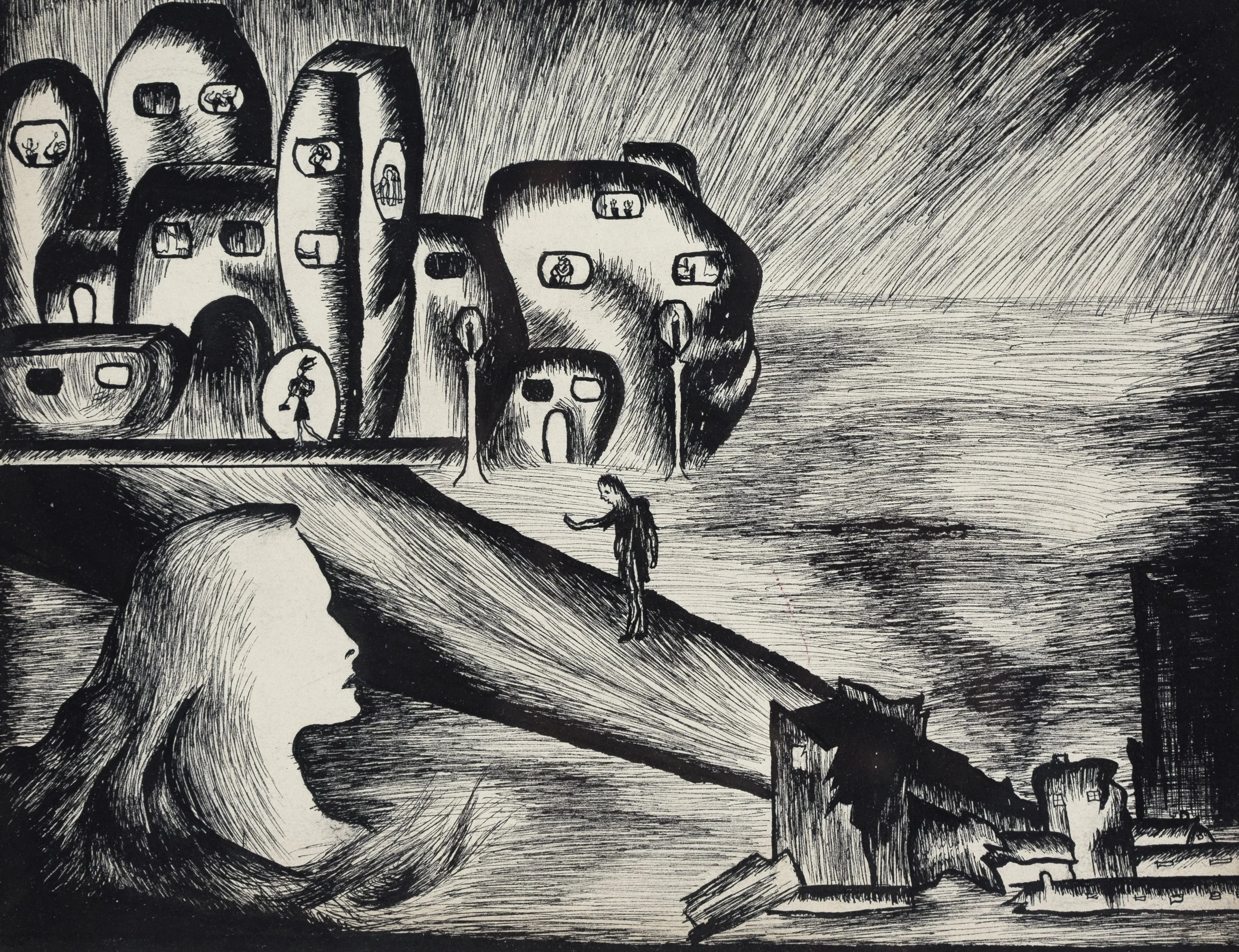
Contemplation, c. 1940s. Ink on paper, 18.5 × 24.2 cm. Collection of Barjeel Art Foundation, Sharjah.
During Efflatoun’s fourth year at the Collège du Sacré-Cœur, the Mother Superior summoned her mother, Salha, to report on her daughter’s misbehavior, such as hiding and reading forbidden novels like Jack London’s White Fang. As the meeting concluded, the nun leaned in and whispered to Salha, “This daughter of yours is possessed by the devil. I’m warning you, she could become a risk to society!” For the young Efflatoun, the strict boarding school was a microcosm of the broader society’s injustices. She despised the difference in treatment between Christian and Muslim students, but she was even more struck by the class hierarchy separating the aristocratic “Mother” nuns from the toiling “Sister” nuns. In her Memoir, she identifies this period as the birth of her class consciousness, writing, “The school, therefore, had the same unfair system as greater society outside... I realized for the first time, at the ripe age of 11, that rebellion was imperative to resist the injustice.”
Salha Efflatoun herself was a formidable model of independence. A divorcee at 19 years old, she defied social convention by raising her daughters alone and establishing Salha, a successful haute couture boutique that catered to Cairo’s elite (and possibly even royalty). As Inji Efflatoun matured, her awareness of injustice expanded beyond gender norms to the oppressive political conditions in Egypt. She stepped into leadership roles at a time when established groups like the Egyptian Feminist Union had, in her view, retreated into “salon activism” and charity work.
Efflatoun’s most ardent campaigns, including the fight for women’s suffrage, the toppling of the monarchy, and the nationalization of the Suez Canal, were driven by her refusal to accept oppression. Her childhood propensity to speak and act against injustice matured into a lifelong, disciplined commitment to changing Egyptian society. Her distinctive choice of artistic styles and subjects reflected her belief in social progress. In 1988, near the end of her life, she wrote, “I am a rebel. Even my colours are rebellious.”
The Privilege of Defection

The Prisoners, 1957, oil on canvas, 29 × 42 cm. Collection of Barjeel Art Foundation, Sharjah.
The Efflatoun family descended from the land-owning, aristocratic effendi class. While Salha Efflatoun defied societal norms as a self-employed divorcee, Inji’s own rebellion involved a more extensive reckoning. She struggled with a paralyzing “class complex,” embarrassed by her mother’s luxury fashion boutique and her own broken Arabic. It was not until her husband, Hamdi, reframed her background that she felt emboldened to fully commit herself to the pursuit of socialist organizing. He assured her that an aristocrat defecting to the people’s movement was a “significant victory” for the revolution, rather than an unwelcome intrusion.
This reframing helped solidify her life trajectory. She stopped apologizing for her status and redoubled her efforts to organize and lead. Her career is extraordinary not just because she embraced socialist visions, but because she had the courage to use her privilege to be a more effective movement activist. She gradually disentangled herself from the trappings of her lifestyle and gained confidence in her convictions, eventually becoming a “risk to society” in the eyes of the state.


Inji Efflatoun (in plaid skirt) leading an anti-British, women-only march in November 1951. Image courtesy of the ArtTalks Archive, Cairo.
Efflatoun treated privilege not as a passive asset, but as a valuable strategic resource. In one memorable incident in 1946, she arrived at a large political gathering (under the guise of a tea party) at the Lycée school to find the police had preemptively blockaded the road, declaring the event unauthorized. While hundreds of women waited, Efflatoun rushed to the Ministry of Foreign Affairs to ask a favor of the unknowing office director. She secured written permission, returned to the school, and held the permit over her head. The police had no choice but to stand aside.
Political Maturity

Worker (or Carrier of Bricks), 1950. Oil on wood, 89.2 × 35 cm. Courtesy of Ramzi and Saeda Dalloul Art Foundation (DAF), Beirut.
Inji Efflatoun’s longevity as an activist was largely due to her willingness to continuously re-evaluate her stances and alliances. Operating in a volatile political climate, her tactful approach gave her the flexibility to collaborate across political lines with Wafdists, liberals, and communists and speak for the Egyptian cause on the international stage.
She gained such autonomy by challenging the prevailing decorum for feminist groups, advocating for a platform that included working-class women rather than just the elite. This led her to establish the League of University and Institutes’ Young Women in 1945. While she was working as a teacher at the Lycée, she successfully mobilized a new generation of university students to challenge the stagnation of older organizations like the Egyptian Feminist Union. When nationalist sentiment surged, the League gained momentum by organizing protest chants and marches—a role largely neglected by established feminist organizations. Through these efforts, she emerged as a leader and bridge between feminist circles and the nationalist and labor movements.
Perhaps the most striking example of her political maturity was her perspective on Gamal Abdel Nasser. Despite his regime imprisoning her for over four years and subjecting her family to significant hardship, she refused to let personal bitterness distort her political judgement. In her later years, she spoke of him with grace, stating, “Nasser, although he put me in prison, was a great patriot.” She recognized that their shared battle against imperialism outweighed her personal suffering. Against the backdrop of our modern political atmosphere, this degree of unwavering solidarity is remarkable.
Art as Politics

Worker (or Carrier of Bricks), 1950. Oil on wood, 89.2 × 35 cm. Courtesy of Ramzi and Saeda Dalloul Art Foundation (DAF), Beirut..jpg
Efflatoun’s artistic practice was one constant in her life, evolving in stride with her political consciousness. Under the tutelage of her mentor, Kamel El-Telmisany, she learned early on that “painting is nothing more than an honest expression of society and self.” While her early surrealist works expressed a personal rebellion against her bourgeois upbringing, her style later shifted toward a social realism aimed at capturing the “real Egypt.” She rejected the traditional subjects of fine art, instead traveling deep into the countryside to paint the fellaheen (agrarian workers), endeavoring to capture on the canvas their movement and dignity.
For Efflatoun, art was never a passive observation, but a potent form of commentary and even a weapon. Her 1951 painting We Shall Not Forget, depicting the funeral for martyrs killed by British forces, was so resonant that university students turned it into a protest poster, leading to the confiscation of the original work by state security (and it has still not resurfaced). Even imprisonment could not stifle her expression. She fought for the right to paint while in El-Qanater prison, documenting the harrowing reality of her fellow inmates and convincing guards to smuggle canvases to her family.

Lan Nansa (We Shall Not Forget), 1951. Image courtesy of Hassan Mahmoud Galal el-Din

Photograph of anti-British march for the funeral of Suez Canal martyrs, 1951. Image courtesy of ArtTalks Archive, Cairo.
In her later years, Efflatoun’s style transformed again into her “White Light” period. Emerging from the despairing prison atmosphere, she painted landscapes where the negative space of the canvas shone through rhythmic brushstrokes, symbolizing a reclamation of freedom and light.
Conclusion
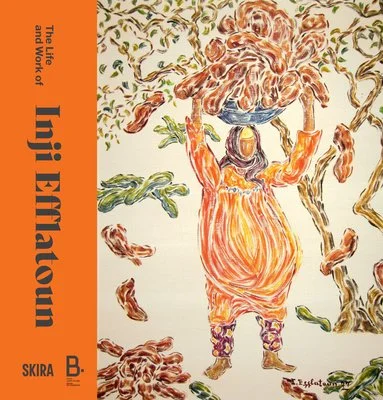
Since the 2019 seminar that set us on the path to translating Efflatoun’s Memoir, global interest in her art and life has only increased. Her Memoir is now available for the first time in English in the edited volume, The Life and Work of Inji Efflatoun, edited by Sultan Sooud Al-Qassemi and Suheyla Takesh. We submit that the surge in attention is perhaps just as much about our present-day search for agency in an unstable world as it is about historical interest in 1950s Egypt.
Ahmed and I spent much of 2020 through 2022 navigating this text. Working closely with Efflatoun’s words inspired us to think about our specific roles at this moment in history. How are we serving the communities in which we live? What historical changes are taking place in our neighborhoods, cities, and global society? Ultimately, Efflatoun’s life dissolved the boundary between art and activism, leaving behind a legacy that exemplifies creativity in service of social change. Her story invites us to look beyond our immediate circumstances and ask how we, too, might have more agency than we think.

Portrait of a Prisoner, 1960. Oil on canvas, 41 × 28 cm. Collection of Mathaf Arab Museum of Modern Art, Doha. Photograph Naifa Hamad Almarri.

Motherhood, c. 1950s, oil on wood, 75 × 47 cm. Collection of Barjeel Art Foundation, Sharjah.
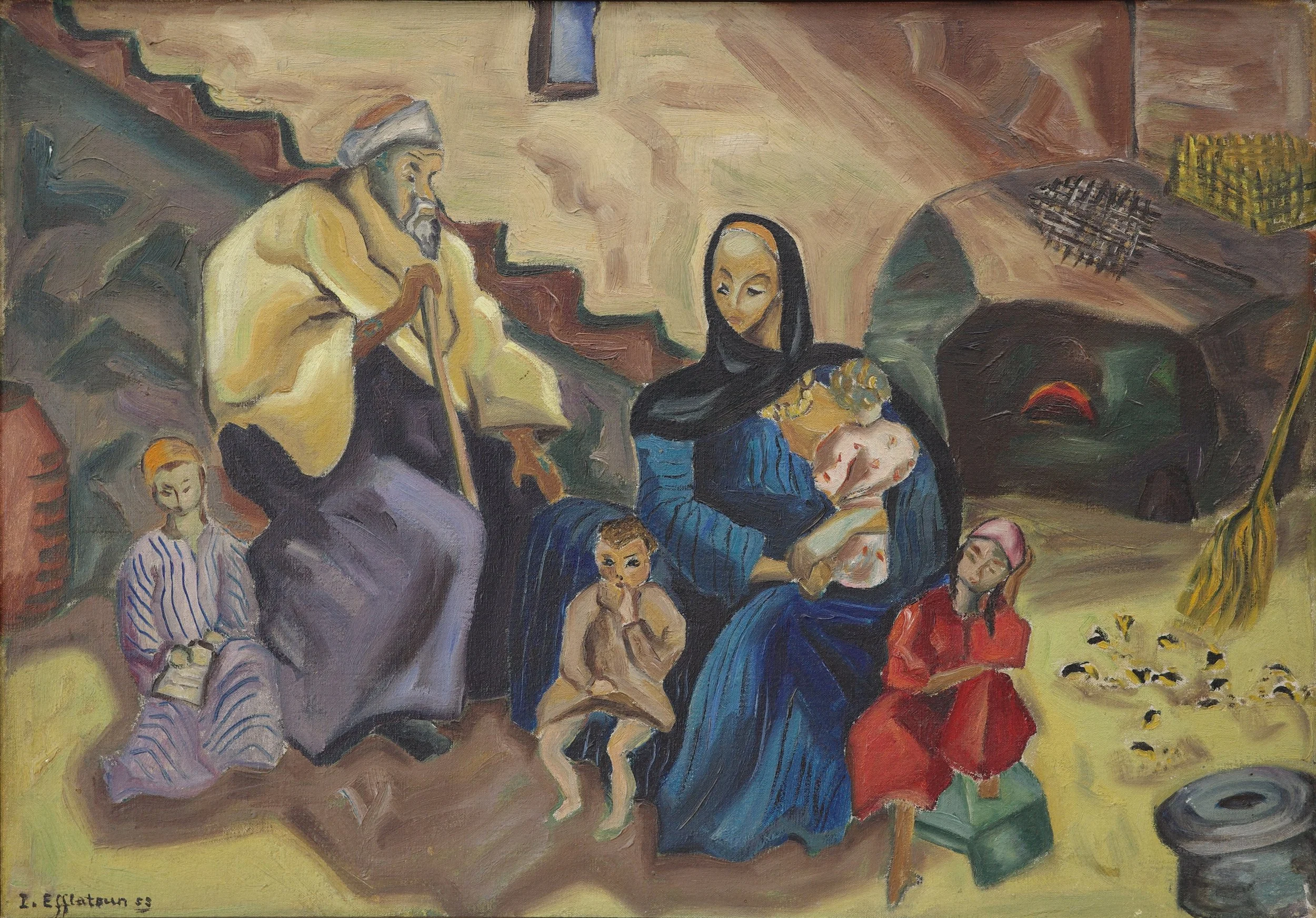
Fourth Wife, 1952, oil on canvas, 40 × 56 cm. Collection of Barjeel Art Foundation, Sharjah.

Ezba (Farm), 1953, oil on board, 47 × 63 cm. Collection of Barjeel Art Foundation, Sharjah.
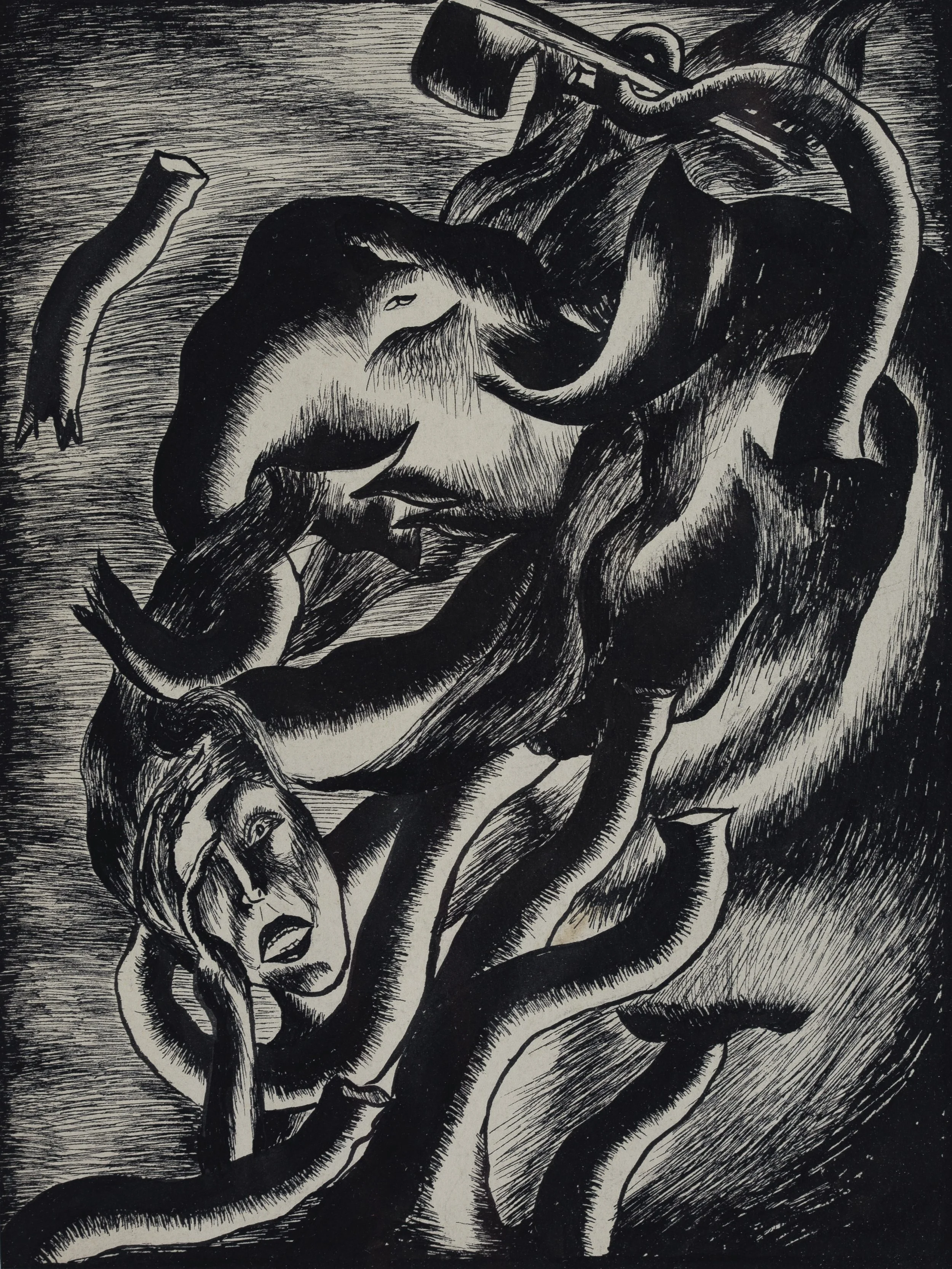
Study, c. 1940s. Ink on paper, 21 × 15.5 cm. Collection of Barjeel Art Foundation, Sharjah.
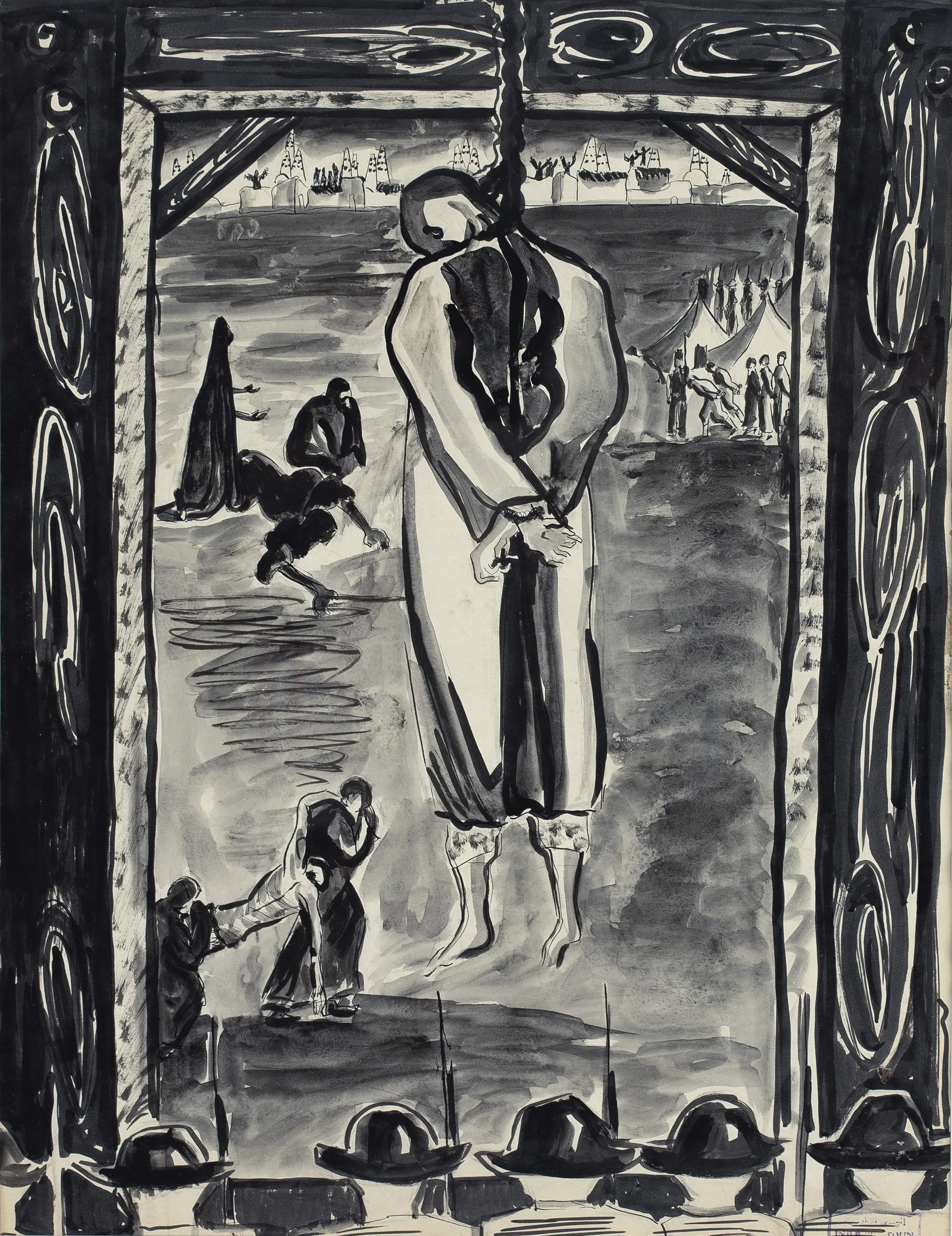
Dinshaway Massacre, c. 1950s. Ink on paper, 63.5 × 49.3 cm. Collection of Barjeel Art Foundation, Sharjah.
Avery Gonzales is a Sociology PhD at UCLA, translator and community-builder based in Los Angeles, California. He has lived in Beirut and Amman, and he previously worked at the Getty Research Institute in California.
Ahmed Gobba is a development finance professional, translator, and Arab art enthusiast whose career has taken him from his native Egypt through Oman and Singapore to his current home in Rabat, Morocco.