Muthaffar al-Nawab: Poetry, Exile, and the Voice of the Arab Working Class
Words by Abdullah Al Tekreeti
The sun is just about to set on Baghdad’s literary and cultural center, Al-Mutannabi Street. As the day’s book sales and ceaseless oud tunes quiet down, a few moments are spared for clandestine wares. Hushed voices and quiet hands exchange several dinars and an unassuming cassette tape. In a day or two, the tape’s contents will be uploaded to online video-sharing sites, and a foul-mouthed revolutionary poet’s words will once more be recited to the masses.
The Reluctant Aristocrat’s Early Years
Born in 1934 to a family of aristocrats, Muthaffar Abdul Majid Al-Nawwab1 life began with a divine stroke of foreshadowing; his first moments spent in a struggle against his own lungs' inability that he just barely won.2 The eldest of seven, his early years were spent pursuing the fine arts in a lavish dwelling on the banks of the Tigris. The high-born family prized not only the arts, but education, and so his birth year was forged to dictate 1932, allowing Muthaffar to enter school a few years earlier.
Younger than his peers, he was a frequent target for local bullies, who picked on him due to his short stature and meekness. Unfortunately, his father’s unwillingness, or perhaps inability, to work, coupled with rising expenses and an increasing number of dependents, forced them into years of hardships. Soon, the splendid riverview house was sold alongside his mother Wajiba’s valuables, and his father was forced into labor. Muthaffar’s afternoons across the Tigris were gone as the family moved into an aunt’s house further inland in a rough neighborhood. Still, his talent for literature shone despite the harsh circumstances thrust upon him. His poetic talent was first recognized by his teachers as early as the third grade. No later than middle school did his verses grace the pages of student magazines.

Muthaffar Al-Nawwab pictured as part of a s ... Fekaiki. Courtesy of Betool El Fekaiki
The Student & the Communist/The Red Student
At 17 years old, Muthaffar enrolled at the College of Arts to study Arabic literature.3 His enrollment was likely facilitated by broad state funding, as he had to make the hour-and-a-half trip to the campus on foot due to his inability to pay the cab fare. Though financially struggling, Muthaffar's tenacious college years would prove the ultimate foundation for the rest of his years.
It was there that he had his first taste of proper organization in leading an informal coalition of students to petition the university to convert a public utility building on campus grounds into an art atelier. In fact, it was there that his little-appreciated painting talent was recognized by another of Iraq's iconic artists, Hafidh Al-Droubi.4 Somewhere between his love for the arts, university classes, and a rough upbringing among Baghdad's downtrodden, Muthaffar found himself within the ranks of the Iraqi Communist Party (ICP). Nothing is known about his initiation, as the ICP went to great lengths to maintain its veil of secrecy between regional offices and the main Politburo that made the final decision regarding members; still, his membership would mold the rest of his life.
The “Southern” Poet
Though a Baghdadi, after graduating in 1955, Muthaffar would take a post as a middle school teacher in Southern Iraq.5 Barely a year in, his stint as a teacher was cut short due to his "political activity," undoubtedly linked to the ICP. The next three years proved to be particularly difficult. He was unable to secure gainful employment, only finding a job after the 1958 revolution overthrew the British-backed Hashemite monarchy.
His unemployment years were nonetheless crucial in the creation of Muthaffar’s canon. In a fateful 1956 railway trip from the South to Baghdad, he struck gold. Following a conversation with a sullen southern woman who spun him a tale of forbidden love between her and a suitor of another tribe, Muthaffar wrote Li L Rayl Wa Hamad, “For the Rail and Hamad.” The poem, written in the Southern dialect, tells of her taboo love and rage against backwards tribal norms.
Li L Rayl Wa Hamad itself acquired a certain taboo nature. Despite being in Muthaqaf magazine and later being immortalized with a musical rendition by Yas Khidr, its colloquial language was at direct odds with the elites that hoarded high literary culture in Iraq.6
In another episode in the late 1950s, Muthaffar joined protests that erupted following the murder of the prominent communist organizer Sahib Mulla Khassaf, who was ambushed and killed during civil unrest.7 Amidst the bedlam of the following protests, Muthaffar debuted a mournful poem that lamented his fallen comrade, titled Madhayef Hail, or Cardamom Guesthouses, told from the view of his widow.8 Once more, Muthaffar's prose spoke of love and revolt of the working class hand in hand, while further cementing his love for the Southern dialect.

Muthaffar Al Nawab pictured alongside fellow inmates at Nugrat Salman prison C. 1967. Image courtesy of Dr Ibrahim Al Allaf
Most importantly, these years affirmed Muthaffar’s unique style of poetry. Years earlier, poets Badr Shakr Al Sayyab and Nazik Al Malaika broke the chains of classical Arab poetry and introduced free verse. Uncontent, Muthaffar went even further. He utilized traditional Southern Iraqi poetic meters and fused them with colloquial, often vulgar, language. Though his snobbish critics loathed his style, he, knowingly or otherwise, tapped into an ancient form of Arabic poetry, Zajal. This Andalusian style of poetry covered many themes, from love and intoxicated infatuation to the critique of one’s enemies, and Muthaffar had cast in it a new life in Iraq’s marshes. Ever the rebel, Muthaffar’s tendencies bled into his poetry. He refused to be merely an inheritor of a single tradition, rather blending and struggling with multiple. If the monarchy and the fragile republic that was born out of its ashes produced a poet of the everyman and forbidden love, Iraq’s rotating cadre of rulers would likewise birth a foul-mouthed Pan-Arab critic who forged his own path.

Muthaffar Al-Nawwab pictured alongside Iraqi musician and folk singer Sa'di Al Hadethi. Circa 1990-1995. Courtesy of Betool El Fekaiki. Courtesy of Betool El Fekaiki
Poet on the Run
Unfortunately for Muthaffar, his ties to the ICP would once again land him in hot water. Just before the 1963 Ba’thist revolution, a conflict broke out between the communists and the nationalists in the government, with the latter gaining the upper hand. Against this backdrop, the poet attempted to flee to the Soviet Union first through the Basra-Iran route. Though he made it to Iran, he was arrested by the Savak, Iran’s secret police, and given over to Iraqi custody. Following torture and a sham trial, he was sentenced to death, with his sentence then lessened to life in prison after his family and friends petitioned the court.
His time behind bars,9 however, would prove short as he would escape in 1967 by using kitchen knives to dig under the prison's10 double walls into a nearby garage. The escaped convict then fled to the familiar safety of the Southern marshlands, where he was aided by communist sympathizers. There, his love for the dialect and its surrounding culture deepened in hiding, where he continued to write and perform his poems. During his time in hiding, the cassette tape had entered Iraq's political, musical, and poetic scenes. Attempting to lay low away from government eyes, Muthaffar could not perform his poems the way he liked, and condemning them to life on the page was far too grave a sin for him. Instead, his words were cast out and wide with the humble cassette tape.11 Deep within the marshlands, Muthaffar could only reach the outside world through the cassette. Fortunately for him, the medium's affordability, anonymity and ease of access12 had been a perfect fit for his everyman poetry. However, this artistic freedom of exile would not go on for too long. A blanket pardon roughly eight months later brought Muthaffar back to Baghdad and briefly back to teaching, but freedom under a hostile government proved fragile. He was arrested once more on unspecified grounds, and by 1968, Iraq was no longer safe for him at all.
The Final Exile
Just before his permanent 1968 exit from Iraq, Muthaffar had been part of a large movement of Arab poets who were heavily affected by the Palestinian Naksa.13 In fact, the great demarcation of his poetry post-1967 is the usage of Fusha Arabic instead of colloquial Iraqi. This was a conscious choice he made to further his audience, stating, "In colloquial poetry I talk about the Iraqi situation, the farmers' cause, for example. The colloquial is more direct, more melancholic. In fuṣḥā-poems I deal with the Arab cause in a more comprehensive way […] Colloquial is more capable of mobilizing people than fuṣḥā."14
His poetry, agitating as it was for the Arab cause and for the Iraqi working class, his ICP allegiance had made him a prime target for the new regime. The same year he had earned his freedom, Muthaffar would find himself across a young Saddam Hussein.15 The poet recounted the meeting, saying that Saddam was eloquent and that they discussed a great number of matters. Most importantly, Muthaffar had refused to align himself with the new government and instead resigned to continue to write and paint independently. By the end of their meeting, Saddam gifted Muthaffar a small pistol as a gesture of goodwill, and even accepted the poet's request to not be driven back home with a government car, out of fear that people would assume he was "bought." Of course, this conclusion only ended so amicably with the understanding that Muthaffar would, once more, be exiled.
The next few years created the exiled revolutionary poet's persona that Muthaffar is known for. Unable to reside in Iraq, he travelled extensively between Beirut, Damascus, Eritrea, Libya,16 Europe, and the United Kingdom.17 Around the time of this exile, Muthaffar wrote and performed his most famous poem, "Jerusalem is the Bride of Your Arabism," in which he criticized Arab leaders for their inaction as Palestine was sacked by the Israeli occupation. Despite being effectively banned from his home, Muthaffar pulled no punches when it came to his politics. Where his dialect work and vulgar language had drawn the ire of Iraq's cultural elite, this poem drew the fury of an entire region's rulers, resulting in bans from most Arab countries.
Banned, politically volatile, and not a fan of the written word as much, Muthaffar's poetry lived less on the page than on tape. What circulated instead were recordings of his live readings across the world, passing hand to hand across the region, including into Iraq and Syria.18 It was this underground market, not published material, that made him a household name. Still, he recognized that he needed a permanent base. This fundamental contradiction resulted in an easy alliance with the government of Hafez Al-Assad, and later Bashar, who had banned his poetry earlier. Still, this Syrian hospitality came at the cost of Muthaffar's silence and performative allegiance to the local Ba'ath party; in fact, when Hafez died in 2000, the rebel poet eulogized him on national television.
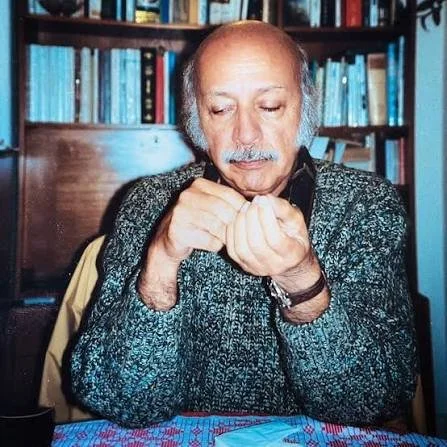
His final years were a stark departure from the life of revolutionary chase across borders and into the marshes alongside militarized rebels. His mother's death and a Parkinson's diagnosis had finally disarmed his venomous tongue.19 Just before his trip to the UAE, his last voyage before his death, Muthaffar returned to Baghdad and found his home "beautiful in the dust."20 The exiled poet had finally found his way home. Likewise, probably to his delight, his poems had found a new home outside the cassette tape in Al-Mutannabi street, onto the internet, and into every Arab household. Even today, decades after Muthaffar first orated to crowds of workers and then lashed out against those who aided in the subjugation of the Arabs, his voice continues to motivate the oppressed and the downtrodden, and most importantly, agitate.
Muthaffar Al-Nawwab passed away on May 20th, 2022, in Sharjah. Though in life Iraq’s government cast him out, his body was brought back to the homeland in a presidential jet. His momentous funeral, attended by tens of thousands, would have likely brought him immense joy as his mourners pelted attending politicians with stones.
Footnotes:
1 His surname denoted a lineage that reportedly could be traced through migrations out of Abbasid Iraq and into a reign over Northern India.
2 Baqir Yasin, Muzaffar al-Nawwab: Hayatuhu wa Shi'ruhu [Muzaffar al-Nawwab: His Life and Poetry] (2003 ed.)
3 He entered the college prior to its inclusion into Baghdad University.
4 Al-Droubi is quoted as praising Muthaffar's command of colors.
5 This decision must be read with the ICP's role in his life, as that region was a breeding ground for Communist sympathizers due to its poor working conditions, poverty, and wealth of young men.
6 Muthaffar would frequently butt heads with cultural elitists in Iraq, who criticized him for the use of colloquial and vulgar language.
7 The rebellion was agitated by a pro-armed struggle sect of the ICP following delays by the local landlords and bureaucrats in instating the 1958 agrarian reforms.
8 Another popular title was Suwayheb, a friendly nickname for the fallen communist.
9 Muthaffar also helped orchestrate the escape of a fellow prisoner and death row inmate, Hamed Maksood, by disguising him to look like an old man and forging visitor hand-stamps.
10 Muthaffar was imprisoned inside a prison known as Nugrat Salman, or Salman's Hole, in a desert south of Baghdad, only later transferring to a prison in Hilla.
11 The earliest record of a cassette tape player in Iraq is a photograph taken by several Egyptian construction workers in Iraq's city of Ramadi in 1975; the three men posed with a cassette tape player much like how a family would for a timeless household portrait. Unlike their home country, the players and tapes were significantly cheaper, costing them only 20 dinars, the equivalent of USD 400 today.
12 Simon, Andrew. Media of the Masses: Cassette Culture in Modern Egypt. Stanford, CA: Stanford University Press, 2022.
13 This list included the likes of Nizar Qabbani and Egypt's Ahmed Fouad Negm.
14 Tramontini, Leslie. "Muẓaffar al-Nawwāb's Concept of Colloquial Poetry as Art." In Commitment and Beyond: Reflections on/of the Political in Arabic Literature since the 1940s, edited by Friederike Pannewick, Georges Khalil, and Yvonne Albers. Wiesbaden: Reichert Verlag, 2015. 201–212.
15 Muzaffar al-Nawwab, interview by Al-Fayhaa TV, recorded in Dubai, April 9, 2005, video posted to YouTube as "مظفر النواب يروي تفاصيل لقائه بصدام حسين الذي دام 1:45 دق", accessed July 2026, https://www.youtube.com/watch?v=f5PZGjevV9w
16 His trip to Libya was particularly fruitful as he was gifted with the Libyan passport, which became his primary travelling document.
17 Muthaffar would hold regular poetry readings in London, frequented by artists such as Betool El Fekaiki.
18 "من 'مرينا بيكم حمد' إلى 'سجن عكا'.. مدينة سلمية جمعت الحزن مع السياسة" ["From 'We Passed By You, Hamad' to 'Acre Prison'.. The City of Salamiyah Where Sorrow Met Politics"]. Syria TV, accessed July 2026, https://www.syria.tv/من-مرينا-بيكم-حمد-إلى-سجن-عكا-مدينة-سلمية-جمعت-الحزن-مع-السياسة
19 During a reading of "Jerusalem is the Bride of Your Arabism," Muthaffar was allegedly heckled by the audience, who denounced him for not speaking out against the American-led invasion of Iraq and even casting a vote in the post-2003 government.
20 Felenda, Isabelle, trans. and intro. "Muzaffar al-Nawwab's 'One Day, We'll Return to Our People.'" ArabLit & ArabLit Quarterly, July 30, 2025. https://arablit.org/2025/07/30/muzaffar-al-nawwabs-one-day-well-return-to-our-people/
About the Author:
Abdullah Al-Tekreeti is a writer based in Sharjah, UAE, where he works at the Barjeel Art Foundation. His work explores the Arab intellectual and political tradition, modern Arab art, and the histories of working-class and revolutionary movements and figures across the Arab world.