Submerged Nubian History and the Right of Return
Words by Michael Ishak
About a thousand kilometers up the Nile River lies a region spread between Upper Egypt and Northern Sudan called Nubia. It is home to a rich culture that dates back to ancient Kushan kings and today is still known as Ard Al-Dhahab, the Land of the Gold. ّIt is a little-known fact that across the 20th century, over a hundred thousand Nubians were forcefully displaced from their homes due to flooding caused by the construction of two major dams along the Nile River in Upper Egypt, the Aswan Dam and the High Dam. Along with this was the complete submersion of over a hundred villages and thousands of years of cultural heritage.
The largest mass displacement took place in 1963 upon the construction of the High Dam, which forced thousands to relocate to less fertile lands 50 to 80 kilometers away. Among these towns was Dahmit, where the Nubian sociologist Saker El Nour finds his origins. In sharing his father’s first-hand accounts of their old village and the tahjeer (displacement), El Nour revitalizes the memory for fellow members of the Nubian diaspora who can’t access their heritage sites.
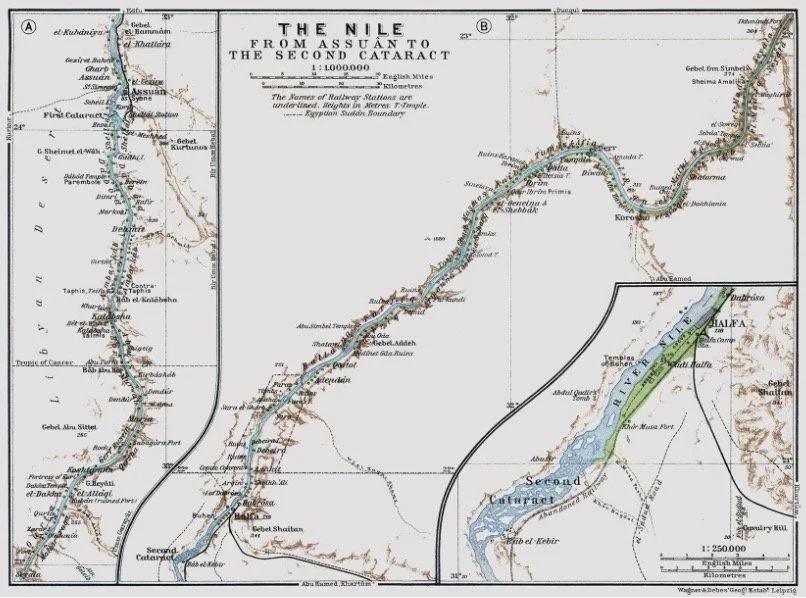
Map of the Nile from Aswan to the Second Cataract, drawn by Karl Baedeker in 1898.1
Nubians today preserve memory through language, music, and customs, many calling for the right of return. But what does return even look like when ancestral homes are submerged underwater? Today, I want to address the means of reconstructing the collective memory of these historical Nubian towns before the tahjeer and examine the question of return.
Contemporary Nubian activist Fatma Emam Sokery talks about her fond memories of her uncle Abbas giving her the novel El Shamandoura (The Buoy) by Mohamed Khalil Kassem, who is considered the father of Nubian literature.2 Nubian society has always prospered on the banks of the Nile since the ancient kingdom of Kush, which dates back to the second century BCE. The Nile is still a vital part of many Nubian traditions, like gifting each newborn with a palm tree, which guarantees each child a future income from the sale of the fruits. The river bank not only aided tradition but their internal economy, which relied on the annual flooding of the Nile: "We did not need the government to give us anything," says Aswan native Anna Zolikha.3
In 1961, a few years before the final mass displacement of Nubia's population, the American University in Cairo's Social Research Center launched the Ethnographic Survey of Nubia project, which sought to document the endangered villages before their submergence.4 Along with the ethnographical reports by Charles Callender and Fadwa el Guindi was the work of photographer Abdul Fattah Eid, who captured over 500 photographs of Nubian life.5 These photographs tell us who the people of Dahmit were, how they dressed, what they ate, the instruments they played, the art they made, and the holidays they celebrated.

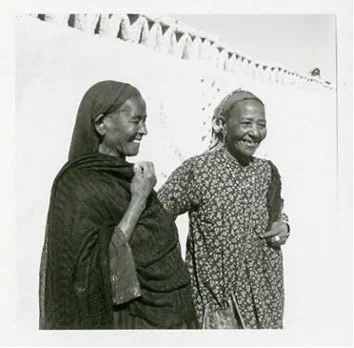
"A mother and her children stand outside one of the temples of the sheikh worship of Dahmit," and "Two elderly women wearing Nubian traditional clothing in the Nubian village of Dahmit."6
The new villages which the government built for the relocated Nubian populations following the floods were in the Kom Ombo desert, with most housing miles away from the riverbank. Efforts were made to recreate their old villages by maintaining their names and relative geographical position to one another. However, for years, Kom Ombo remained a dry plain that lacked fertile soil and infrastructure to properly support the displaced community. Thus, both Nubian lives and livelihoods were uprooted in the process of displacement, leaving their destiny, along with their history, submerged underwater. Not to mention, these facts are often kept hidden from the public eye, both locally and internationally. When I went to Aswan in 2023, I visited "The Nubian Village," a tourist site located in the historic village of Gharb Al Sehail. The souq (marketplace) and its attractions, like the crocodile sanctuary, a weaving workshop, camel rides, etc., are offered to immerse visitors into Nubian life, but make no attempt to make visitors aware of the plights of the Nubian people. Today, tourism is one of the only opportunities for local Nubians to make a livelihood, while others move to Cairo or immigrate abroad to find work.
My second visit to Nubia in 2025 was much different. I got to sit down with the elders of the community in the village of Dakka, who were children at the time of the tahjeer. The word that kept coming up in conversation was fag'a (suddenly), that in such a short time, the government came to Dakka and said that everyone would have to leave. They got on boats that would take them to the new villages. When they arrived, life changed, and it would never be the same. Their new homes were only two rooms instead of the traditional Nubian homes that had room to house complete extended families. Their new village was three miles away from the Nile, while they used to live at the riverbank. There was a lack of infrastructure in the new Dakka: no water, no fertile soil for cultivation, no opportunities for work. We asked Al Hagg to tell of his memories of the old village. He talked of richness not in a material sense but with regard to how the land brought them prosperity and self-sufficiency. It sparked me to ask them about what their return could look like.
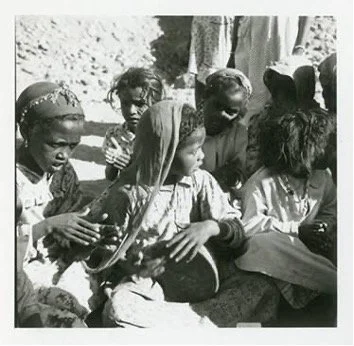

"Little Nubian girls singing, clapping, and dancing at Mawlid" and "A Nubian man plays with a group of men celebrating Mawlid in the Nubian village of Dahmit."7
Nubian movements have formed in the effort to raise awareness for their history and a 100-year struggle with forced relocation. The Nubian Culture and Tourism Festival, which began in 2012, is an initiative that hosts week-long celebrations of Nubian traditions, art, music, and history, all in the form of social gatherings, a context which is crucial to Nubian culture. Taking place on the banks of the Nile in Khartoum, Wadi Halfa, and Aswan, these festivals create a sense of continuity with the past by bringing Nubians from all across Egypt and Sudan closer to their place of origin to revitalize the collective Nubian memory. In addition to the festival, there have been efforts by another organization called the Nubian Languages and Culture Project to reconstruct old Nubian towns that existed before the floods through documentary footage, images, and oral histories. The initiative is also building an online interactive map where such recordings and histories are categorized by their exact location. But what does this mean about returning if such claims to land only exist in memory?
Creating spaces like the Nubian cultural centers in Aswan unifies displaced groups back in their homeland to reclaim history and heritage through the process of memory recollection, but it also provides grounds for a physical and permanent return for the Nubian people. Of course, it would be outlandish to call for the draining of Lake Nasser. I instead argue for the opportunity for Nubians to relocate back to the Nile, not miles away from it, but directly on the bank.
"I had naively thought that the demand for returning to the old land was dogmatic… I learned, however, that when Nubians speak of the right of return, they mean to be granted the right to develop and reside in the land around the lake – a demand that is not unrealistic or dogmatic at all."8
— Fatma Emam Sokery
My desire to learn more about Nubia stems from a deeper passion to understand Egypt's complicated history. I wanted to return because I wanted to learn this history not from books or journal articles or orientalist travelogues, but from the people themselves. I wanted to be a part of their history in the attempt to preserve it. To document the heritage of a people who were forced to leave the land they inhabited for millennia: their homes, their ancestors' tombs, their heritage, and a future of freedom and prosperity submerged underwater by a manmade reservoir. Thus, by showing the Egyptian government how important the Nile river bank is to the prosperity of Nubian heritage via recollections of memory and historical reconstructions of pre-flood Aswan, they are creating an authentic case for the right of return, one that I believe shall not be refused.
ربك لما يريد
احلامنا هتتحقق
وكلامنا هيتصدق
والغايب هيعود
When God wishes,
Our dreams will come true
Our words will be believed
And the absent will return
- From “Rabbak Lamma Yerid” by Nubian singer Mohamed Mounir, 2000.
About the Author
Michael Ishak is a senior at Columbia University studying Middle East History, with particular interests in culture and international affairs. He is also an experienced musician and oud player. His work aims to amplify marginalized voices in the MENA region.
1. Map of the Nile from Assuan to the Second Cataract, in Karl Baedeker, Egypt: Handbook for Travellers (Leipzig: Karl Baedeker, 1898).
2. Diala Ahwach, interview with Fatma Emam, "The Nubian Movement in Egypt: From the Revolution to Current Challenges," Arab Reform Initiative, August 9, 2024, https://www.arab-reform.net/publication/the-nubian-movement-in-egypt-from-the-revolution-to-current-challenges-an-interview-with-nubian-activist-fatima-imam/.
3. Menna Agha, "Nubia Still Exists: On the Utility of the Nostalgic Space," Humanities 8, no. 1 (2019): 24, https://doi.org/10.3390/h8010024.
4. Abdul Fattah Eid, "AUC Social Research Center Ethnographic Survey of Nubia Photograph Collection," The American University in Cairo, 1961, https://digitalcollections.aucegypt.edu/digital/collection/p15795coll27.
5. Eid, "AUC Social Research Center."
6. Ibid.
7. Eid, "AUC Social Research Center."
8. Fatma Emam Sakory, "Being Nubian in Egypt, and in the Constitution," Mada Masr, December 23, 2013, https://www.madamasr.com/en/2013/12/23/opinion/society/being-nubian-in-egypt-and-in-the-constitution/.