Figuring Violence in the Body of the Book: Dia al-Azzawi’s Nashid al-Jassad
WORDS BY Zeina Maasri
This essay launches a collaboration between Daftar and Decolonizing the Page, drawing on books featured in the online exhibition and resource Decolonizing the Page: A Forgotten Golden Age of Arabic Book Arts (1950s-80s).
Nashid al-Jassad: Qasa ʾid marsuma li Tal al-Zaʿtar (The Body’s Anthem: Poems Drawn for Tall al-Zaʿtar) is a two-tiered book edition by the Iraqi artist Dia al-Azzawi, produced between 1979 and 1980 in collaboration with the Beirut-based publisher Dar al-Muthallath, in commemoration of the 1976 violent crackdown on Tal al-Zaʿtar.
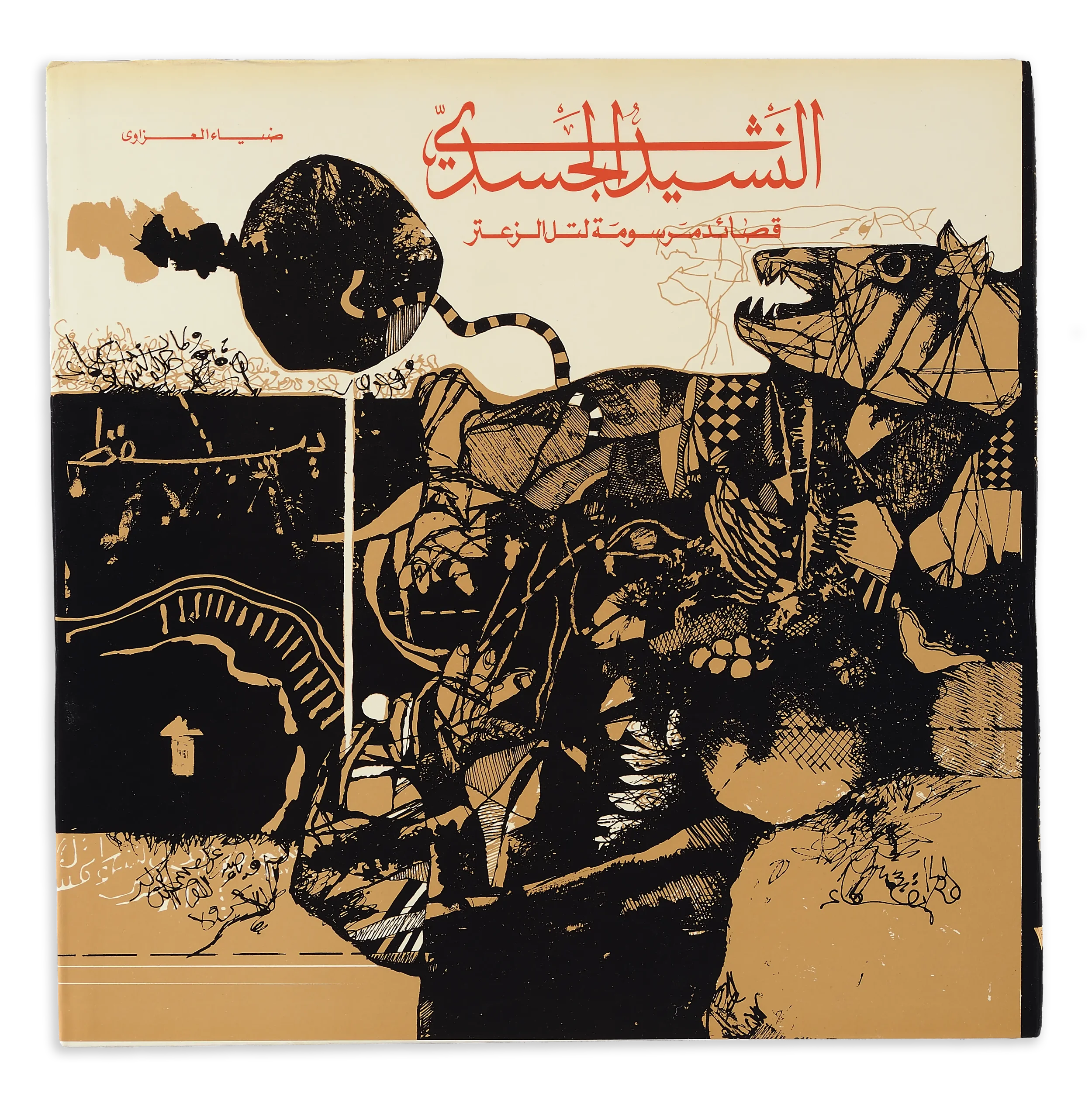
Dia al-Azzawi, Nashid al-Jassad / The Body’s Anthem, Dar al-Muthallath, Beirut 1980. 134 pages. 29.5 x 30 x 1.2 cm.
The massacre of Tal al-Zaʿtar
Tal al-Zaʿtar was a Palestinian refugee camp in the predominantly Christian eastern outskirts of Beirut, Lebanon that succumbed to a brutal siege and assault by Lebanese Front militias in 1976, during the early stages of Lebanon’s Civil War (1975–90). It was the last Palestinian refugee camp in East Beirut to fall, following intense bombardment and a blockade lasting close to two months. As the camp’s defence faltered and fighters surrendered, some residents managed to flee, while between 1,000 and 2,000 civilians who could not escape were lined up and shot on the morning of 12 August 1976. Bulldozers soon razed the camp to the ground. The death toll during the blockade alone is estimated at around 4,280, the majority of whom were civilians. The collusion of both Lebanese and Syrian armies on the side of the Lebanese Front exacerbated the sense of Arab betrayal of the Palestinian cause and deepened disenchantment with postcolonial Arab states’ hollow promises of liberation.
Dia al-Azzawi, Nashid al-Jassad / The Body’s Anthem, Dar al-Muthallath, Beirut 1980.
Azzawi and artists’ solidarity with the Palestinian cause
The violence at Tal al-Zaʿtar became the subject of numerous artistic gestures of solidarity and commemoration by artists, poets, and filmmakers, among them the Iraqi artist Dia al-Azzawi (b. 1939). Azzawi was part of a wider generation of Arab artists and intellectuals on the Left drawn to the Palestinian liberation movement, especially after the Arab defeat in the June 1967 war with Israel. The emergence of popular armed struggle as a revolutionary anticolonial movement rekindled hope among populations disillusioned with political leadership and shaken by the war’s losses. Artists of Azzawi’s generation looked to the Palestinian movement to reimagine art’s radical political potential in the post-1967 Arab context.
In 1969, Azzawi co-founded the New Vision Group with five other Iraqi artists. Their manifesto argued that modern art could fulfil its revolutionary promise “towards a new vision” by responding to political conditions with a renewed aesthetic sensibility. Palestine’s liberation struggle, and the resistance poetry it inspired, became central to Azzawi’s work. He began experimenting with image and text, exploring the reproducibility of print—from posters to artist books—to articulate this new sensibility and express solidarity with the Palestinian cause. Nashid al-Jassad is one such nodal articulation of aesthetic experimentation with political networks of solidarity.
Dia al-Azzawi, Nashid al-Jassad / The Body’s Anthem, Dar al-Muthallath, Beirut 1980.
Visual poetics and politics
Azzawi pays tribute to the victims of Tal al-Zaatar basing himself on three powerful poems by leading left-wing Arab poets of the time: ‘Ahmad al-Zaʿtar’ by Palestinian Mahmoud Darwish, ‘La Mort est arrivée en riant a Tel el-Zaatar’ (Death arrived laughing to Tal Zaʿtar) by Moroccan poet Tahar Ben Jelloun, and ‘yasaran … hatta jabal al-zaytun’ (Leftwards … towards the Mount of Olives) by Iraqi poet Yusuf Sayigh. His collaboration with Dar al-Muthallath extended his connections with the Popular Front for the Liberation of Palestine (PFLP). These ties developed through his friendship with Ghassan Kanafani (1936–72), the Palestinian novelist, critic, and activist, and through his earlier contributions to the PFLP’s periodical al-Hadaf (founded by Kanafani), a key political and aesthetic platform that connected artists like Azzawi within transnational circuits of anticolonial solidarity. Dar al-Muthallath itself was a short-lived art publishing house and graphic design studio established in Beirut in 1979 by left-wing Palestinian and Arab intellectuals and artists associated with the PFLP, including Iraqi artist Saleh al-Jumaie, a co-signatory of the “Towards a New Vision” manifesto.
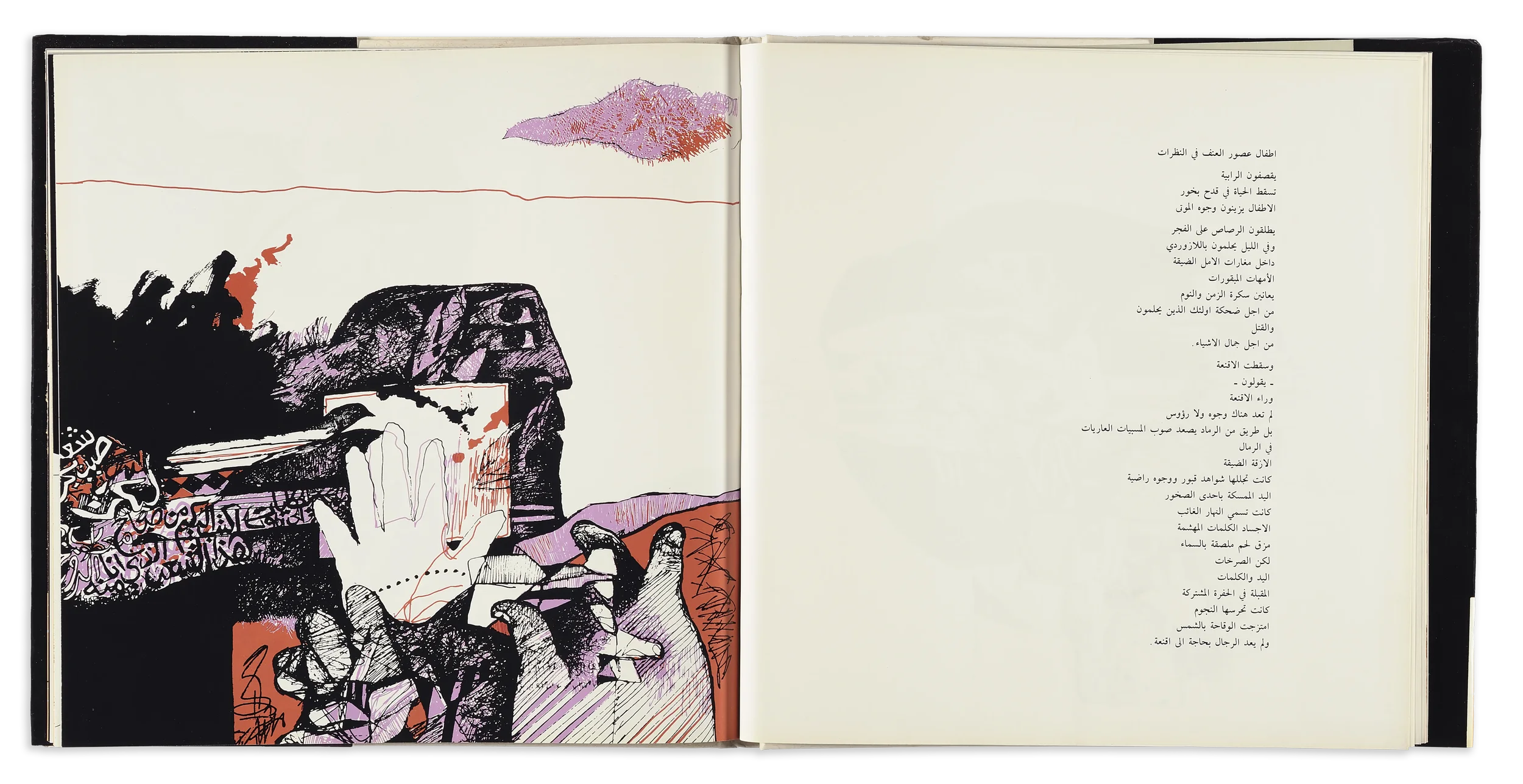
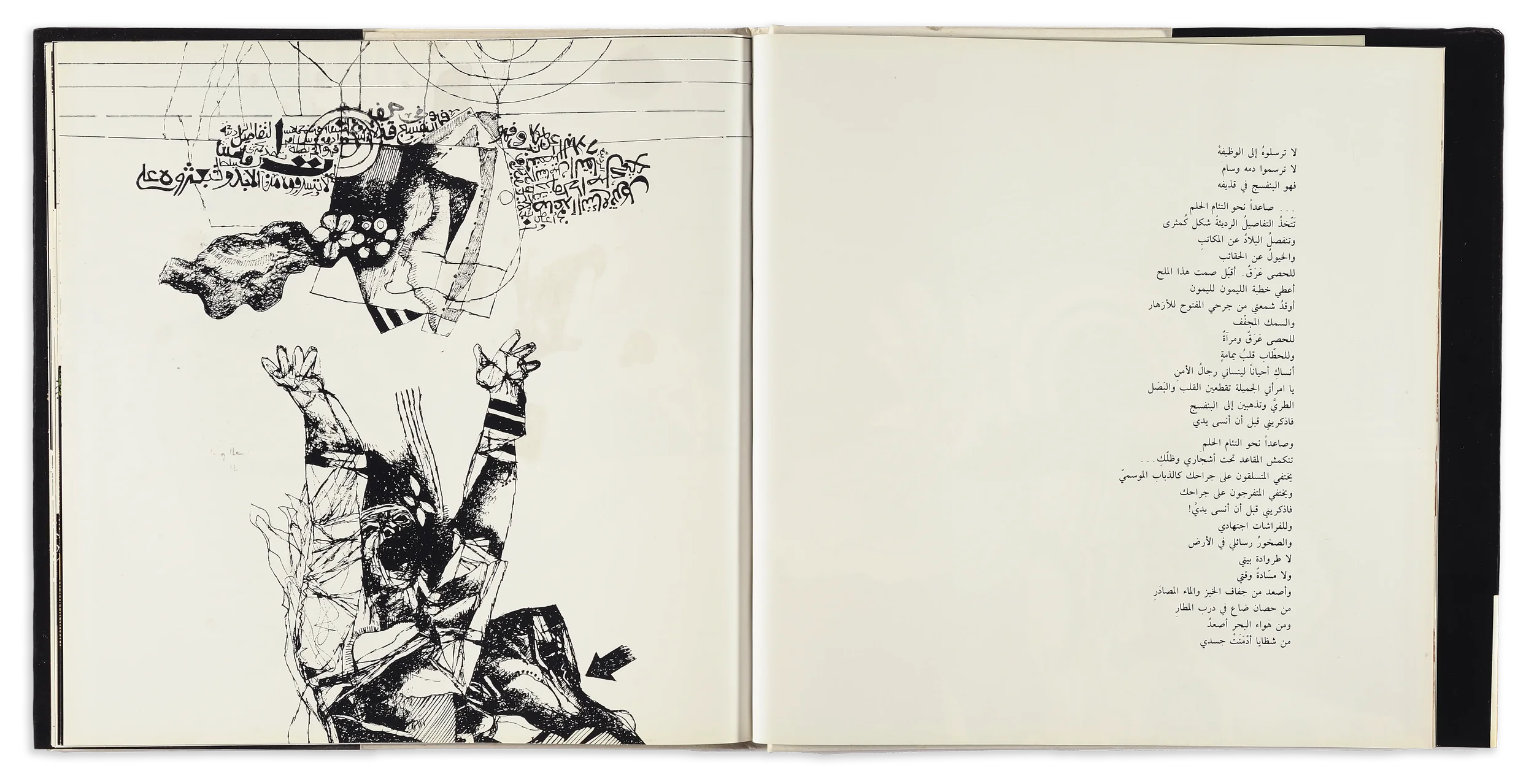
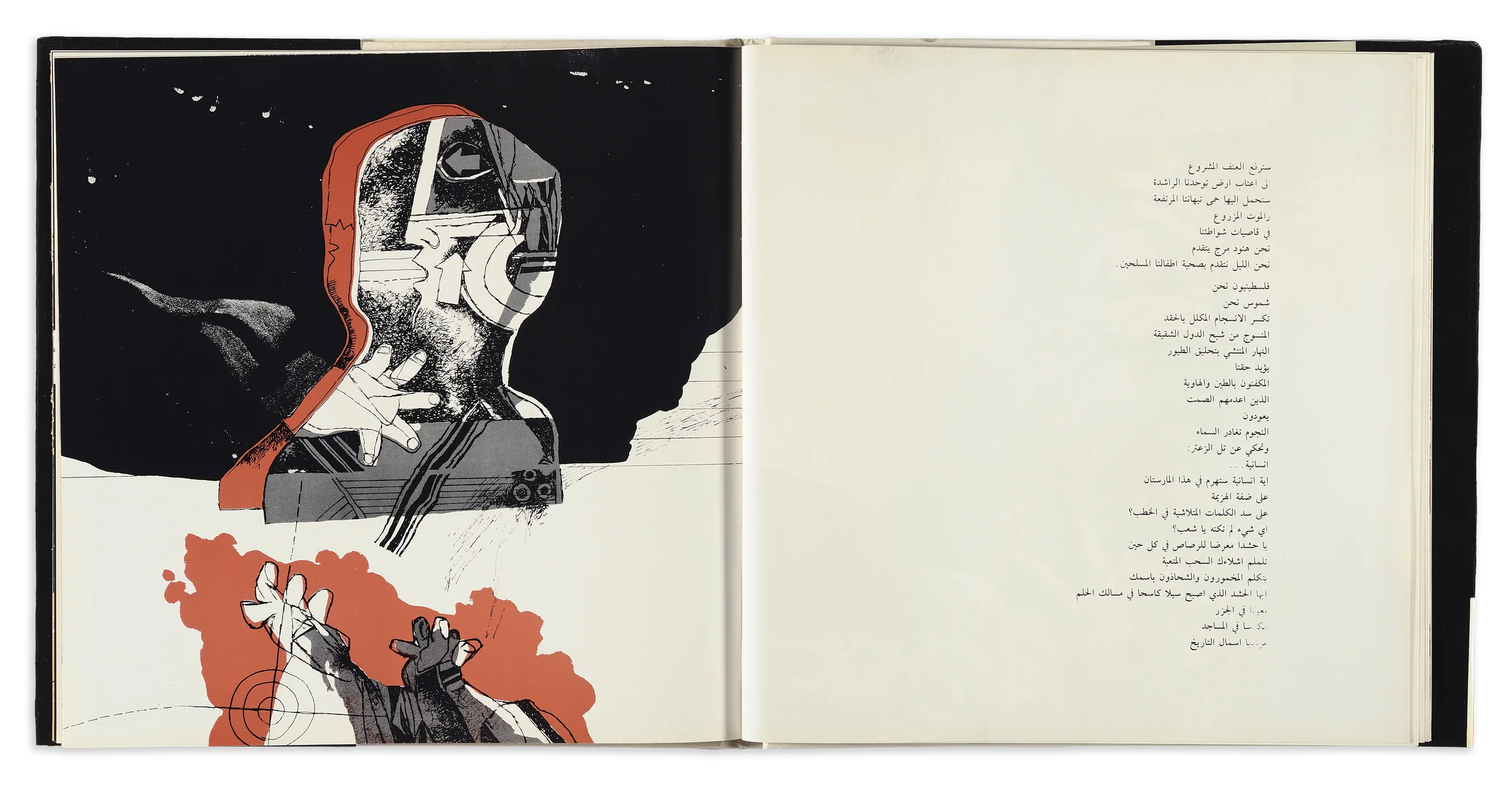
Nashid al-Jassad is produced in two editions. The first consists of seventeen large-format silkscreen prints (50 × 50 cm), along with ten artist’s proofs, assembled as loose sheets in a single portfolio. This edition is limited to 100 copies, each signed and numbered by the artist. It was exhibited and sold in Baghdad at al-Riwaq Gallery in December 1979, with proceeds intended to support survivors of the camp. The second edition, published a year later, takes the form of a hardcover illustrated poetry book. It includes a short historical account, photographic evidence, and translations of all three poems and accompanying texts, produced by prominent figures within the Arab leftist network. The texts were translated from French into Arabic by the Moroccan author and literary critic Muhammad Baradah (b. 1938), with French translations by Etel Adnan (1925–2021), the Lebanese-American poet, essayist, and artist, and English translations by Sumaya Damluji (b. 1956). Together, this two-tiered edition appropriates the visual economy of the deluxe art book for the politics of solidarity.
Dia al-Azzawi, Nashid al-Jassad / The Body’s Anthem, Dar al-Muthallath, Beirut 1980.
Embodying violence, memory and resistance
Azzawi’s Nashid al-Jassad commemorates the violent silencing of a revolutionary promise and the brutality inflicted on civilians in the camp. Though he writes a hopeful statement in his introduction about the ongoing struggle against oppression, visually, he paints the disjointed memory of violent tragedy. Arabic letters, in keeping with his hurufiyya practice at the time, function simultaneously as traces of the poetic texts he drew inspiration from and as handwritten gestures that embody the erratic imprint of violence across the body of the book. Within these fragmented images, composed of textual shards and dense, abstract graphic forms and lines, emerge haunting figures: bodies in distress, shrieking faces, and outstretched hands. Graphic symbols interrupt these forms: numbers, arrows, and dotted lines evoke the remnants of a cartographic map, deconstructed within the amorphous terrain of persistent memory. Azzawi’s drawings bear witness to the event not through the evidentiary claim of photography, but as haunting images that endure the pain of witnessing. The historical event persists here, fragmented by memory’s hauntings and refracted through the artist’s interpretive lens, unfolding in the present. Solidarity, as embodied in the artist’s book, bears witness to violence while also gesturing beyond suffering toward resistance, through a persistent memory that emerges under conditions of silenced history, and through the possibility that life might yet be otherwise.
1. The Lebanese Front was formed by a coalition of right-wing Lebanese nationalist militias representing the pro-Western Christian Maronite ruling political parties, which felt threatened by the revolutionary momentum of the Palestinian Resistance and allied Lebanese Left wing and Arab nationalist parties in Lebanon.
2. For an account of the Tal al-Zaʿtar massacre, see Yezid Sayigh, Armed Struggle and the Search for State: The Palestinian National Movement, 1949–1993 (Oxford: Clarendon Press, 1997), pp. 395–401.
About the Author:
Dr. Zeina Maasri (PhD) is Senior Lecturer in Global Visual Culture at the University of Bristol, UK. She is the author of the award-winning book Cosmopolitan Radicalism: The Visual Politics of Beirut’s Global Sixties (Cambridge University Press, 2020) and Off the Wall: Political Posters of the Lebanese Civil War (IB Tauris, 2009). She curates exhibitions and online archival resources focused on modern visual culture in the Arab world, including most recently Decolonizing the Page: A Forgotten Golden Age of Arabic Book Arts (1950s–80s), an online exhibition and archival resource that sheds light on a remarkable era when Arabic book arts flourished, capturing the artistic, political, and intellectual fervour of decolonization.
This essay is adapted and revised by the author from her book Cosmopolitan Radicalism.