Amazigh Women’s Active Role in Creating Their Language & Visual Culture: Professor Fatima Sadiqi on Symbols & Weavings
Words by Yasmin Meddour
Symbols are intricately woven into North African culture: whether in clothing, tapestries, woollen cushions, how they’re etched into Nana’s face tattoos, or their centrality to flags. At first glance, these symbols might seem to be simply beautiful images. But on closer inspection, they speak to the matriarchal structure of Amazigh culture and its understanding of the natural world. Renowned Moroccan linguist and scholar, professor Fatima Sadiqi says that they form the basis of Tifinagh — the Tamazight alphabet which has been experiencing a revival since the Arab Spring.
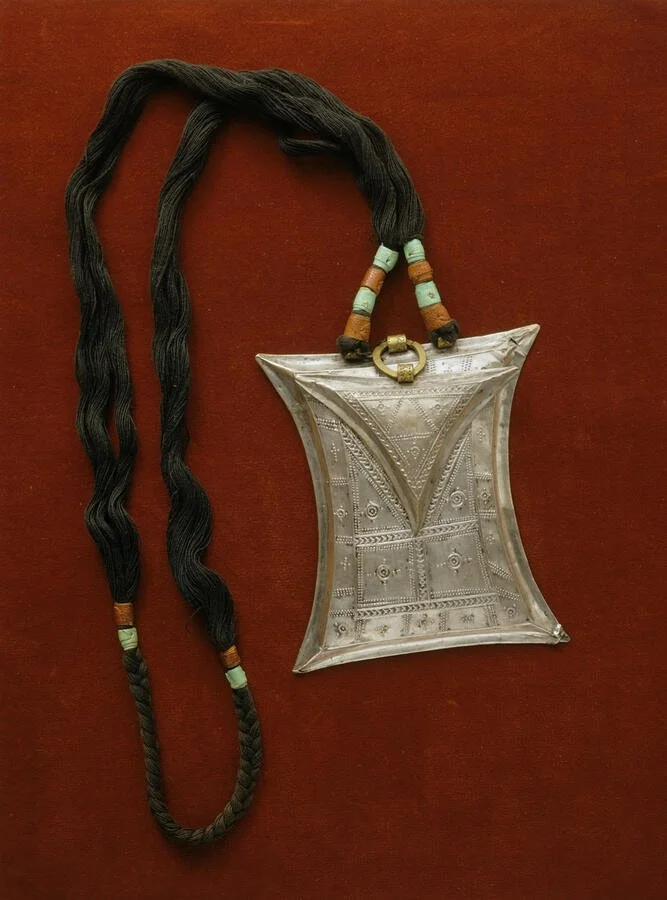
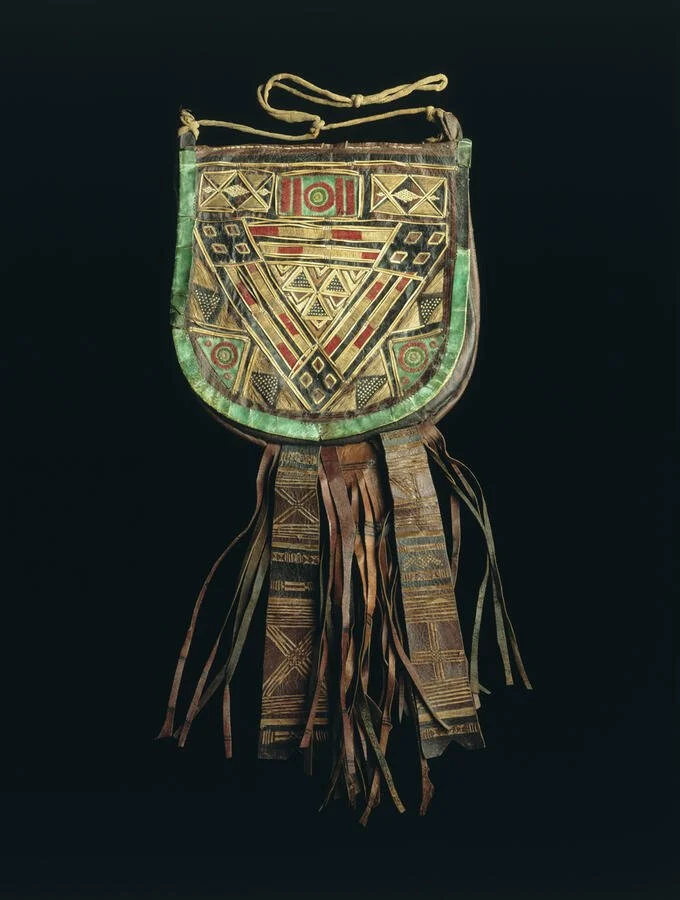
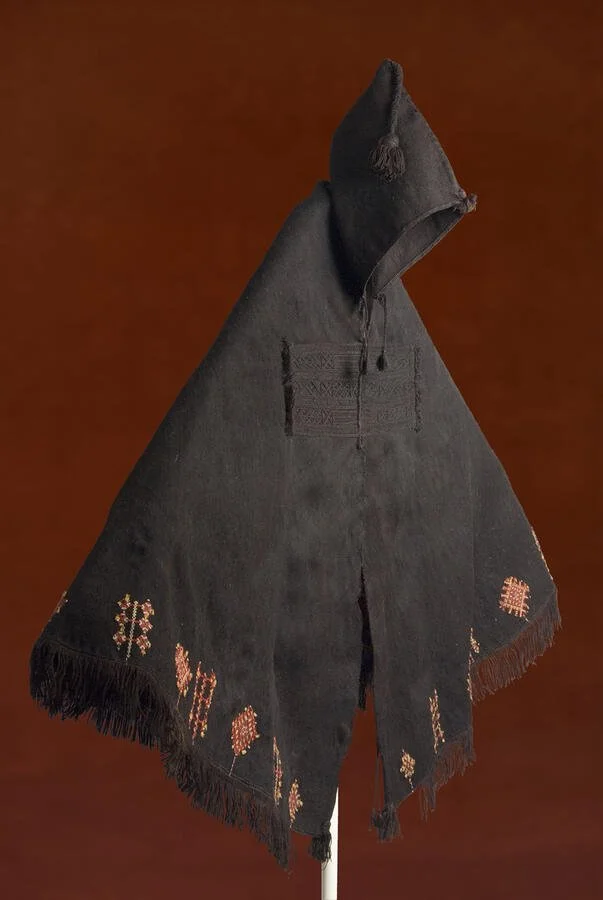
1- Double amulet necklace (tcherot), Niger -2- Man's cape (akhnif), Siroua Mountains, Morocco -3- Man's leather bag, Algerian Sahara
“The Amazigh language is one of the few that have a truly artistic root,” says Sadiqi who specializes in Amazigh culture and orality. She believes that Tifinagh emerged from women’s artwork: codified tapestries laid the groundwork for language and communication. In her book Women and the Codification of the Amazigh Language (2024), she identifies Amazigh women’s active role in their language, and not just keepers of knowledge and culture. Her book argues that the Tifinagh alphabet emerged from ancestral rug designs weaved by Amazigh women. Late Moroccan literary critic, Abdelkebir Khatibi, held a similar view. He believed that Amazigh tattoos functioned like writing or a kind of language.
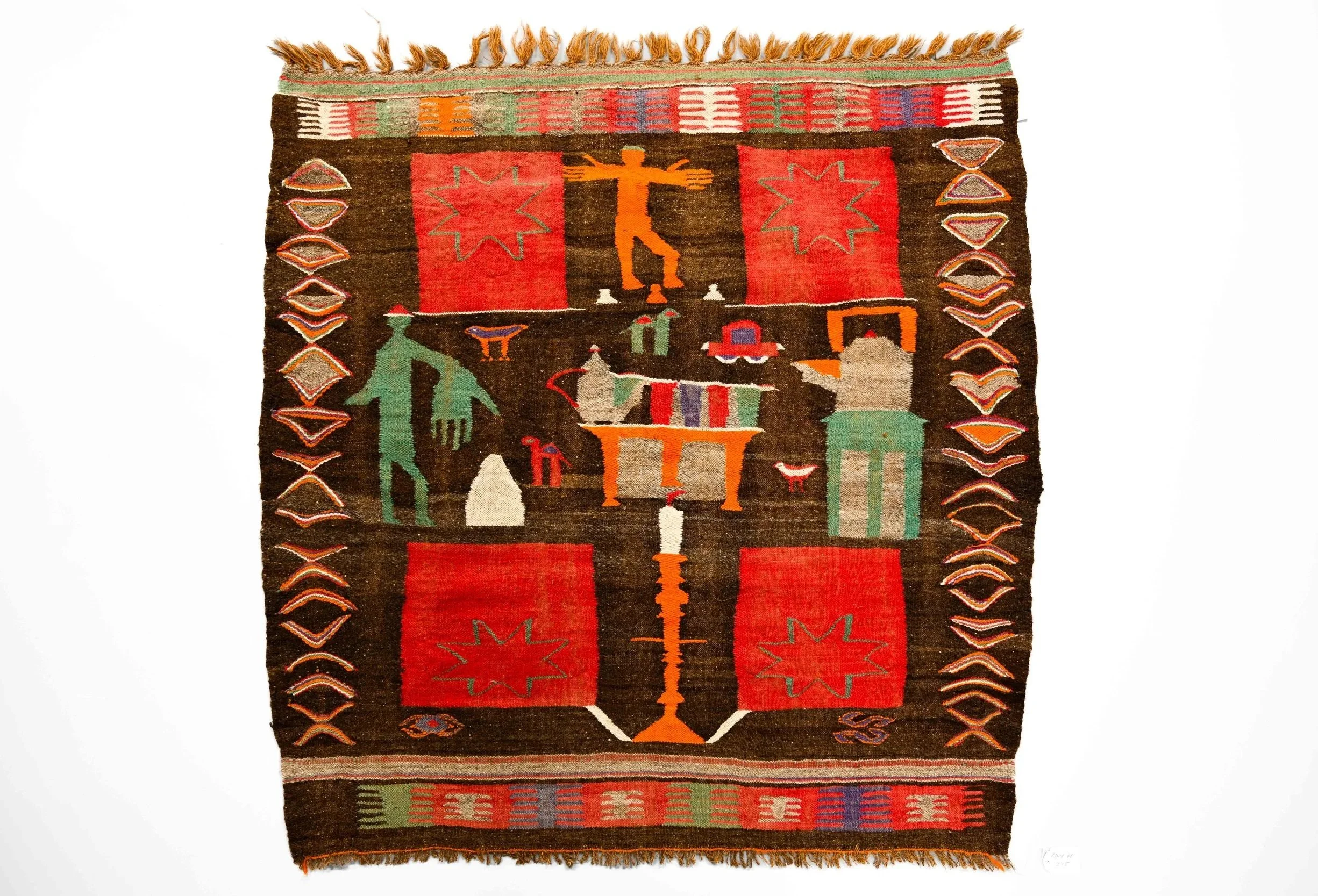
Carpet (Tapis), wool. Boujad, Middle Atlas. Bert Flint Donation. Pierre Bergé Museum of Berber Arts and Musée Yves Saint Laurent Marrakech. Since the Neolithic Age, Amazigh carpets have been woven using a vocabulary of signs and techniques specific to each region. This symbolic, protective and esoteric vocabulary, whose meaning has been lost over the centuries, has been passed from mother to daughter for generations.
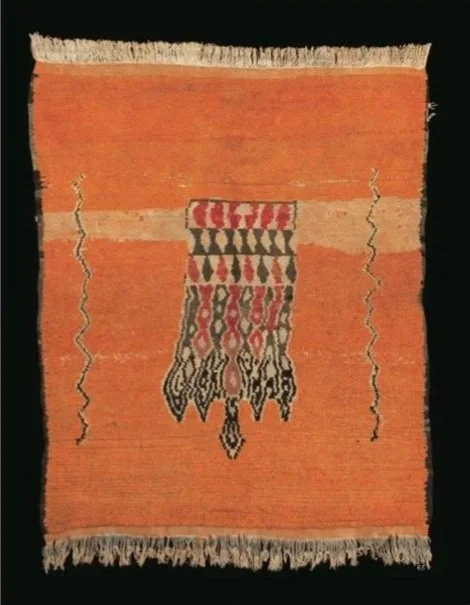
© Jardin Majorelle. Photo: Marlène Poppi
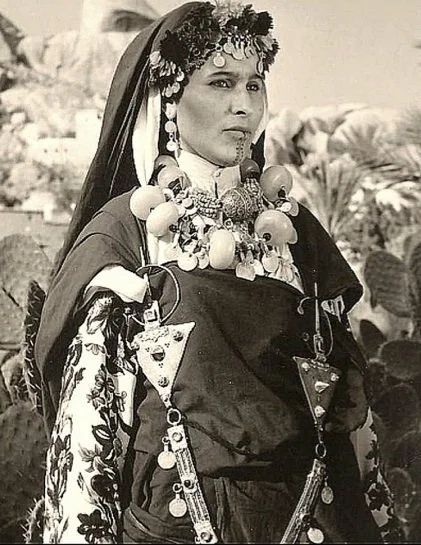
Amazigh woman from Tafraoute, South-Morocco. Stichting Nationaal Museum van Wereldculturen
The practice of tattooing as a communication of identity is similarly found in Kurdish and Yezidi cultures. Amazigh symbols in particular can express sentences or even paragraphs to the viewer. Sadiqi elaborates saying, “they actually cast meaning in one symbol, and it goes straight to the conscience of somebody who looks at a painting or a carpet for example.” Sadiqi says that this continues today: Tuareg people (an Amazigh Nomadic group based in the Sahara) draw symbols in the sand and brush them away after their message is delivered. “The imagery,” Sadiqi adds with a smile, “usually represents things that are important to women: nature, fertility, harvest, spirituality, and sexuality recur as central themes.”
So how do you decode Amazigh symbols? And how are they being reinterpreted today?
Here are some popular symbols and the stories behind them.
ⵣ - the Yaz
Otherwise called the Aza, or the Zay, the Yaz is a symbol of freedom for the Amazigh people. It is on the Amazigh flag which was inaugurated on 12 January 1970, in Tizi Ouzou in Algeria by a Kabylian veteran and activist, Youcef Medkour. He bought fabric from Saint-Pierre, France, and asked local women with sewing machines to thread the emblem, designed by the founder of Berber Academy, Mohand Arav Bessaoud. Together, they brought the Amazigh flag to life.
The Yaz symbol continued to hold political weight. On 2 May 2012, Amazigh singer and actress Fatima Tabaamrant wore a Kaftan embellished with the Amazigh symbol on either shoulder in parliament, and called for rural girls to be educated in Tamazight. After her appearance, the Tifinagh symbol became popular in Moroccan textiles. Tabaamrant played a crucial part in reviving the popularity of Amazigh symbols and was the first to speak Tamazight in Moroccan parliament.
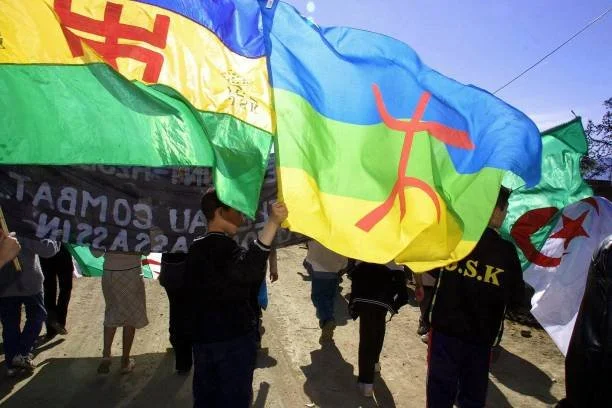
A march in the Agouni Arouss in the Tizi Ouzou province in commemoration of Massinissa Guermah, a young man who died in police custody, 18 April 2002. Photo by HOCINE ZAOURAR-/AFP via Getty Images
Δ - The Triangle
The triangle represents sexuality, fertility and womanhood. It is connected to Tanit, the North African goddess of wisdom, civilisation, rain, and crafts. Her symbol shows a triangular form with a horizontal line for her arms and a circle for her head. The first significant representation of Tanit appeared in the form of pottery, where her figure is depicted beneath a crescent moon. Tanit was worshipped in Carthage (today’s Tunisia) as well as Algeria, Libya and Mauritania. Many scholars believe the Goddess Tanit to be Amazigh due to her location. Amazigh specialist Sadiqi remembers “imploring Tanit for rain” during her childhood in the Sahara. “In periods of drought or little water, you say, ‘We want you to make the rivers flow with water,’” she adds. Tanit’s symbol remains influential across the Mediterranean.
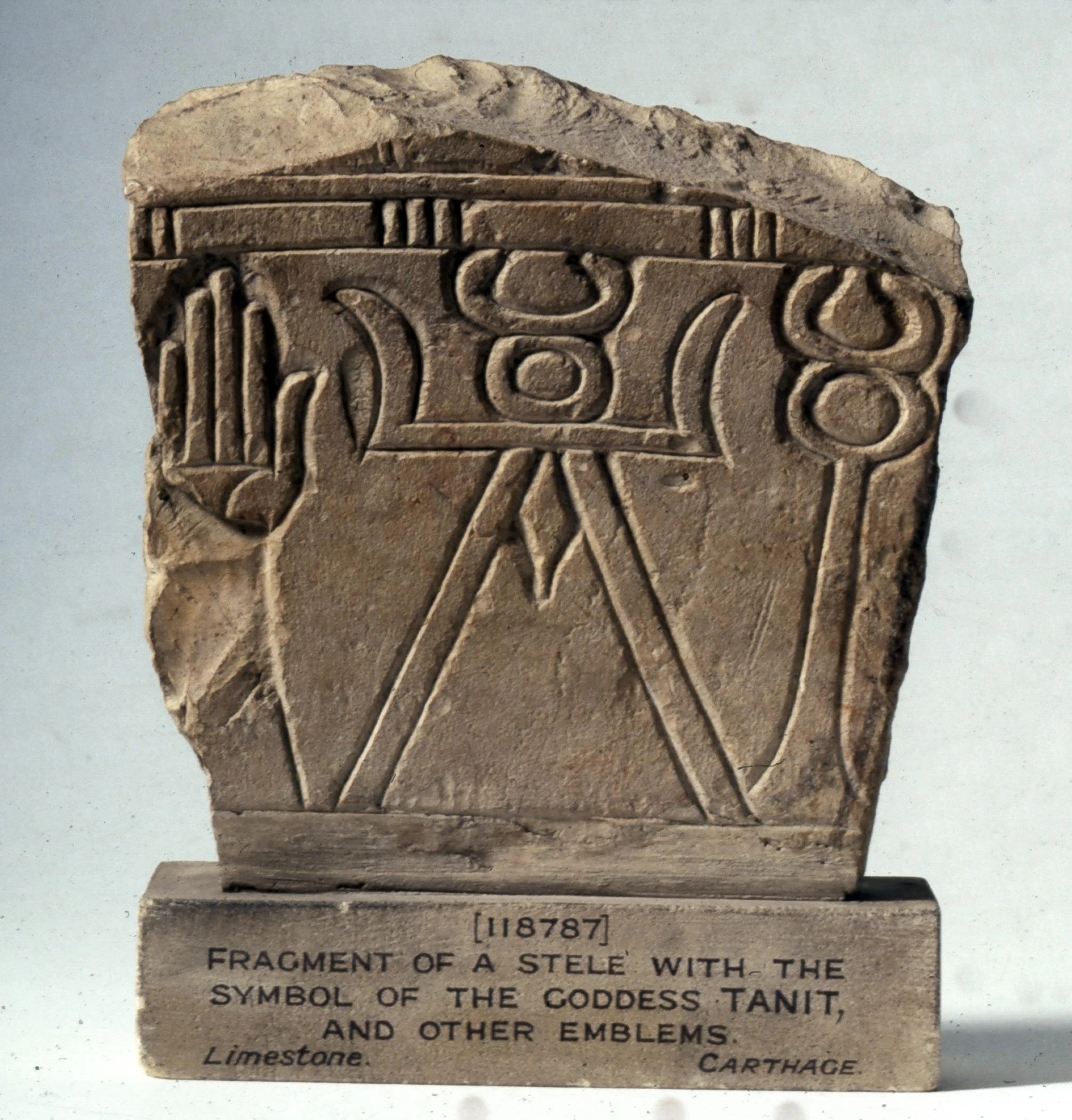
Fragment of a stele with the symbol of the Goddess Tanit, and other emblems, Carthage.
© The Trustees of the British Museum
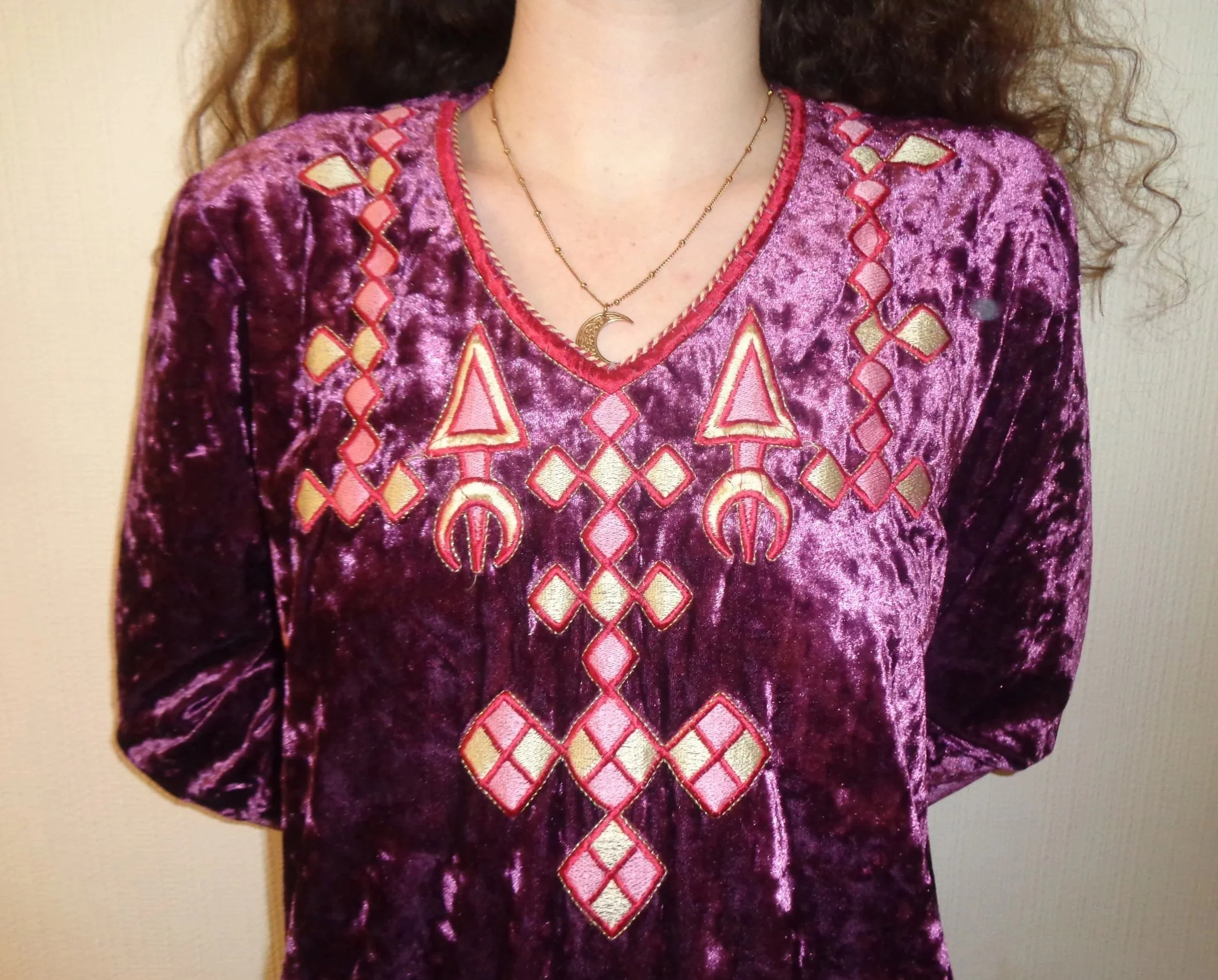
A modern Algerian amazigh house dress with triangles and crescents. Photo: Zahra Onsori
☪ - The Crescent and Star
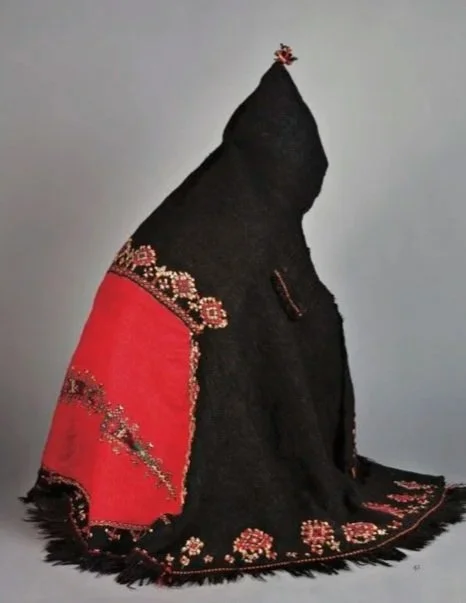
Akhnif, goat hair. Ait Ouaouzguite boy, Siroua
The crescent represents femininity, the lunar and menstrual cycle, and regeneration, while the star represents divine guidance. These celestial symbols are popular in North African fashion and textiles, both modern and old. They are also being reinterpreted by the youth of the Amazigh diaspora. London-based Libyan Amazigh designer Ruaa Elmansuri says she is most drawn to symbols of the night: “A lot of the Libyan traditional jewelry uses the same celestial shapes like the crescent and stars. I wanted to play on that.” Her Gothic surrealist designs incorporate exaggerated crescents and recycled Amazigh materials. “I’m drawn to celestial motifs that symbolise Amazigh identity, as they weave culture and memory into a dreamy, cosmic language,” Elmansuri elaborates.
The crescent is also a highly popular symbol in Amazigh jewelry. London-based Algerian Amazigh jewelry brand Taziri takes inspiration from these themes using the Amazigh word for “moonlight” in its name. Taziri’s bio itself says: “We want our jewellery to be worn like our ancestors wore their tattoos: to tell a story while expressing oneself."
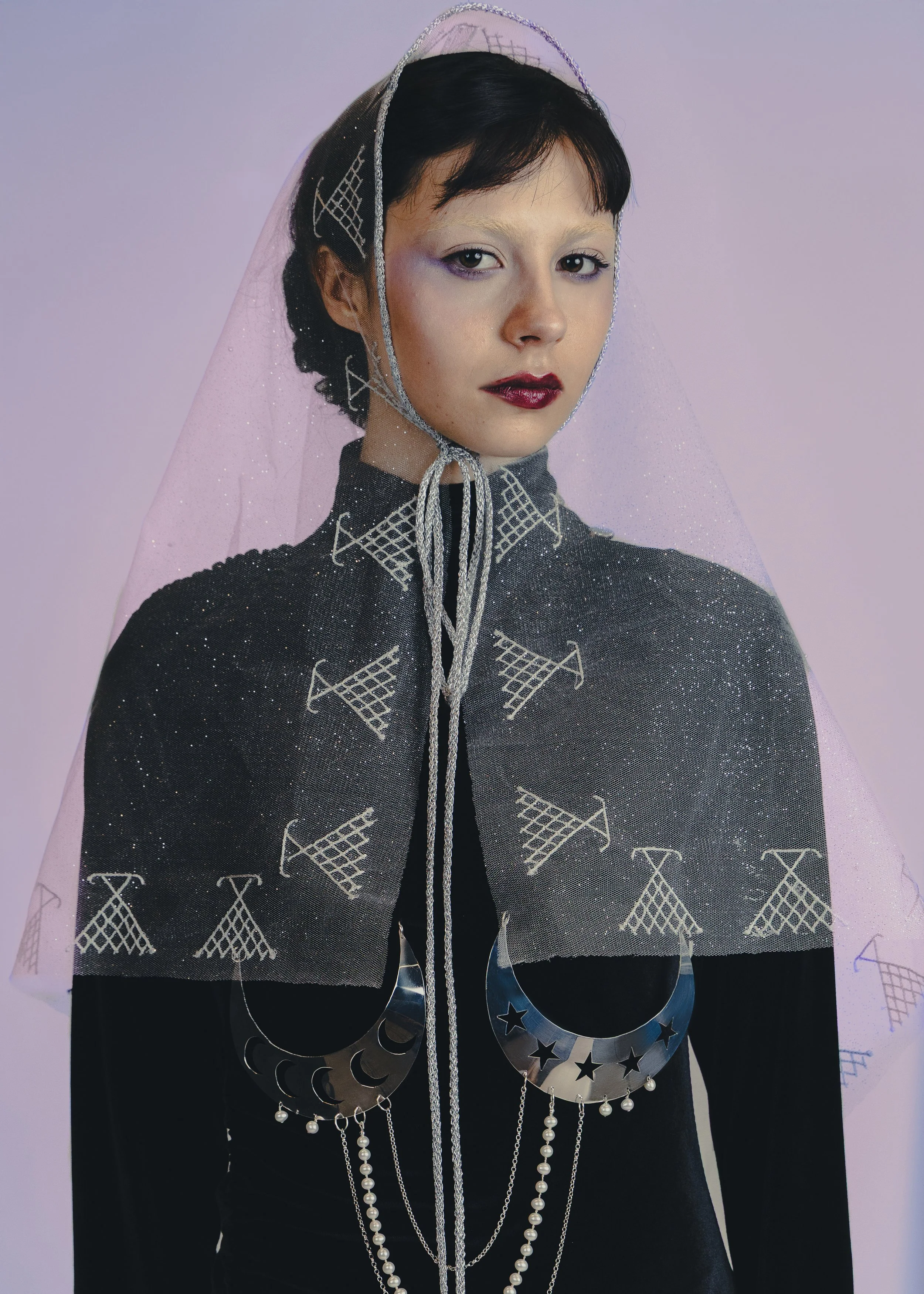
Ruaa Elmansuri’s fashion collection. Photographer: Ishita Mishra. Model: Iris Chambers. HMUA: Ruri Ruperti

Ruaa Elmansuri’s fashion collection. Photographer: Ishita Mishra. Model: Iris Chambers. HMUA: Ruri Ruperti
The Artistic Future of Tamazight
Amazigh symbols continue to be a tool of self-expression, a call for freedom, and a celebration of femininity across generations and continents. And despite threats of erasure, “the language continues to become more and more vibrant,” according to Sadiqi. “In linguistics, it is said that when a population starts to use an alphabet, the language dies.” But in the case of the Tamazight culture, the artistic aspect of the Tifinagh alphabet — in fashion, textiles, jewelry, design — is more powerful, explains Sadiqi. She also says that as Tamazight reaches the public sphere of recognition in art and textiles, so do the contributions of Amazigh women. “Anything that was Amazigh in private is becoming public. The same applies to women. So there is some kind of parallel fate between women and the Amazigh language.” It is no surprise then, that Sadiqi refers to women as “the artists” of Amazigh culture, continuously revealing meaning to their onlookers.
About the Author
Yasmin Meddour is a British-Algerian Amazigh journalist, producer and songwriter based in London. She enjoys writing about global affairs, music, art, and culture, with a special interest in the MENA region.