They Say When You Meet Somebody That Looks Just Like You, You Die
Words by Ahmad Makia
An aspect of my practice has been to decenter the person behind it – myself, my “I” – from the creative output it gives rise to. Am I really a single, lone entity that writes? Or am I a composite, a creole of voices and impressions? Whether cosplaying, collaborating, ghostwriting, or co-authoring, I enjoy thinking of myself as an author who displaces the centrality of my self and subjectivity towards a narrated world of ambiguity. There is little I can know or perceive of myself abstracted from my interrelation with others, be they human, sentient, spiritual, or material. Informed by post-structuralist philosophical thinking, such as Roland Barthes’s concept of the “death of the author”, I think of myself not as a creator of knowledge, but as a medium through which it is rehashed and blended, bringing different coordinates together. Without laying claim to the position of source or originator, for me the practice of writing becomes a form of sorcery and mediation.
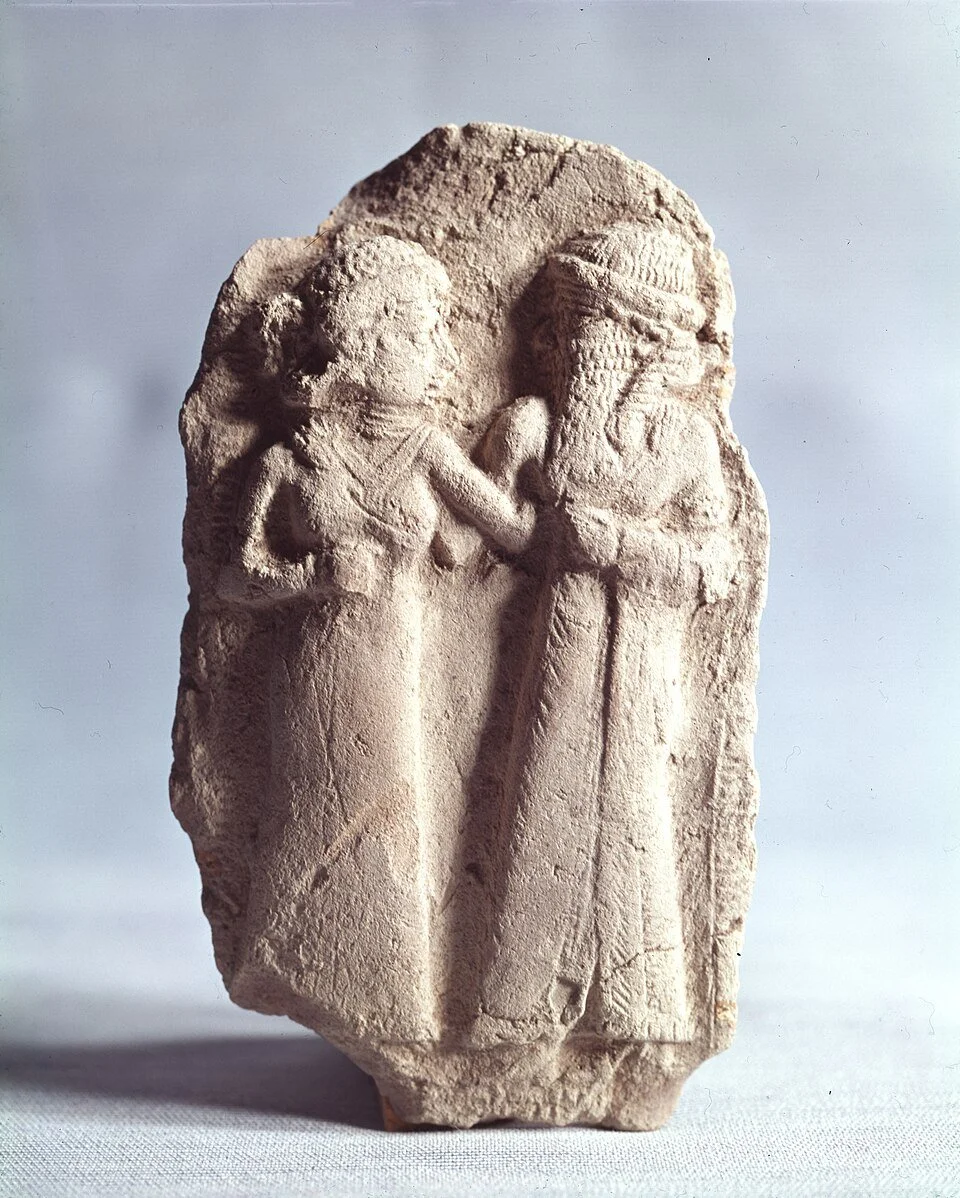
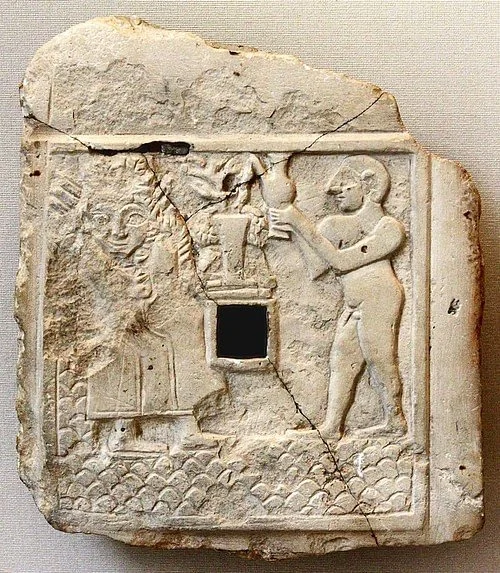
This notion resonates with the earliest lineages of authorship, too. Considered the world’s first named author despite her absence from the world literary canon, Enheduanna was a Sumerian high priestess. Primarily known for her work Exaltation, which was inscribed in Sumerian cuneiform in what is present-day southern Iraq, Enheduanna is especially interesting for the method and form of her writing. Her texts are not self-reflexive or narrative-led, but intertextual, comprising a dialogic exercise made with another goddess, Innana, and “the broader community of singers and scribes who circulate the text” as well as those who utter her poems as spells and forms of storytelling. Questions remain as to whether the texts are indeed all hers or were co-created yet compiled in her name over time, as a result of the different events surrounding the evolution of Sumerian mythologies and Mesopotamian civilization.
The story goes that Enheduanna was exiled after a revolt in Ur. She prays to the male god Nanna for salvation. With no response from him, the priestess begins to call on Innana, the goddess of sex, war, transformation, and paradox, to rule in her favor, even though Innana has not, up to this point, been receptive to invocation or established any rule. Enheduanna’s hymns serve as a means to grant agency to the goddess to come to her rescue, and as they progress, Inanna speaks back to her. Rather than canonizing a single authorial voice, Exaltation thus becomes about metamorphosis and spawning different authors and voices, where pronouns and voices intermingle and change. What these inscriptions impart is that Enheduanna alone “is not sufficient to compose the text, she becomes an author only through a conversation with Innana, the performers, and the copyists of the poem, all of whom participate in the transmission of the author’s identity”.
While the author may thus already have been dead as early as 2500 BC Iraq, millennia before Barthes, this phenomenon resonates with me in a very immediate way. I am an author who publishes under the name Ahmad Makia, and sometimes others or under a collective voice. Years ago, my father remarked that his friends inquire about my texts, sometimes even telling him how much they enjoy my writing. When he mentioned this, I was surprised, because the circulation of my Anglo writings, which masquerade as critical academic texts, is quite remote from the generation and cultural milieu to which my father belongs.
Through this encounter, I discovered that, indeed, there is another writer by the name Ahmad Makia, from Iraq. Deeply profane, critiquing contemporary Iraqi politics, society, and public figures, he is a satirical writer who writes in Arabic. Many of his stories are speculative and suggestive, revolving around local rituals, subcultural eccentricities, and surreal and bizarre encounters. Like me, he is also a self-publisher, sharing most of his speculative scenarios on Facebook and X, or forwarding them en masse through social communication channels like WhatsApp. I use various media, including photocopy shops, mass media stationery, vernacular design, and print, to self-publish, while primarily using Instagram to disseminate, as the audience for which I communicate is more visually oriented than inclined towards storytelling.
In my practice, I have regularly critiqued the pitfalls and hegemony of Fusha Modern Arabic and suggested that vernacular, everyday Arabic creoles used on the streets be incorporated into contemporary writing. Ahmad only writes in Baghdadi Arabic, the language of the streets, and also uses letters such as چ for the che, پ for pe, ڤ for ve, and گ for the Iraqi and Gulf gaf instead of qaf, borrowing from the broader Urdu-Persian script. His idiom reflects the overarching official language of commerce, drama, and even education used in Iraq today, especially prevalent in social media communications.
Is he my doppelganger? A reflection? An extension?
My dialoging partner who represents my fragmented, nebulous, diasporic existence? While I may perform in ways that seek to present a formidable, transgressive body of work, under the guise of a single authorial identity, it is entirely supplanted, expanded, and perhaps even tarnished by someone with whom I share a name, who dabbles in the same professional modes and methods that I do. As with Innana and Enheduanna, one can mistake and interchange us for one another, especially bilingual readers of the Arab region and its diasporas. Perhaps we are even part of the same covert operation. Could it also be me pretending to have many selves? Many voices and forms of circulation? Rather than adopting a pen name, maybe I am disrupting the legacy of my own. Whether deliberate, accidental, or manifested, this experience ultimately reiterates that there is no stable conception of a singular authorial persona, only practices in copyism and imitation, imprints working for and against one another, towards worlds of hyperreal authorship.