Tsawwar… Ali Asfour
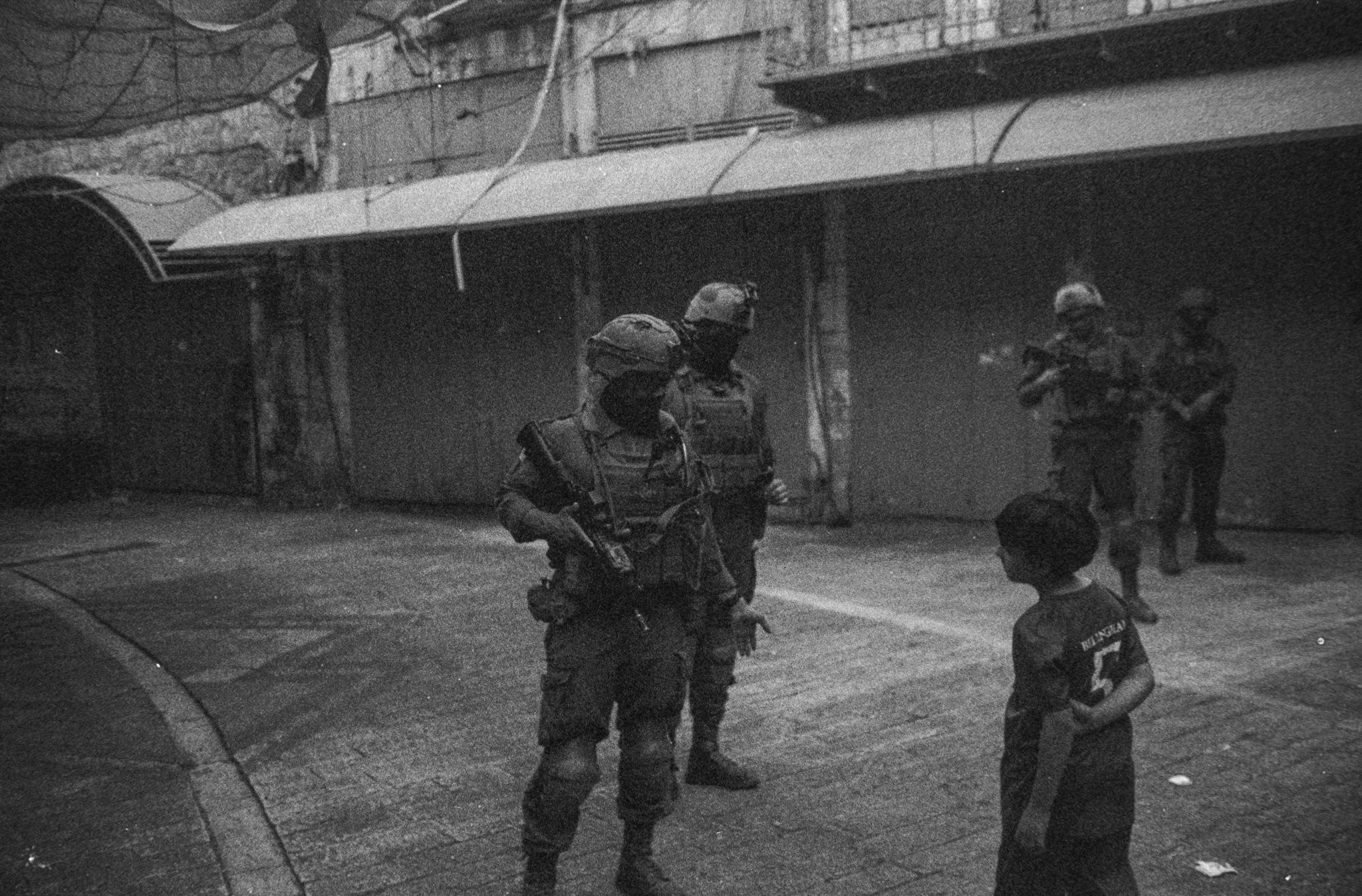
“I Was Three Meters Away: I took this photograph near Shuhada checkpoint in Hebron’s Old City in September 2025. I was three meters from the soldiers. A child stood between us, looking up at them.
Three meters is not a metaphor. It is breath, reach, the time it takes a body to cross space before thought can intervene.
Their rifles were not raised. They did not need to be. They hung casually, already doing their work. Nothing theatrical was happening, and that was the point. Occupation had become routine: soldiers shifting their weight, a market learning to arrange itself around imposed violence.
I lifted my camera knowing how unequal the exchange was. They did not turn away. They carried the ease of people who knew the image could not endanger them. I framed, focused, and waited as I had been trained to do. I hated how calm my hands were and how cleanly the shutter obeyed.
Every Saturday, settlers move through the Old City under military protection. This photograph would not stop the next Saturday. It would not protect the child in the frame, or me. I do not believe photography is resistance by default. An image can confront power, but it can also reveal how little power fears being seen.
I return to this photograph, and it refuses to settle. Some days it feels like evidence. Some days it feels like failure. Some days it feels like the only honest act available when looking away is easier, and refusal carries a cost.
The photograph did not save anyone. It did one thing: it stayed, not as proof of photography’s power, but as a record of its limits, and of the distance between those who can leave the frame and those who remain inside its conditions.”
Ali Asfour is a Palestinian analog photographer, writer, and researcher based between Ramallah, Bethlehem, and Amman. Working primarily with 35mm and medium-format film, he photographs everyday Palestinian life under conditions of regulated movement, contested memory, and ongoing erasure. His practice moves through homes, streets, landscapes, oral histories, and family archives, attending to how identity is lived rather than declared. He approaches photography as a counter-archival act: a way of preserving what persists while questioning the gaps and violence through which official histories are constructed.
Tsawwar is an ongoing visual series in Daftar which explores the stories behind a photograph, taken in the region or by an Arab photographer, written in their own words.