WORDS BY Mary Barghout
While countless historians of Arabic calligraphy have highlighted the many known or mythologized male innovators and pioneers from the extensive histories of the Arabic language – with frequent fliers like Yaqut al-Musta'simi, Ibn al-Bawwāb and Ibn Muqla named and acknowledged for their contributions to the development of Arabic and the refinement of the six styles (الستة الاقلام) – women's involvement through both creative artistry and patronage of the art is harder to trace.
While some of the granular details of calligraphic contributions by creators of all genders (exact dates, attributions, lineal descent of an artist to a master, etc.) can be debated further, the importance of women within the lines of calligraphic knowledge transmission cannot be denied. And within an art form where lineage is of extreme importance, with stylistic genealogies referring back to one's teacher and their teacher, much can often be lost in the difficulties of documentation and in locating primary sources through such vast periods of historical time. But, as David Simonowitz notes in his article on contemporary master of Arabic calligraphy and historian Hilal Kazan, "...the situation for women scholars, and especially for scholar-calligraphers, may have been more complex than the meager sources would indicate…"1
The 'meager sources' themselves may have been weakened by the amount of time between the lives of the calligraphers and the times when calligrapher lists and biographies were written. Given the development of craft and/or regionally specific (down to at least the city level) biography collections, there are certainly further research opportunities indebted to the value placed on record keeping within historical Islamic creative arts, "...for it seems that there are few cultures which have been as prolific in producing biographical dictionaries in premodern times as the Arabic branch of Islamic culture."2
The closer we get to present times, the more readily available information is for public research. For instance, there are detailed descriptions of calligraphers (and ink makers, illustrators, illuminators, and bookbinders) within the Ottoman period, as the nature of empire created a need for abundant record keeping, lists of names, promotions, and even pay changes of the various guild/craft workers.3
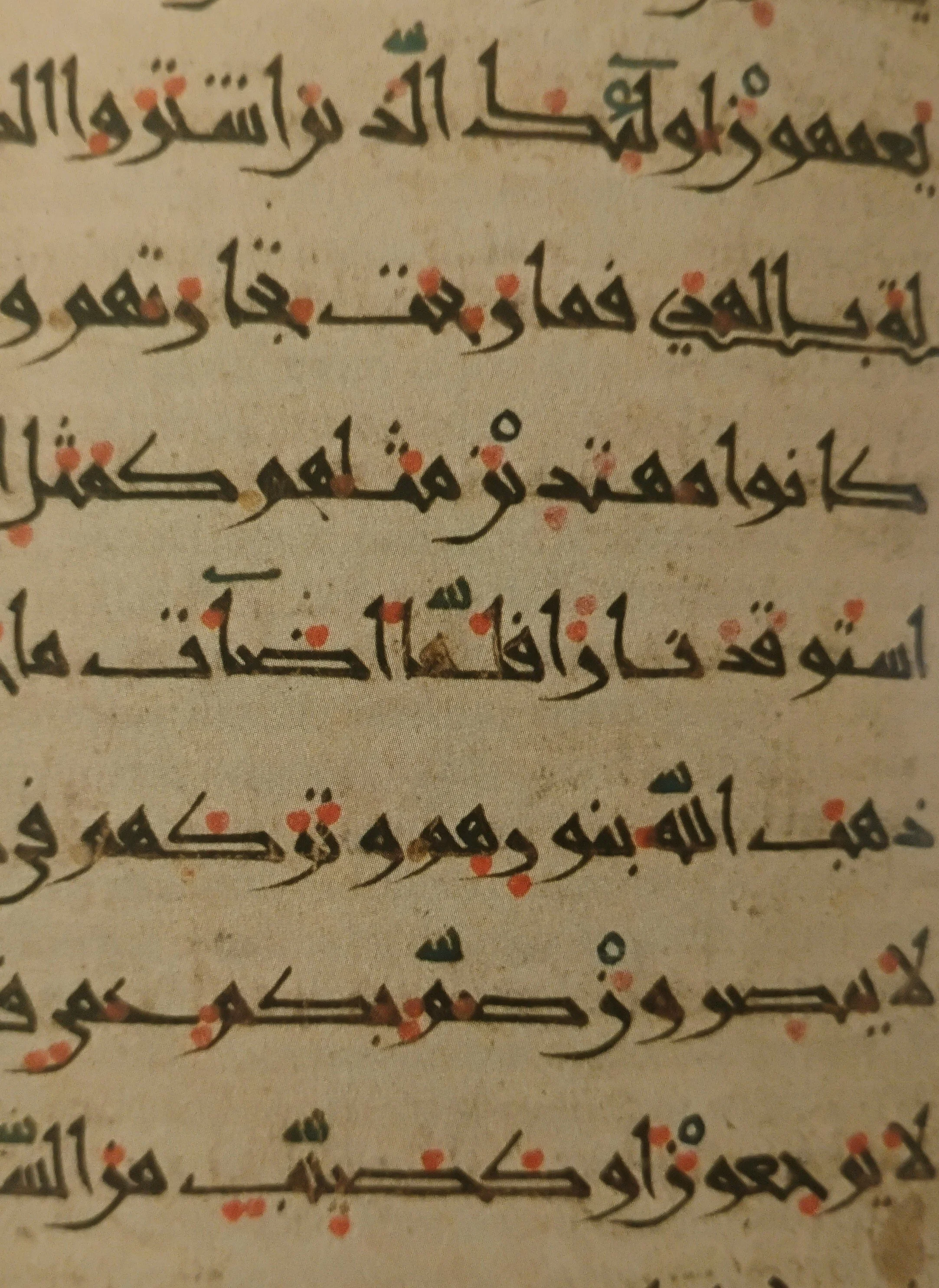
Image from a Qur'an manuscript copied by 'Ali ibn Shadhad al-Razi al-Bayyi in 972. Not only the oldest Qur'an transcribed on paper, but also the oldest surviving copy of broken cursive. Image from p. 152 of Islamic Calligraphy by Sheila Blair.
Trickier to find are references to calligraphers within North African countries as their styles are sometimes referred to as mere deviations from the main calligraphic styles. Here too, women's contributions as patrons or producers of calligraphy fail to be mentioned; though, they sometimes appeared in anecdotes by European historians, portrayed as seeming to lack cultural awareness or depth of understanding.
For example, the mention of a Qur'an supposedly penned by a woman calligrapher merely for marriage traditions to one European observer: "Sir Edward Denison Ross while in Tunisia saw two parchment folios of a Maghribi Kufic Kur'an written by a woman and dated Ramadan, 275 (Jan. 7-Feb. 7, 889)... Local Muslims informed him of their tradition that in the early days of Islam it was considered desirable for a Tunisian girl who wished to make a good marriage to make at least one copy of the Kur'an with her own hands. This interesting tradition he found fully borne out by the large number of parchment Kur'ans written by women and dating from the 4th to the 6th century...now kept in the library of the Great Mosque at Kairawan."4
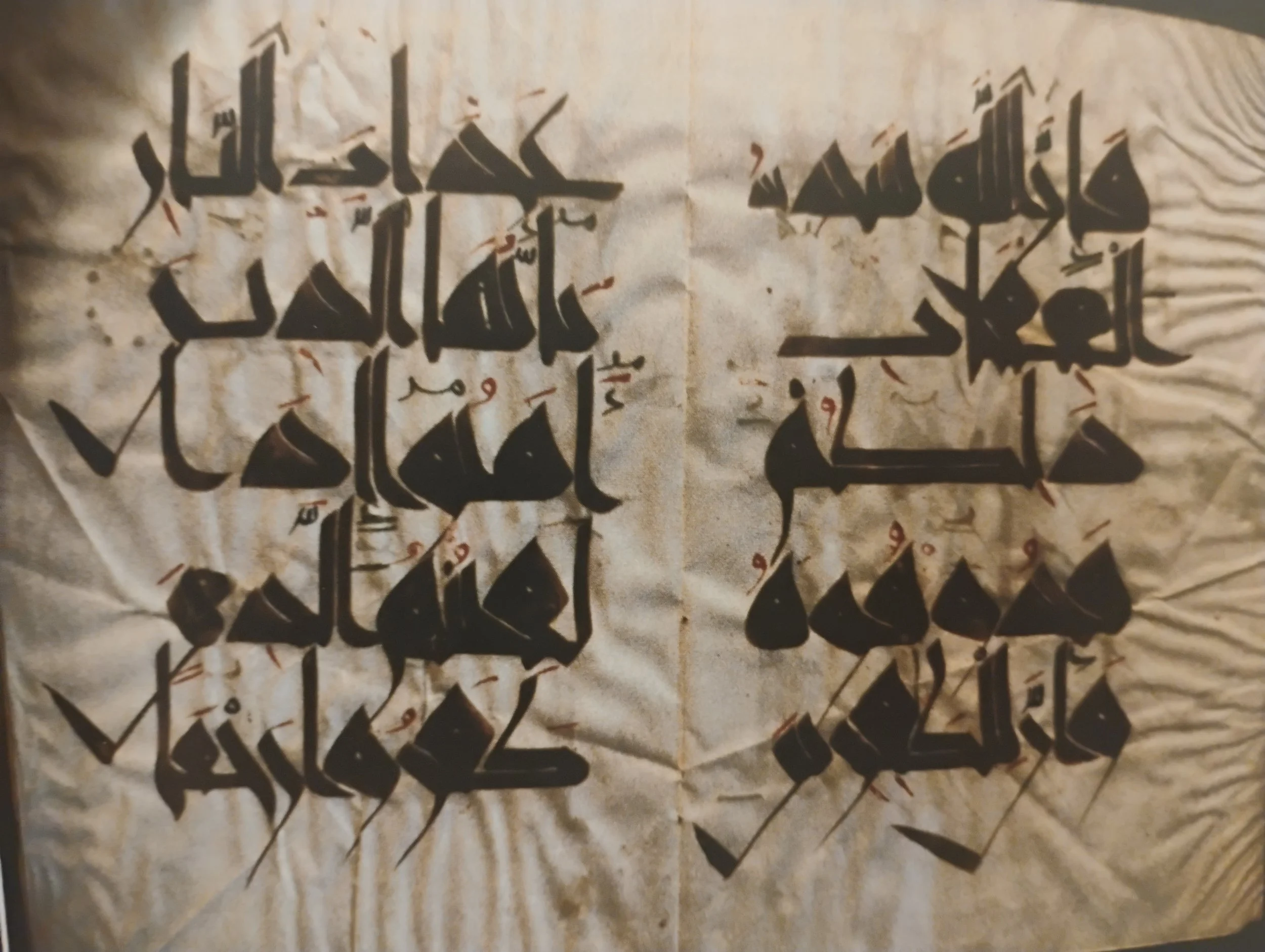
Image containing a double page with Sura 8:13-14 from the Nurse's Qur'an on parchment, from January 1020. Image from p. 155 of Islamic Calligraphy by Sheila Blair.
This story was found in a collection of parts of Qur'anic manuscripts collected by the Oriental Institute and published by the University of Chicago press in 1939, and while it included images of fragments of Qur'ans with vague descriptions like 'Kur'an Parchment. First to Second Century after the Hijrah,' it did succeed in showcasing the state of calligraphic knowledge at a point in time.
Despite the occasional eye-roll-worthy gaps in our material knowledge of women's involvement in the tangible history of Arabic calligraphy, one example of a Qu'ran stands out and has been referenced consistently across multiple historical studies as having been penned due to the direct support of women. The Nurse's Qur'an (sometimes referred to as the 'Nursemaid's Qur'an') was written in a broken cursive style of Maghrebi script (with a diagonal slant to the letters, and dramatic contrasts between thick and thin lines).
"As opposed to the rigidly rectilinear character of the Kufic style, broken cursive is markedly diagonal. The bodies, tails and upper strokes of many letters are pitched at a 45° angle to the ruled baseline, and the bodies of looped letters are triangular...alif and many other ascenders have a small triangular serif added at the top left. Strokes vary in thickness. All in all, broken cursive is heavily stylized..."5
This dynamic and curiously detailed Qur'an was commissioned during the Sanhaji rule in Tunisia due to the firsthand participation of both a nurse and a secretary. Durrah al-Katibah, a secretary in the court of the Banu Ziri and its prince al-Mu'izz ibn Badis supervized the work of calligrapher Ali ibn Ahmed, after the particular copy of the Qur'an had been endowed by the nurse herself, to the Great Mosque of Kairouan, during Ramadan of 1020.
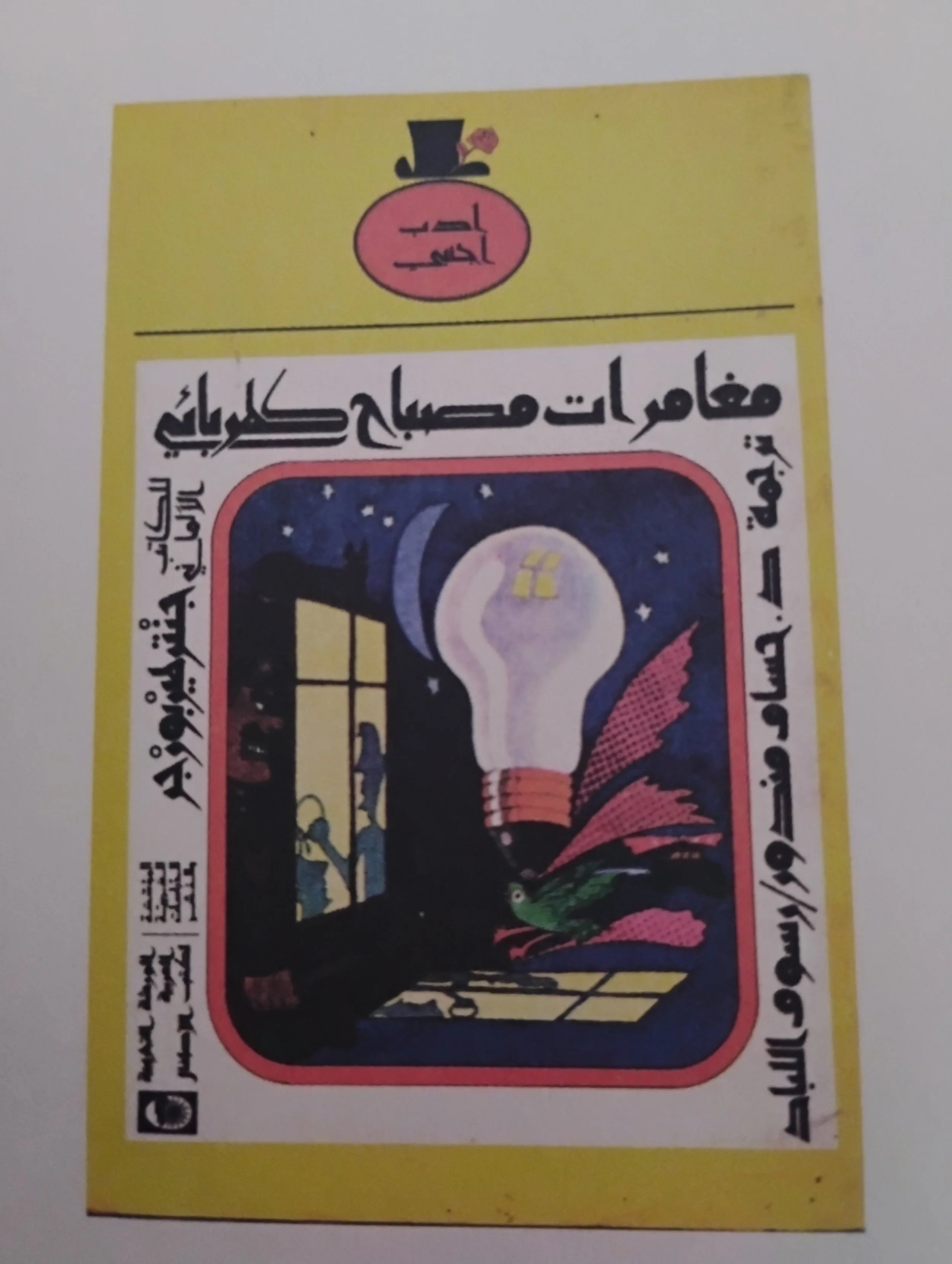
Much later example of the impact of broken cursive on a book cover designed by prolific artist, illustrator, and cartoonist Mohieddin al Labbad. Image from p.m 266 of A History of Arab Graphic Design. (see footnote 6)
Despite not being able to truly confirm some of the more colorful history of this nurse (for instance whether she was originally from Byzantium, and if she was truly captured by pirates during the reign of Sannaji prince al-Mansur, who purchased her and eventually had her name changed to Fatimah then declaring her the nurse of his son Badis, with Badis himself, upon ascending to power, raising his former nursemaid to a more esteemed position due to her intelligence and appreciation for books) the origins of the Nurse's Qur'an are clearly detailed and its provenance undeniable. "Ali6 ibn Ahmad wrote, voweled, marked, gilded, and bound this Kor'an manuscript for the exalted nurse under the supervision of Durra, the female secretary."7
Despite this detailed notation, the collection of manuscripts itself appears to be a sort of collaborative effort between what could have possibly been multiple calligraphic artists. Potentially, this incredible Qur'an was compiled through collaboration rather than individualized effort. Regardless of what is known, or what is muted within the texts that make up the histories of Arabic calligraphy, in the Nurse's Qur'an we find a beautiful example of broken cursive, and the nuanced ways that women of intelligence and authority have been involved in history and its transmission, creation and distribution even if their names are not always as clearly penned as that of Fatima and Durra, a nurse and a secretary.