Reflections on Perfect Victims
Words by Falasteen Mansour
Reading Muhammad el-Kurd’s Perfect Victims for the first time was an awakening. Finally, someone had put the thoughts and feelings I have experienced over two years of genocide into words. His lyrical and often scathing prose on being Palestinian in a world where our lives are severely undervalued struck a chord with me. As a college student studying journalism, I am taught to approach every story with a sense of unwavering objectivity, but truthfully, this notion was rendered completely meaningless to me after seeing how media outlets (particularly Western media outlets) spoke about my people. The martyrs of Gaza were not given their due respect and were instead transformed into a mass of faceless statistics to be reported on the daily evening news.
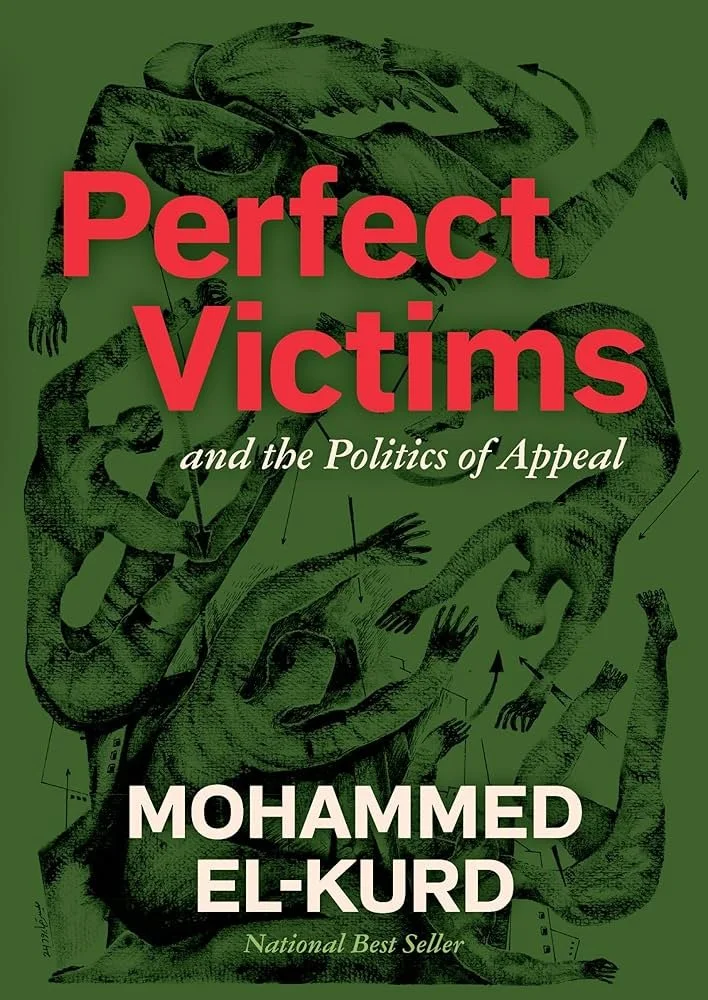
Perfect Victims encapsulates not only how Palestinians are viewed on a global scale, but also the often overlooked ways in which we are perceived. Non-Palestinian victims of tragedy are afforded life stories, personality traits, and candlelit vigils, while the thousands of martyrs in Gaza aren’t even given graves, much less individualized memorials. This concept becomes ever clearer when a calamity strikes the West: take the recent killings of two U.S. citizens at the hands of ICE agents, for example. Both victims had entire biographies and commemorations being circulated within hours of their death, while it took mainstream news headlines days before declaring that six-year-old Hind Rajab was murdered by Israeli forces.
The lack of concern shown toward Palestinian suffering, even in the face of genocide, is nothing new. After all, Israel requires the normalization of Palestinians' deaths to justify their settler colonial regime. El-Kurd furthers this idea of normalization by explaining that Palestinians are requisite collateral damage for the West to continue its imperialistic exploits, “...our death is sustenance for the world we live in, necessary to maintain things as they are. Our blood is the price of the colony’s sense of ‘security’.” For those in the West to feel safe, there must be a demonized scapegoat to fear, or else the internal population will start to question the war mongering that has been made commonplace with their tax dollars. This ongoing genocide has served as a sort of reckoning for thousands of people previously blinded by ignorance, but why did it take thousands of murdered Palestinians to justify our existence? Why is our loss of life a prerequisite for acceptance? El-Kurd explains within the first chapter of this book, “the sniper’s hands are clean of blood”, the concept that you don’t need to physically kill a Palestinian for our lives to be considered meaningless: the blatant lack of concern and regard for Palestinian life (and that we are human) is in and of itself dehumanizing.
Chapter three, entitled “Shireen’s passport” particularly stuck out to me as it covered the discourse surrounding Palestinian journalist Shireen Abu Akleh’s murder in 2022. The primary concern for many news outlets covering her death was to ensure that the public knew an American citizen had been killed, as though Shireen being solely Palestinian would have completely justified an Israeli soldier shooting her point-blank in the face. El-Kurd’s ruminations on the disdain that Western powers hold towards Palestinian identity are not only raw and truthful but also serve as a call for introspection. To overcome and break free of the “victimhood” complex that has been thrust upon us as Palestinians, we have to be willing to question our own perceptions and inclinations. Do we still feel the need to defend ourselves against Western archetypes, or align ourselves with a more neutral or benign position when it comes to topics such as resistance? When we are asked the question of “Do you believe that Israel has a right to exist?”, do we have the urge to propose a two-state solution defense mechanism in response to this query?
Perfect Victims dissects the many facets that come with being Palestinian, including the burden that Palestinians carry to constantly prove that we are valuable members of humanity. El-Kurd illuminates this struggle, while also grappling with issues of identity and recognition. A phrase he repeatedly mentions throughout the chapters while explaining the dehumanization of Palestinians is the “West’s refusal to look us in the eye”. This lack of basic dignity is at the core of the Palestinian experience. No true change can come without moving past mere recognition and having Palestinians be accepted (as well as their full rights established) on a global scale. While we may not see these attitudes in the present moment, imagining a future where Palestinians are both liberated and respected—because the two should never be mutually exclusive—is something to work towards, even if, for now, this ideal future only exists in our minds.
About the Writer
Falasteen Mansour is a journalism student at Northwestern University in Qatar, pursuing minors in Media and Politics and Middle East Studies.