How We Remember Water: On Ain Adhari, Al Sayah Island, and the Afterlife of Bahrain’s Springs
Words by Noora Alhashimi
At the 2024 conference conducted in Bahrain on the Archaeology of Irrigation Technology and Water Management in the Islamic World, freshwater was framed not only as heritage but as a strategy for facing water scarcity and climate change. Among the outcomes was a call to ensure “that the Bahraini public are sensitised to the variety and value of the archaeology of water through the media, school curricula, and through investment in some of the key sites.”1 But what happens when these sites no longer hold water?
Truthfully, I do not know much about Ain Adhari, the most popular of Bahrain's artisanal springs. By the time I could swim, it had already dried up. I know the reiterated folklore; how a virgin girl stomped her feet on the ground and gave way to a rush of clear blue that permeated across the island's Northern agricultural greenbelt, watering the distant and neglecting the nearby.2
I know that Adhari is one of many springs in Bahrain that structured over 4000 years of consistent habitation including the Dilmun Civilization in an otherwise harsh climate. It forms part of the country's identity today as an island of both salt and sweet water. I know that its memory is emblematic of an early approach to treating water as a communal yet sacred, life-giving feature, the same water that inspired mythologies of paradise such as the Epic of Gilgamesh.
But mostly, I know Adhari as it is today; the name of a desolate amusement park plonked against a major highway, just a few steps beyond the original site where an abandoned artificial pool waits, emptied.
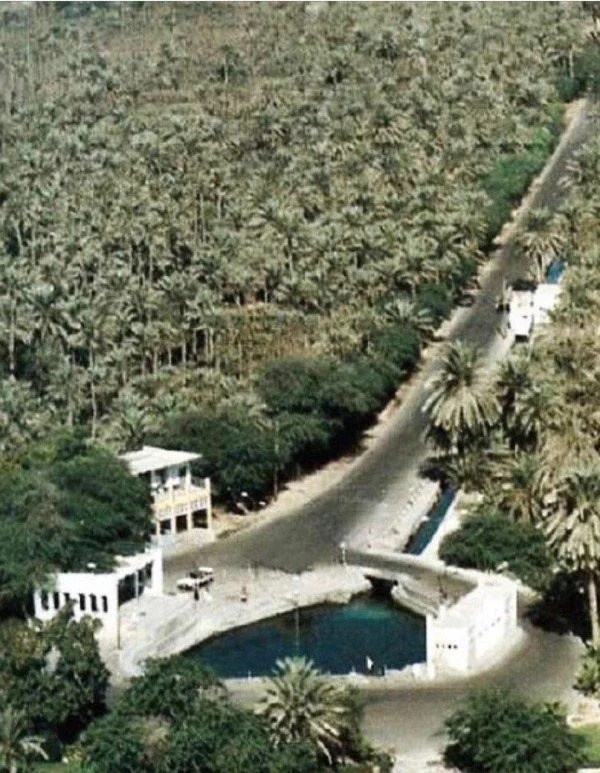
Ain Adhari in the 1960s. Source: @theoldbahrain
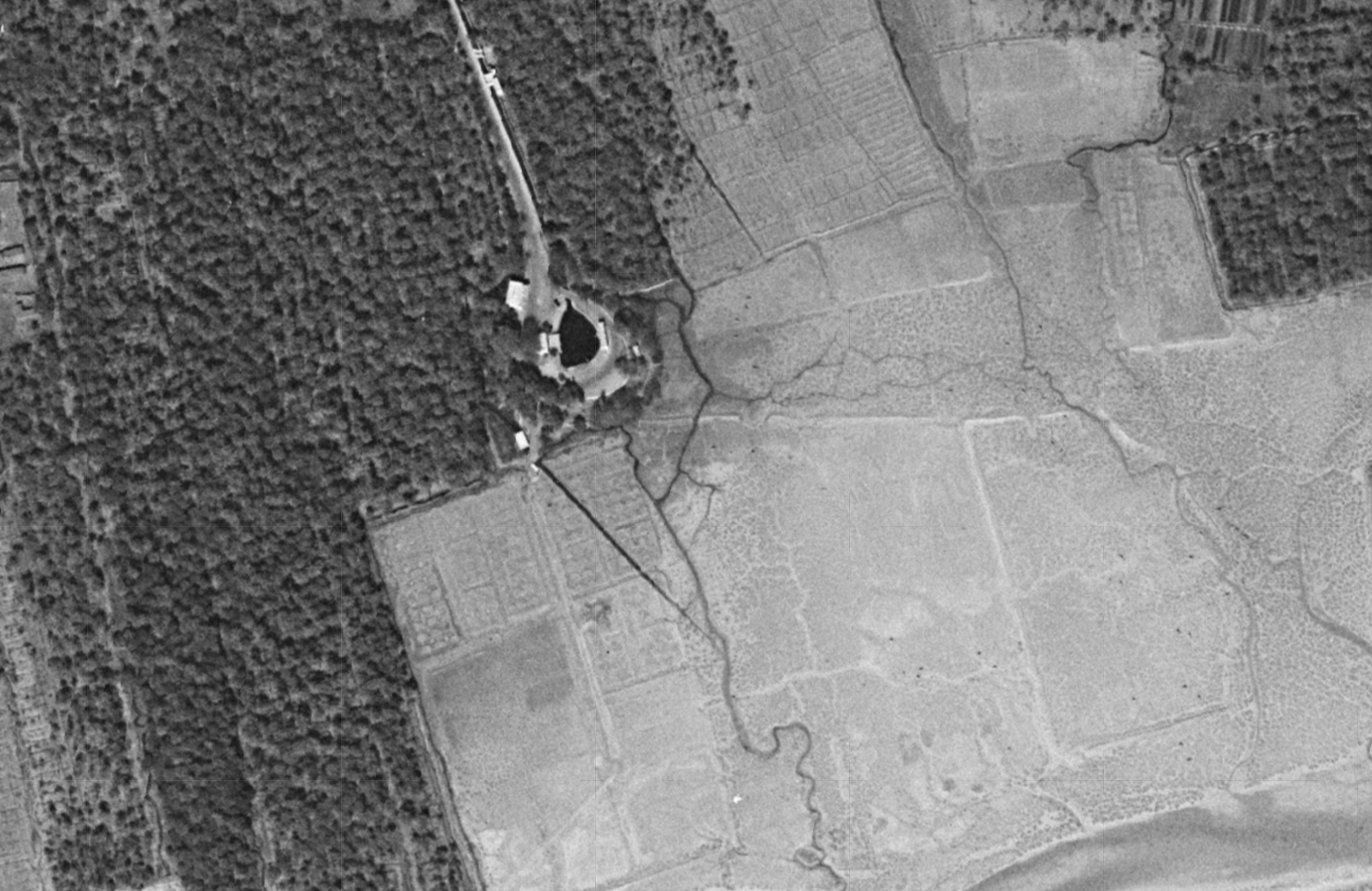
Aerial View of Ain Adhari in 1967. Source: USGS Declassified Satellite Imagery obtained from mapbh.org
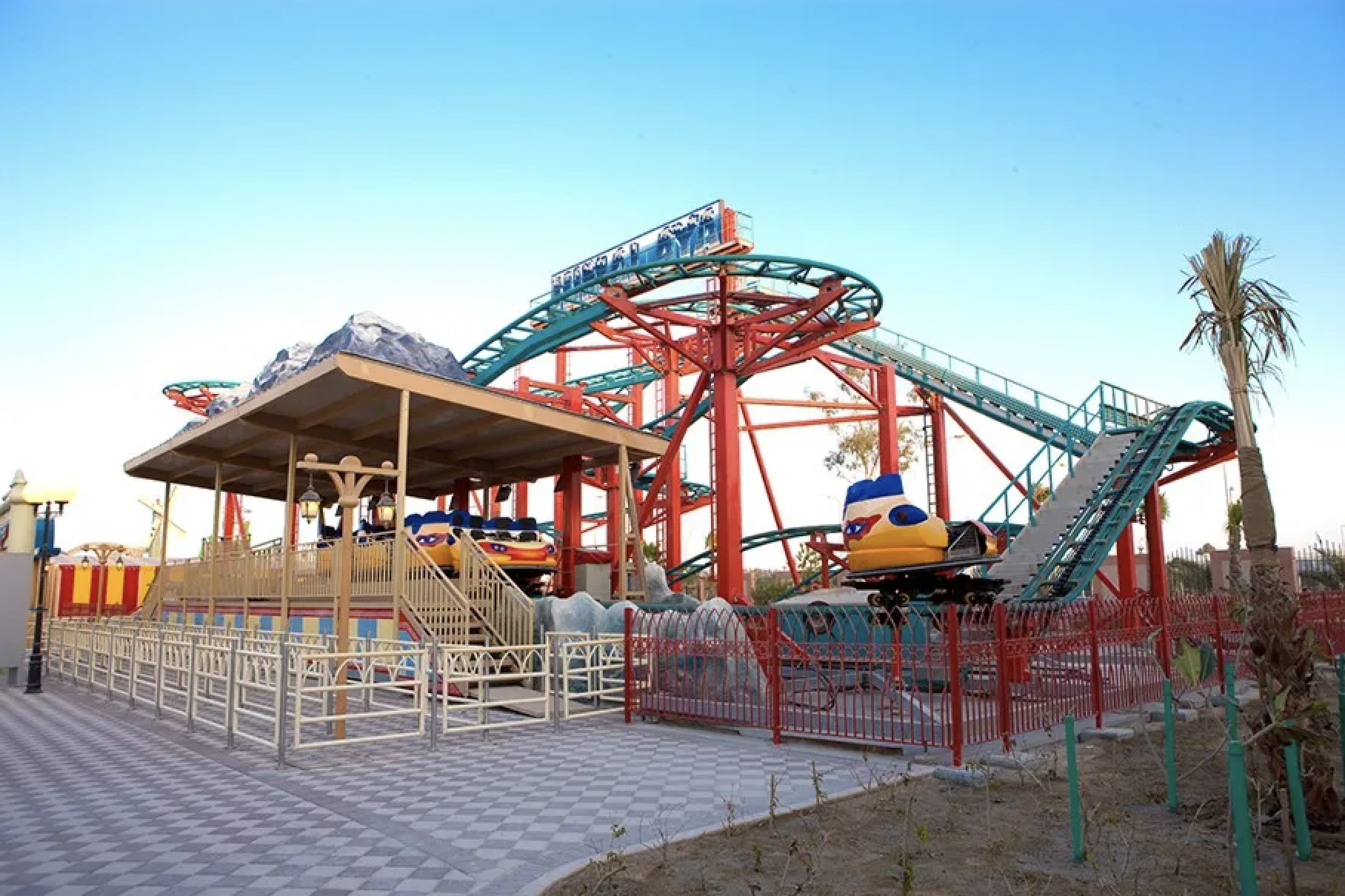
The Spinning Madness Rollercoaster at Adhari Park
I could not tell you much about the Adhari that survives in memory, if dipping your toes felt cool beneath the array of palms I see in photos, if it was as crowded as my father describes on Thursday afternoons, if the water was as sweet as its nostalgia. I could not tell you what the women scrubbing their bundled laundry socialized about, how high the water splashed as the boys dived and if a Western researcher occasionally stood slouching beneath a palm tree, scribbling this scene down well into the '80s.3 Much like the next Bahraini who grew up at the turn of the century, I inherited Adhari through anecdotes repeated often in childhood, but over time, even these stories have grown faint.
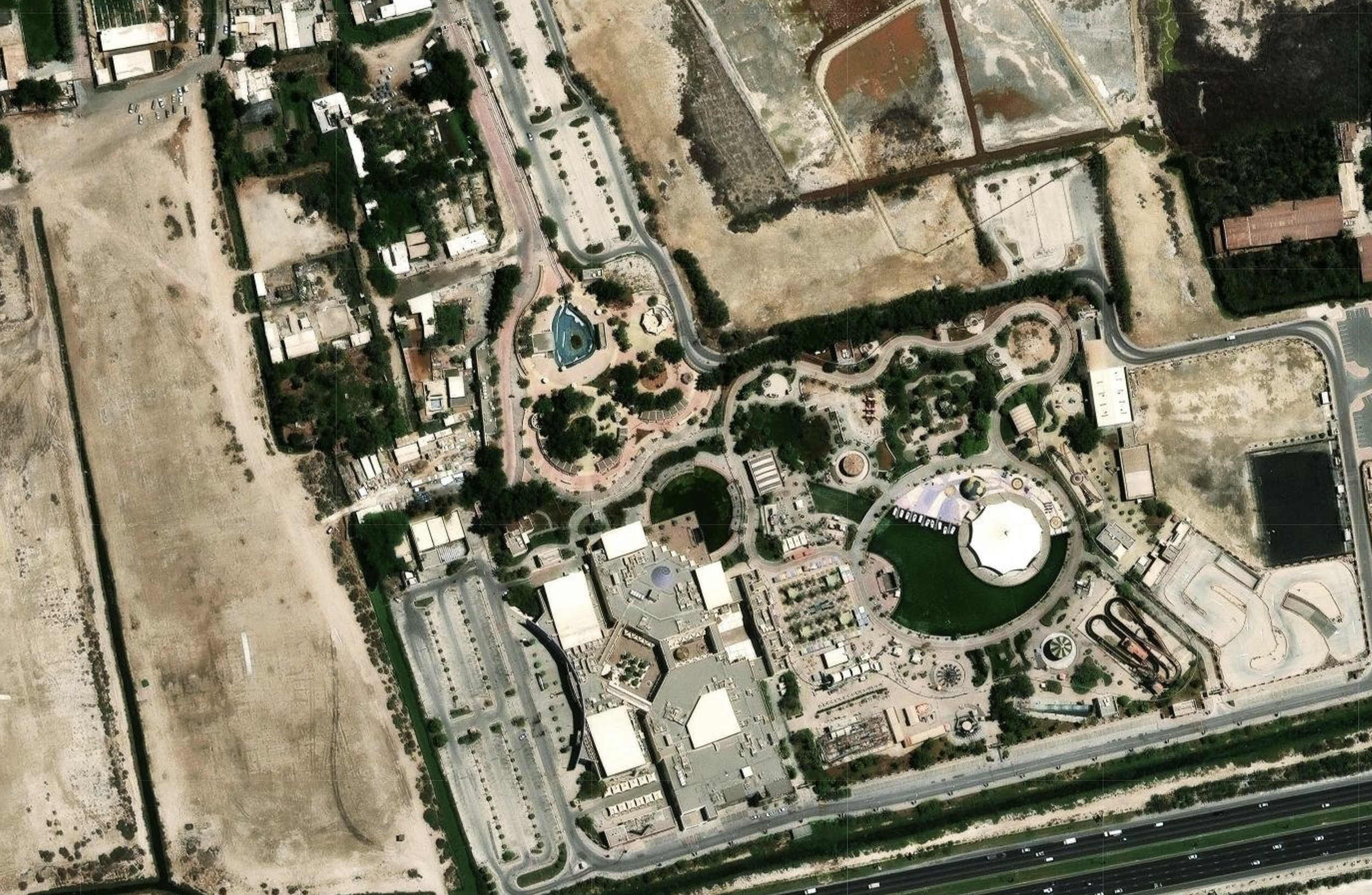
Aerial View of Ain Adhari Today with Adhari Park in view. Source: OpenStreetMap obtained from mapbh.org
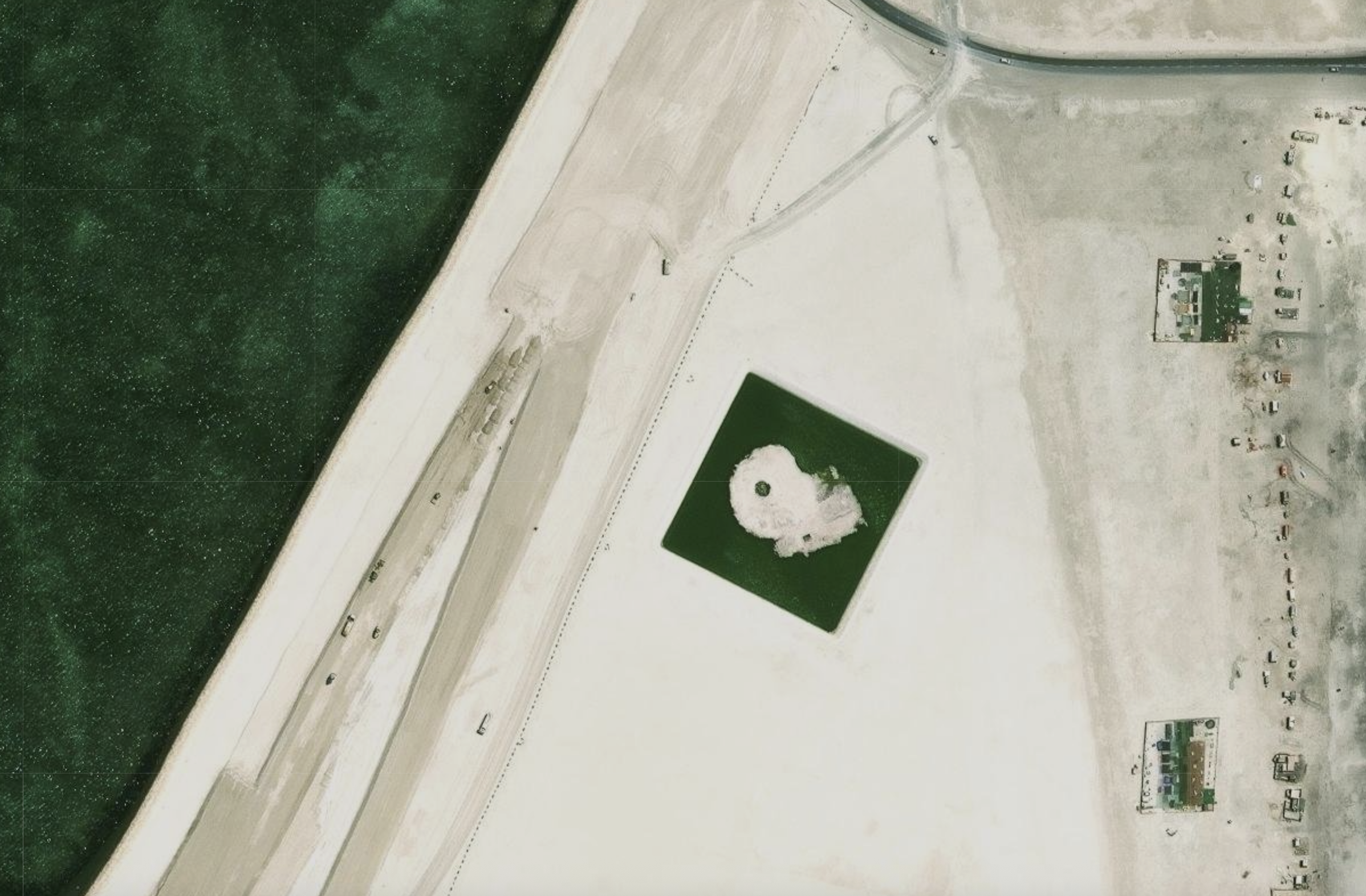
Aerial View of Al Sayah Island Today with its reclaimed border. Source: OpenStreetMap obtained from mapbh.org
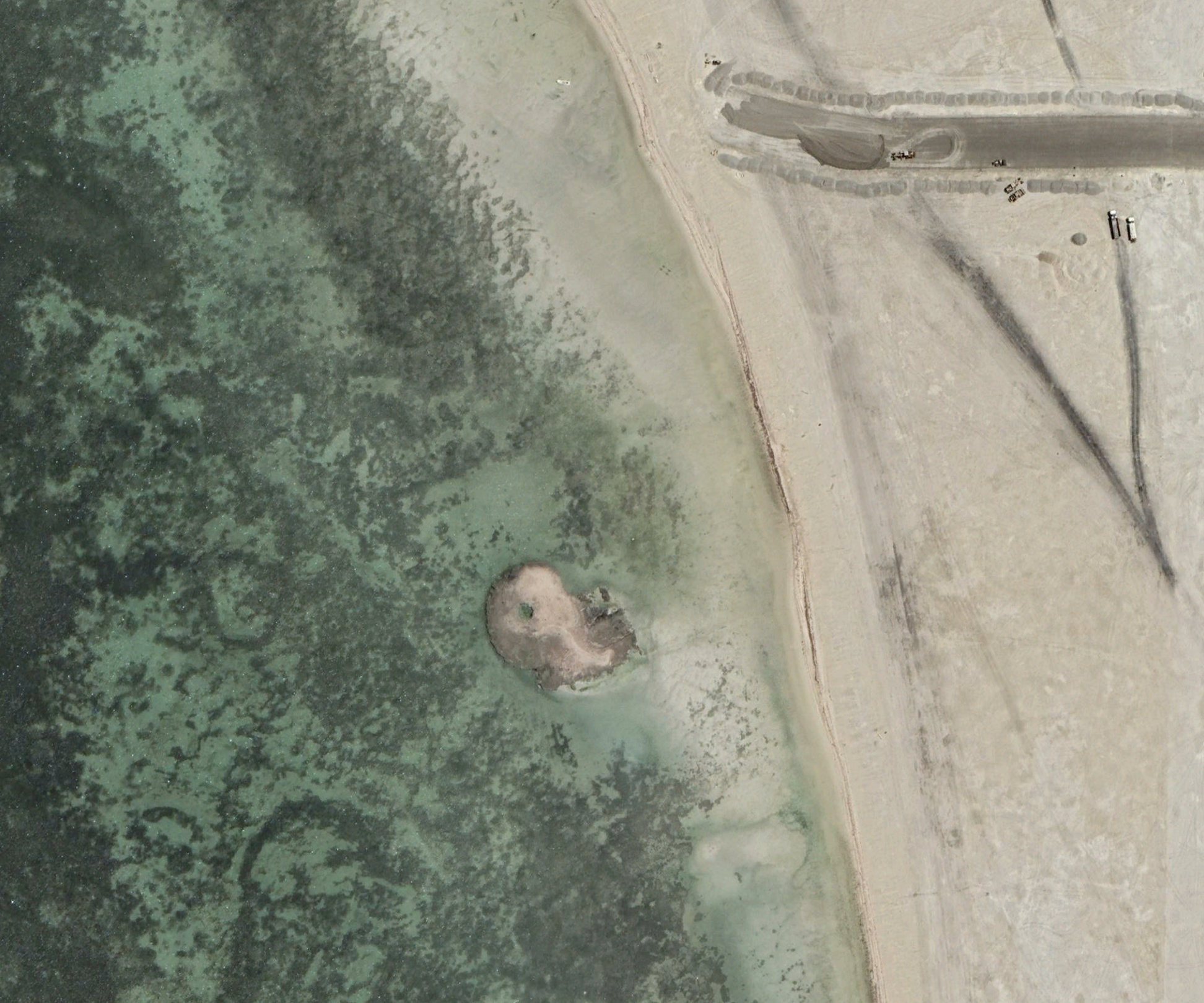
Aerial View of Al Sayah Island in 2019. Source: Google Earth.
Today, there is a stark contrast between that oasis-like imagery and the physical reality of a retiled chlorine pool closed to the public and overshadowed by an unrenovated Spinning Madness rollercoaster. The site holds neither cultural nor environmental state protection. Instead, it is categorized as a recreational zone within a 165,000 sqm amusement park developed in 2008. Its website describes the park's features through 16 points, with an emphasis on becoming the top family tourist destination in the GCC and makes no mention of the historical significance of the spring.4 The only presence of water is a central lake where one can rent a paddle boat.
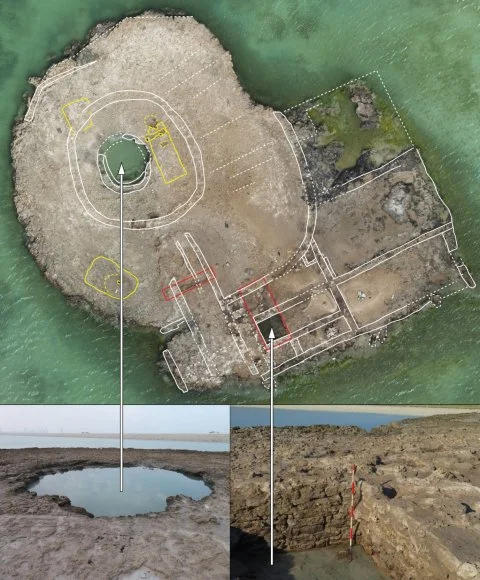
Detailed View of Al Sayah Island's Archeology. Source: Robert Carter, using photogrammetric images by Rodrigo Ortiz Vazquez and Akinori Uesugi
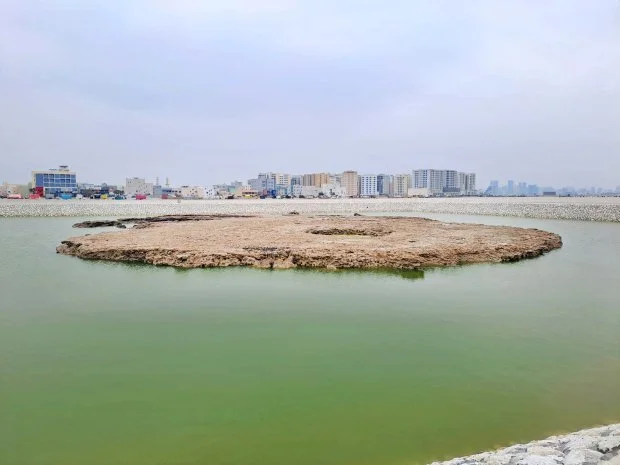
Front View of Al Sayeh Island. Source: Gulf Daily News Online
Al Sayah Island in the northwest of Muharraq tells a similar story, and I know even less about it. In 2022, it was under threat of reclamation in favor of a new bridge linking Busaiteen and Bahrain Bay but was ironically saved by being the first example of reclamation on Bahraini waters, earning its national heritage status. Yet Al Sayah is an unexpected example of reclamation. It was primarily built to outline a naturally occurring chowchab, or a freshwater spring rising amid the sea, as early as the 6th or 8th century. What remains today is a more prominent outline; a 100x100 meter frame that technically preserves the island, but does so by landlocking it into a sea basin surrounded by ongoing reclamation and entirely detaching it from the open sea. Current plans propose to utilize it as a tourist destination fitted with museums, cafes, restaurants and merchandise kiosks. The spring itself, it was suggested, "could be like a fountain."5
Like a fountain. The phrase lingers like stagnant water. A spring that once demarcated the promise of drinkable water to seafarers and pearlers, reduced to decoration.
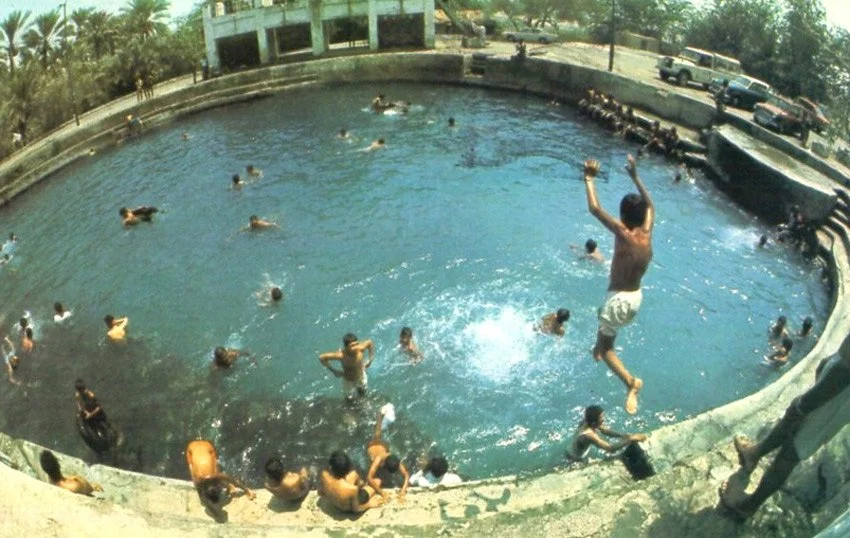
Ain Adhari in the 1980s. Source: Gulf Daily News Online
The idea is not malicious. It is perhaps the most practical route. The issue is neither tourism nor the typology of a theme park or a fountain. The treatment of these two springs raises a deeper concern about how Bahrain chooses to manage the memory of its natural landmarks in parallel, particularly its namesake waterscapes. Ain Adhari and Al Sayah sites are not isolated cases. They form part of a broader spatial pattern that generally favors urban expansion to natural preservation. In addition to the loss of such springs, Bahrain has buried nearly all its original coastlines through land reclamation and has rendered a majority of its greenbelt grey. Simultaneously, there is a growing tendency to take these fading landscapes and celebrate them as cultural assets in memory and storytelling, but never through space, never through environment.
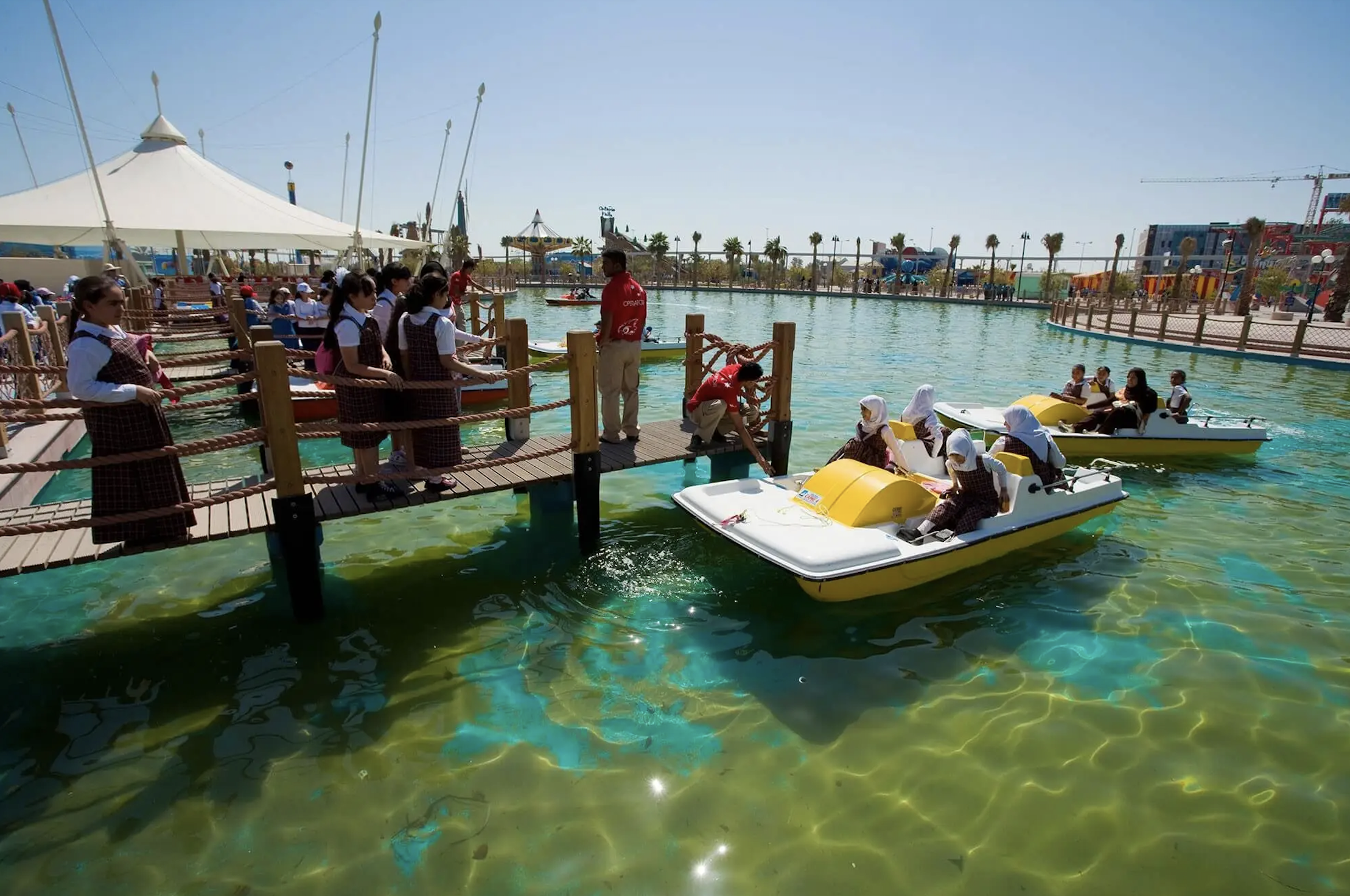
Adhari Park's Central Lake and Paddle Boat Ride. Source: Adhari Park
While the Adhari Park barely references the silent Ain Adhari sitting behind it, Al Sayah at least retains its physical location. Still, if a spring is severed from its hydrological, ecological, and spatial relationships, what exactly is being protected? We are yet to see what will become of Al Sayah, and just how much cultural context can fit into its 100-meter frame.
For a small archipelago with limited land, carving space for natural heritage is contentious. However, if natural heritage represents a nation's cultural and historical identity, it demands sensory interaction and orientation. When reduced to narrative alone, its meaning can unknowingly fade. A new generation is emerging whose parents also never swam in Bahrain's springs, a generation without their own stories to tell, let alone places to share. Memory in this instance is not abstract; it is rooted in its territory. Without a physical space to anchor such natural landmarks, how we remember is how we will eventually forget.
About the Author
Noora Alhashimi is a Bahraini architect and artist interested in the intersection of cultural landscapes and public space. Her previous writings on land reclamation and urban transformation in Bahrain have been published in the International Planning Studies Journal, and in short story form for the Barjeel Art Foundation's Mudun Anthology. She completed a Master of Science in Architecture and Urban Design at the Politecnico di Milano, where she returned briefly as an Urban Design Tutor. She is currently based in Milan, where she works as an architect at Park Associati.
Footnotes
1 Insoll et. al. (2025). The Archaeology of Water in Bahrain, pp. 20. in the Islamic Period in The Archaeology of Irrigation Technology and Water Management edited by Insoll T., MacLean R., Almahari S. Archaeopress Archaeology, Oxfordshire.
2 A popular Bahraini phrase translated from Arabic "القريب وتخلي البعيد تسقي عذاري"
3 For further reading, see Clarke, A. (1981). The Islands of Bahrain: An Illustrated Guide to their Heritage. Bahrain Historical and Archeological Society, Bahrain.
4 "About Us – Adhari Park." https://adharipark.com.bh/about-us/. Accessed on 10 Feb 2026.
5 Al Aali, M. (14 Mar 2023). "Historic island to be turned into a tourism destination in Bahrain" Gulf Daily News (GDN) Online. https://www.gdnonline.com/Details/1206723/Historic-island-to-be-turned-into-a-tourism-destination. Accessed on 10 Feb 2026.