Baya in Technicolor
Baya’s dreamlike paintings redefined North African art. Her bold use of color and surreal depictions of women, nature, and folklore captivated the likes of Picasso and Matisse. Blending tradition with fantasy, her work became a powerful symbol of identity and resilience, celebrating the richness of Algerian heritage through a unique lens.
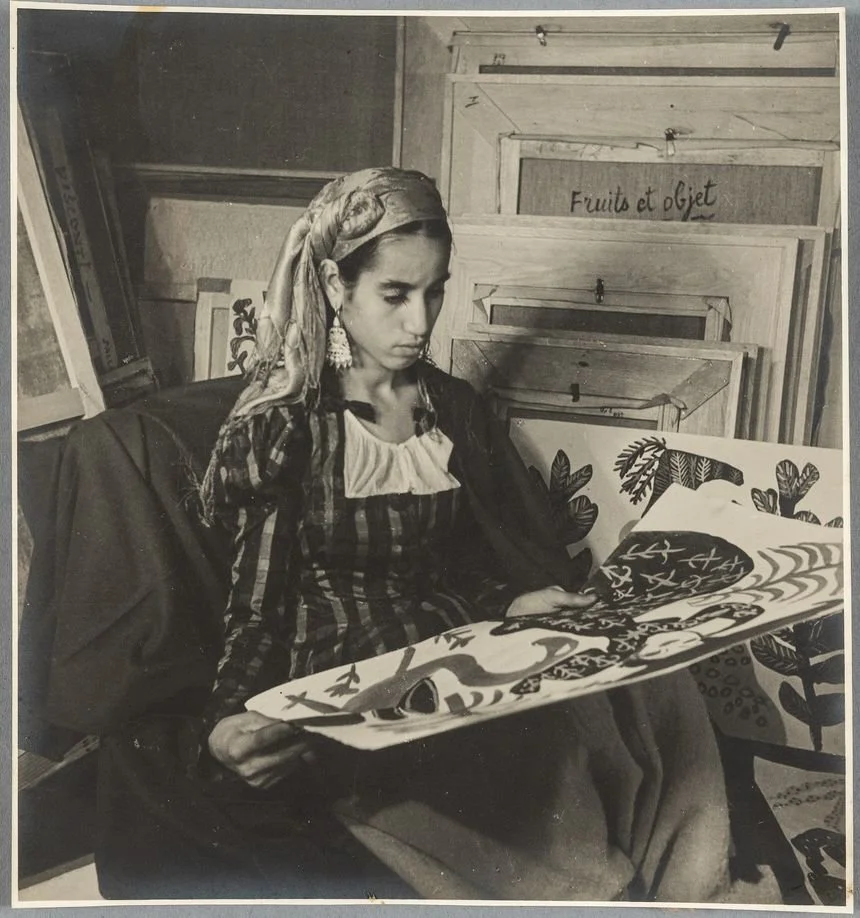
Baya (ANOM), 1948

Baya, Femme robe jaune cheveux bleus (Woman with blue hair in a yellow dress), 1947 © Galerie Maeght, courtesy of Grey Art Gallery, via artsy.net
At the age of 16, Algerian artist Baya (born Fatma Haddad) blazed onto the art scene of 1947 with her radical painting of a woman, depicted more as a "goddess-queen whose ovaries were marked by flamboyant birds and whose vulva was represented by a red-winged butterfly. Her crown tall and swathed with flowers, and her gaze authoritative. She stared at the viewer with large, piercing eyes."

Baya at the exhibition of Algerian artists, Fête de l'Humanité, La Courneuve, September 1998. Photograph by Abderrahmane Ould Mohand

Baya, Woman with Candelabra (Madoura workshop), 1948. Painted terracotta, H: 33 x W: 28 x D: 29 cm. Private collection of Gabrielle Voinot
She'd been invited by art dealer Aimé Maeght, who'd caught sight of her work on a trip to Algiers, to participate in an exhibition of international surrealist art in Paris. Later that same year, Maeght hosted a solo exhibition of Baya's work where she enthralled the artistic and intellectual establishment. French writer, poet and surrealism theorist André Bréton wrote of her: "I speak not as others have, to deplore an ending, but rather to promote a beginning, and at this beginning, Baya is queen. The beginning of an age of emancipation and of agreement, in radical rupture with the preceding era...for the rocket that launches the new age, I propose the name Baya. Baya, whose mission is to reinvigorate the meaning of those beautiful nostalgic words, 'happy Arabia.' Baya holds and rekindles the golden bough."

Baya, Landscape (Garden of Eden), 1966. Gouache on paper, 100 x 150 cm (private collection)
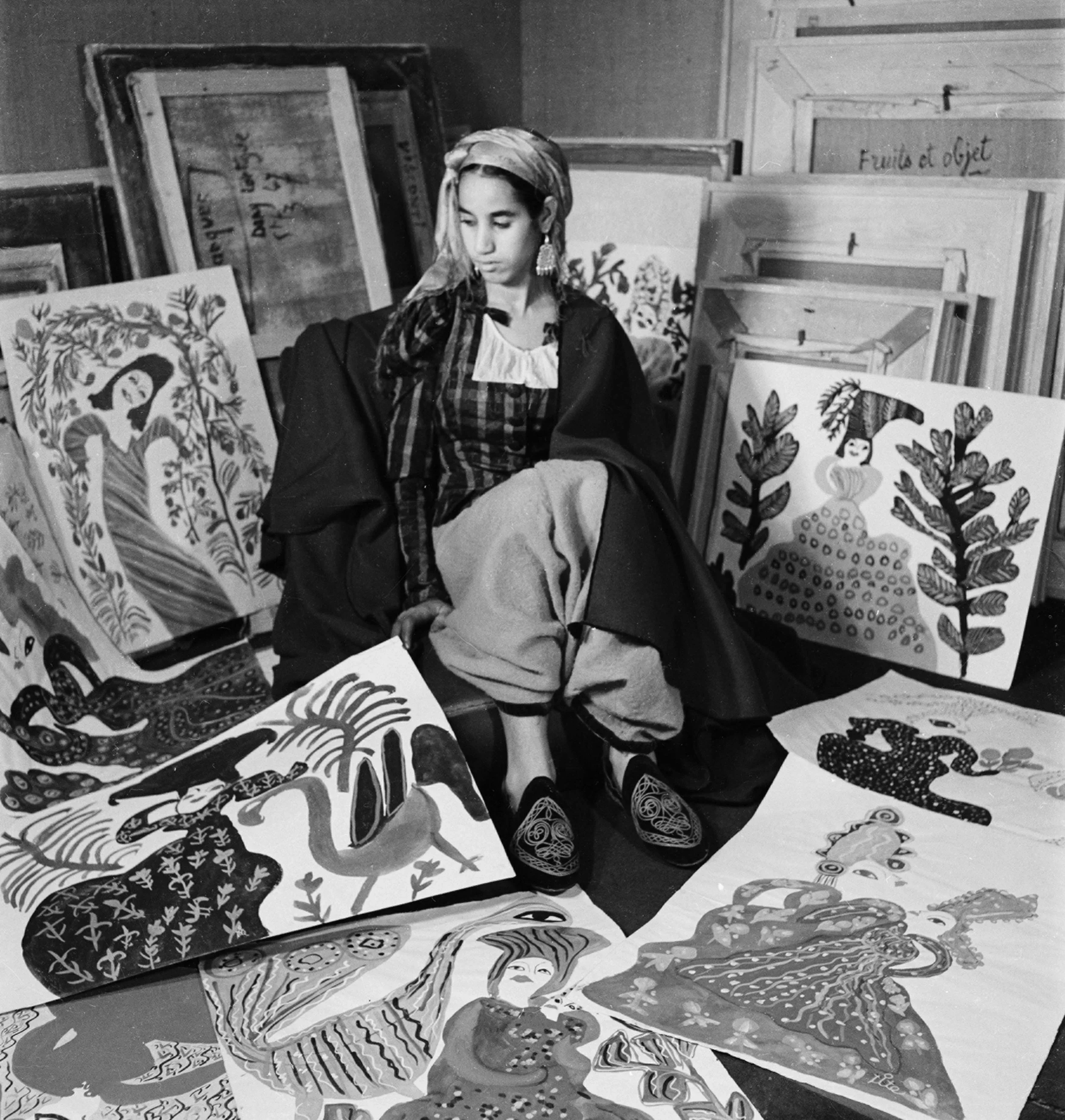
Baya, Galerie Maeght, Paris, 1947 © André Ostier / Association des Amis d’André Ostier © Othmane Mahieddine
From 1948 until 1952, Baya was invited to become an artist-in-residence at the Madoura ceramic studio, alongside Pablo Picasso, in the South of France. She is said to have been one of the muses behind Picasso's "Women of Algiers" series. She later paused her creative practice to raise her family alongside her husband, musician Hadj Mahfoud Mahieddine, but returned to her art in the 1960s with a slightly different flair.

Femmes Attablees, 1947 via OPEC Fund